
This essay began several years ago when a reviewer, criticizing a book I'd written for being too self-conscious, said, "Shields went to Brown. Of course." Of course—what did that mean?

By the time the article came out, we'd forgotten all about it, and like any newspaper story whose subject you know well, it got things wrong and was unbelievably boring. I don't remember much about the article except that it appeared to have been written, in general, by the Brown admission office, dwelling as it did upon the precipitous rise in the number of applications. I do remember, however, the photographer taking picture after picture of me and my classics classmate as we talked about who knows what outside Wayland Arch.
In our stance toward the Times Magazine in 1975 can be found what that reviewer was hinting at in his of course. In the work of a striking number of creative artists who are Brown grads (including my own), I see a skewed, complex, somewhat tortured stance: antipathy toward the conventions of the culture and yet a strong need to be in conversation with that culture. These impulses are obviously not unique to former or current residents of Providence, Rhode Island, but to what degree can Brown be seen as a crucial incubator-conduit-catalyst-megaphone of the postmodern American imagination? Paula Vogel, who until recently taught playwriting at Brown for twenty years before leaving for Yale, says: "I do think Brown is a particularly strong incubator, based on 1) our actual location; 2) our history as a school (the anti-Harvard, anti-Yale); and 3) the non-integration of artists into the curriculum here: we're still on the margins and, therefore, artists who also teach a history/theory/literary curriculum are the artists who come to Brown."
Is there a Brown aesthetic, and if so, is there an analogous Harvard or Williams or Oberlin or Stanford or Amherst or Cornell or Yale or Berkeley aesthetic? If the artists who have graduated from these other institutions aren't joined by a cohesive aesthetic approach, why does Brown have such a thing while they do not? Brown is Ivy, but it's, crucially, not Harvard, Princeton, or Yale. Brown students affirm a discourse of privilege at the same time they want to and even need to undermine such a hierarchy. Brown: we're number sixteen in the latest U.S. News & World Report rankings; we try not necessarily harder but differently.
The result, in the arts: a push-pull attitude toward the dominant narrative. Take film director Todd Haynes '85, pitching his 2007 film I'm Not There to Bob Dylan, its anti-subject: "If a film were to exist in which the breadth and flux of a creative life could be experienced ... the structure of such a film would have to be a fractured one, with numerous openings and a multitude of voices, with its prime strategy being one of refraction, not condensation. Imagine a film splintered between seven separate faces—old men, young men, women, children—each standing in for spaces in a single life."
Or documentary filmmaker Ross McElwee '70: "Any attempt at some pure form of objectivity always seemed to me impossible and, at least in my attempts, dishonest, in some ways. In all the hue and cry about objectivity and truth being captured by a camera at twenty-four frames per second, I've missed the idea of subjectivity. Somehow melding the two—the objective data of the world with a very subjective, very interior consciousness, as expressed through voice-over and on-camera appearances—seemed to give me the clay from two different pits to work with in sculpting something that suited me better than pure cinéma verite."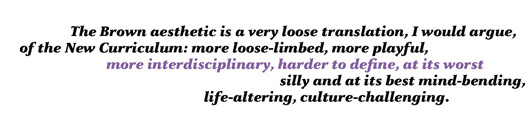
Here's Ira Glass '81, producer and host of This American Life, on how Brown shapes his work even today: "I was a middle-class kid who didn't know what he believed. My religion became semiotics. Semiotics was the conspiracy theory to beat all conspiracy theories. It wasn't just that authority figures of various sorts did things that were questionable. It's that language itself was actually a system designed to keep you in your place, which, when you're nineteen or twenty, is pretty much exactly what you're ready to hear. Semiotics was how I defined myself. To a large extent, it still is. Most of what I understand about how to make radio is all filtered through what I learned in semiotics at Brown. There are certain things I learned from [Professor Emeritus of Modern Culture and Media] Robert Scholes—about, say, the way to structure a narrative to produce the most anticipation and pleasure—that I think of every day. Honestly, I wouldn't have my job now without it."
Here's the Boston Globe in 2004 commenting on Brown's modern culture and media department: "From its founding as a fledgling program in 1974 to its morphing into a full Department of Modern Culture and Media in 1996, Brown semiotics has produced a crop of creators that, if they don't exactly dominate the cultural mainstream, certainly have grown famous sparring with it." Note the emphasis on sparring: over the last thirty-five years, Brown semiotics majors and others have tended to produce work with, as novelist Rick Moody '83 puts it, an unmistakable tendency to "infiltrate and double-cross."
In the late 1960s, Robert Scholes was invited, on the strength of his book The Nature of Narrative, to a semiotics conference in Italy; he'd never heard the term before. He joined the Brown faculty in 1970 and by 1974 had founded the semiotics program. Scholes says he chose the word "semiotics" because of its lack of meaning. "It didn't have a lot of baggage. It was almost a blank signifier." ("Semiotics?" I remember my mother saying. "What the hell is that?") In the immediate wake of the New Curriculum, Brown could not have been more open to "interrogate certain ideological assumptions attendant upon bourgeois notions of pleasure," according to film scholar Michael Silverman, one of Scholes's first recruits. The irony being, of course, that as novelist Samantha Gillison '89, says, "Semiotics was an exclusive, self-contained puzzle for super-smart, super-rich kids."
"I see two distinct 'schools' of Brown writing with regard to contemporary culture," Elizabeth Searle '88 AM wrote to me recently. Searle is the author of the collection Celebrities in Disguise, whose title novella, about figure skaters Tonya Harding and Nancy Kerrigan, she adapted into the opera Tonya and Nancy. "Some, such as Moody or you yourself, engage in a full-frontal assault, perhaps influenced as I was by [T.B. Stowell Adjunct Professor Robert] Coover and his ahead-of-the-curve A Night at the Movies. Other Brown alums follow more of a lone-Hawkesian flight path regarding popular culture. Jack Hawkes [the novelist John Hawkes, who taught at Brown for thirty years] seemed to soar above the whole computerized wasteland of contemporary culture with blissful indifference. Students of his like Joanna Scott '85 AM and Mary Caponegro '83 AM seem to me to have followed suit, creating their unique takes from the vantage point of distant worlds (as in Scott's The Manikin or Arrogance) or by conjuring up worlds wholly of their own making (as when Caponegro, in The Star Café, concocts a sexual funhouse in which a warped mirror forces lovers to view the strange twisted postures of sex with only their own body and not the body of their partner reflected for view). What the two 'schools' seem to me to have in common is—for want of a better, fresher metaphor—an insistent, outside-the-box mentality that both Coover and Hawkes, our founding fathers, shared."
It's important to acknowledge, of course, that such self-reflexive, genre-bending, fourth-wall-shattering gestures are hardly exclusive to Brunonians. Brown didn't invent postmodernism. So, too, many extremely successful Brown grads are working a fairly traditional artistic vein. As Beth Taylor '89 PhD, director of Brown's nonfiction writing program, says, "Certainly our Literary Arts program has defined itself as experimental and against-the-grain since Coover and Hawkes brought it to national prominence in the 1970s. And perhaps, post-1969 New Curriculum, more Brown students have tended toward comfort with dissent than pre-1969 alums. But over the years I have seen as many writers go off to mainstream publications as to alternative ones. And their stances have ranged from flip/skeptical to documentarian/fact-checked journalism."
The Bourne film trilogy by Doug Liman '88 does not, for example, alter the face of an art form. The Heart of the Sea: The Tragedy of the Whaleship Essex, which won the 2000 National Book Award for Nathaniel Philbrick '78, is an admirable work of traditional nonfiction. Thomas Mallon '73, an historical novelist, has positioned himself in direct opposition to contemporary postmodernist relativism; he credits Mary McCarthy's "premodernist" sensibility with inspiring him to become a writer, and he says about his collection of essays In Fact that "its prevailing moods and enthusiasms remain more retroverted and conservative than the academic and media cultures in which they were experienced." Similarly, Susan Minot '78 is a direct descendant of the literary Episcopalianism of Henry James, Edith Wharton, John Updike, and Shirley Hazzard. The poetry of Deborah Garrison '86 is accessible in an old-fashioned way, as the irresistible title of her first book, A Working Girl Can't Win, suggests. When Alfred Uhry '58 wrote Driving Miss Daisy, he steered it straight down Broadway. Kermit Champa, the Rosenthal Professor of the History of Art and Architecture until his death in 2004, believed in Gesamtkunstwerk—in his words, the "absolute aesthetic fullness of art." Comp Lit prof Arnold Weinstein is an ardent advocate for relatively traditional high-modernist fiction. (I should know; I house-sat for him one summer thirty years ago, and I read all the marginalia in the books on the shelves: he really, really, really doesn't like Beckett.)
Brown, the seventh-oldest college in America, was founded in 1764 as the Baptist answer to Congregationalist Harvard and Yale, to Presbyterian Princeton, and to Episcopalian Columbia and Penn.
At the time, Brown was the only school that welcomed students of all religious persuasions. Ever since the Ivy League athletic conference was formed in 1954, Brown has been proud of the club it belongs to and anxious about its status within that club. So saith Groucho Marx, two of whose films, Monkey Business and Horse Feathers, were cowritten by S.J. Perelman '25: "I'd never join a club that would have me as a member." At once rebels (we're more interesting than you are) and wanna-bes (we got 1390 on our SATs rather than 1520), we're like Jews in upper-middle-class America: we're in the winner's circle but uncertain whether we really belong. In general, Brown is (perceived to be) not the best of the best but within shouting distance of the best of the best, which creates institutional vertigo, an ambivalence toward cultural norms, and among artists a desire to stage that ambivalence, to blur boundaries, to confuse what's acceptable and what's not.
In 1850, Brown's fourth president, Francis Wayland, argued for greater openness in the undergraduate curriculum: every student should be able to "study what he chose, all that he chose, and nothing but what he chose." In 1969, the New Curriculum reanimated Wayland's charge. The Brown aesthetic, if we can call it that, is a very loose translation, I would argue, of the New Curriculum: more loose-limbed, more playful, more interdisciplinary, harder to define, at its worst silly (in 1974, my freshman roommate attended a lecture by Buckminster Fuller about the spiritual properties of the geodesic dome and spent all of November chanting in a teepee) and at its best mind-bending, life-altering, culture-challenging. Harvard runs the world; Brown changes it.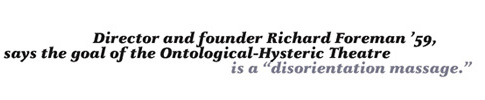
The New Curriculum made, brilliantly, a virtue of necessity. It took what was less traditionally pedantic and hypertensive about Brown and made it the very emblem of off-center experimentation and excitement, of off-axis cultural participation. Brown is "branded" with a specificity that is surely the envy of other schools. Amy Hempel, who did not attend Brown but whose Collected Stories carries a foreword by Rick Moody, says, "The smart dog obeys. The smarter dog disobeys." Dave Eggers, author of the seminal anti-memoir memoir A Heartbreaking Work of Staggering Genius and the recipient of a 2005 honorary degree, said at Commencement that year: "Man, did I want to go here. Brown was the number-one school I wanted to go to when I applied to college. I wanted to go somewhere without any rules, but I was brutally rejected."
The literary critic Stanley Fish, describing seventeenth-century "masterworks" such as Milton's Paradise Lost, coined the term "self-consuming artifact," a perfect phrase for a lot of what is, to me, the most exciting artistic work done by Brown alums and faculty. This would include nearly every sentence S.J. Perelman ever wrote and pretty much everything Nathanael West '24 wrote as well, especially Miss Lonelyhearts and The Dream Life of Balso. It would include the exquisitely self-conscious cartoons of Edward Koren, who taught in the Brown art department for many years, and In the Beginning by Richard Kostelanetz '62, which consists of the alphabet, in single- and double-letter combinations, unfolding over thirty pages. Shelley Jackson '94 MFA, who describes herself as a "student in the art of digression," once published a story in tattoos on the skin of 2,095 volunteers. Andrew Sean Greer '95 MFA, whose second novel, The Confessions of Max Tivoli, is told in the voice of a man who appears to age backwards, says about working with Robert Coover, "He encouraged us to write anything except conventional narrative."
The Brown literary aesthetic tends to be consciousness-drenched. Jaimy Gordon '72 AM, '75 AD, author of Shamp of the City-Solo and many other difficult-to-categorize works, says, "This will sound odd, but I like having a mind. I like thinking, though I'm aware that I think eccentrically and often ridiculously, so that my thoughts threaten to isolate me, even though they take shape in the common tongue. I do have confidence that what goes on in my mind ... can be turned into something made of language that will be arresting to those who are susceptible to splendors of rhetoric."
Which could serve as the epigraph to the giddy hall-of-mirrors novels of Nancy Lemann '78, especially my favorite, Sportman's Paradise. Brian Evenson, who directs the literary arts program at Brown and whose first work of fiction, Altmann's Tongue, got him dismissed from Brigham Young University for its violation of Mormon tenets, says, "I'm fairly aware of philosophy and am especially interested in questions of epistemology, particularly theories that suggest the impossibility of knowing." Evenson's story "Prairie" ends with a character unsure whether he's alive or dead. Jeffrey Eugenides '82 says about his Pulitzer-winning novel, Middlesex: "My narrator is not entirely reliable. He's inventing the past as much as he is telling it. The bottom line is that you can't really know much about what you really don't know. There are very old-fashioned narrative techniques deployed in the book as well, but postmodernism is always recuperating old styles of narration." John Hawkes, without whose encouragement I would never have become a writer, famously said, "I began to write fiction on the assumption that the true enemies of the novel were plot, character, setting, and theme, and having once abandoned these familiar ways of thinking about fiction, totality of vision or structure was really all that remained."
I myself wrote in a fairly traditional manner for quite a while: two linear, realistic novels and dozens of conventionally plotted stories. I'm not a big believer in major epiphanies, but I had one in the shower about fifteen years ago. I had the sudden intuition that I could take various fragments of things—aborted stories, outtakes from novels, journal entries, lit-crit—and build a story out of them. I really had no idea what the story would be about; I just knew I needed to see what it would look like to set certain shards in juxtaposition with other shards.
Thalia Field '95 MFA, who is now an assistant professor at Brown, says, "For me it is 'realistic' to be paradoxical, polyvocal, cacophonous. Stories where everything is tidy and psychologically or symbolically closed seem hopelessly incomprehensible, totally unlike lived experience. Whose universe is that?" Richard Foreman '59, the playwright and director and founder of the Ontological-Hysteric Theatre, says the goal of his company is a "disorientation massage."
Now I have trouble working any other way, but I can't emphasize enough how strange it felt at first, working in this modal mode. The initial hurdle (and much the most important one) was being willing to follow this inchoate intuition, yield to the prompting, not fight it off. I thought the story probably had something to do with obsession. I rummaged through boxes of old papers, riffled through drawers and computer files, crawled around on my hands and knees on the living room floor looking for bits and pieces I thought might cohere if I could just join them together. Scissoring and taping together paragraphs from previous projects, moving them around in endless combinations, completely rewriting some sections, jettisoning others, I found a clipped, hard-bitten tone entering the pieces.
Coover: "Sometimes the revolution of form seems almost accidental. Disparate elements are somehow juxtaposed, in art or life or both, creating a kind of dissonance, and an artist comes along who resolves that dissonance through the creation of a new form—a Chr√©tien de Troyes, for example, who secularized the monkish appetite for allegory and raised fairy tale to an art form by enriching it with metaphor, design, fortuitous mistranslation, and exegetical tomfoolery, thereby inventing the chivalric romance, a form that dominated the world for five centuries.... At other times—as with Ovid or Kafka or Joyce—this new form is clearly the conscious invention of a creative artist, pursuing his own peculiar, even mischievous, vision with the intransigence of a seer or an assassin. For these writers, the ossified ideologies of the world, imbedded in the communal imagination, block vision, and as artists they respond not by criticism from without but by confrontation from within."
We were taught at Brown to question ourselves rather than naively and vaingloriously celebrate ourselves, to turn ourselves inside out rather than (easily) inward or outward, to mock ourselves, to simultaneously take ourselves utterly seriously and to demolish ourselves. Don't you finally want to get outside yourself? Isn't that finally what this has to be about, getting beyond the blahblahblah of your endless—
Yes, yes, a thousand times yes. I mean, no. Or, rather, yes and no. I want to get past myself, of course I do, but the only way I know how to do this is to ride along on my own nerve endings; the only way out is deeper in. I'm drawn to writers who appear to have Heisenberg's uncertainty principle tattooed across their foreheads: the perceiver changes the nature of what's being perceived.
Last year I was the chairman of the nonfiction panel for the National Book Awards. One of the other panelists, disparaging a book I strongly believed should be a finalist, said, "The writer keeps getting in the way of the story." What could this possibly mean? I like it when a writer makes the arrow point in both directions, outward toward another person and inward toward his own head. The writer getting in the way of the story is the story, is the best story, is the only story.
We semiotics concentrators— although I actually wound up changing my major to British and American Literature—knew that on day one.
David Shields is the author of The Thing About Life Is that One Day You'll Be Dead, a New York Times best-seller that will be reissued in paperback in February. His next book, Reality Hunger: A Manifesto, will be published by Knopf in January 2010.
Illustration by A. Richard Allen.