
When Carle Pieters arrived at MIT as a graduate student in the late1960s, the Apollo program was sending back some of the first close-upphotographs of the moon. Piles of them would arrive at the astronomylaboratory where Pieters worked. Because she didn't yet have enoughtraining to do the more technical jobs in the lab, it fell to her toorganize and file the images.
 Photos by Leah Fasten
To someone else, this might have seemed like grunt work, but to Pietersit was a gold mine. "Once you start looking at image after image of aterritory that you've never seen before," she says, "you can't help butask questions." Craters, mountains, basins—every formation on the moon,she knew, held a story waiting to be discovered. "I was going around,showing people: 'This is an odd feature. What does this mean? What doesthat mean?'" She wondered about the ages of the cratersand the impactthat created them. She inquired about the types of rocks making upcertain surface formations. Sometimes, she recalls, her colleagues hadanswers, but sometimes they were stumped. "One time in particular,"Pieters says, "I went to a senior graduate student who I thought kneweverything. I showed him this one feature, and he said, 'You know,Carle, your guess is as good as mine.' I said, 'Oh!' From there on in,I sort of was hooked."
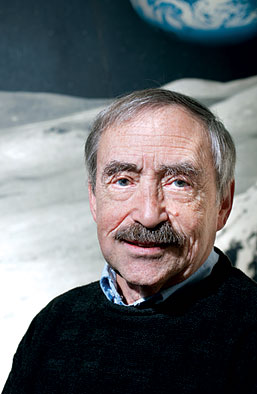
Almost thirty years later, Pieters, a Brown professor of geologicalsciences, sits in her cluttered office on the second floor of theLincoln Field building. She has short gray hair, big pale-blue eyes,and the air of an absentminded grandmother. She's rummaging through therocks sitting on top of a filing cabinet. Space-themed snacks are onthe bookshelf behind her: a Mars bar, a moon pie, a Snapple drinkcalled Moon. Pieters is describing the Moon Mineralogy Mapper, alsoknown as M3, the instrument she designed and sent to the moon last year.
"Minerals have highly diagnostic features that are fingerprints," she explains. She developed the M3,a spectrometer, to find each mineral's unique color fingerprint—itsspectroscopy—as a way of knowing more about the moon's surface.
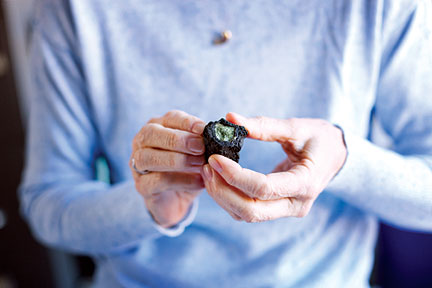
"This is basalt," she says, handing over what looks like a lump ofporous charcoal. "And this is a beautiful olivine inclusion." Shepoints to the innards of the black rock, exposed as if someone hadcracked it open. The olivine, one of thousands of minerals that M3is mapping on the moon, is sage green; its tiny hard-edged crystalssparkle like grass after rain. "Your eye has three colors. So you cantell it's green, and it's different from other things," Pieters says ofthe olivine. "Our spectrometer has 260 different colors. We not onlylook at the visible wavelengths, but we go further into longerwavelengths. The eye sees, say, between 400 and 700 nanometers. That'sfrom blue to red. Our instrument goes to 3,000 nanometers, or threemicrons."
With that kind of perception, Pieters' M3 can "see"things on the moon that have never been seen before. Like water. InSeptember, Pieters made headlines by announcing the discovery of wateron the moon, in the process upending the notion of an arid moon, one ofthe fundamental truths scientists had long accepted about our nearestcelestial neighbor. As if that weren't enough, two months later a teamincluding Pieters' colleague in the geo sciences department PeterSchultz announced that the Lunar Crater Observation and SensingSatellite (LCross), which he had designed and sent crashing into acrater on one of the coldest sections of the moon, had kicked up aplume of debris that included water ice.
"This concept, water on the moon, is just wild," Pieters says. "Everybody goes, whaat?"
The belief in a dry moon is a legacy of the manned Apollo missions ofthe 1960s and early 1970s. In addition to photographs, the Apolloastronauts brought back to Earth rocks and dirt, hundreds of pounds ofthe stuff. Scientists detected minute traces of water in some of it,but their assumption was that the containers holding the material hadleaked just enough on Earth to allow the water into the samples. Theirconclusion was that the moon is a desert.
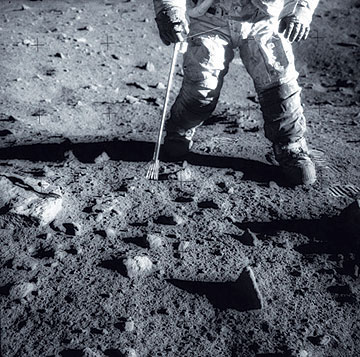
Another Apollo legacy is the sense that we're done with the moon.From 1969 to 1971, the United States sent human beings to the moon sixtimes. Each time, astronauts set up a lunar module, some twenty feettall, which hunkered on the surface like a giant spider. With theirspacesuit-booted feet, the astronauts explored the area around themodules, leaving footprints in the lunar dust.
And then they left.
The instruments designed by Pieters, Schultz, and other alumni and faculty are part of a sudden new interest in the moon. M3,which was funded by NASA but rode to the moon on the Indian spacecraftChandrayaan-1, and LCross, whose spacecraft is NASA's LunarReconnaissance Orbiter (LRO), are part of a new wave of lunar missionsNASA has been developing. The next one, the Gravity Recovery andInterior Laboratory (GRAIL), is scheduled to launch next year. Itsdesigner and principal investigator is MIT Professor Maria Zuber '83ScM, '86 PhD, another product of Brown's geological sciencesdepartment.
So why this new interest in the moon? Professor of Geological SciencesJames Head '69 PhD, who has been both mentor and colleague to Zuber andothers, says the moon is a key to understanding the Earth's geology. OnEarth, oceans, plate tectonics, erosion, storms, wind and severeweather have all conspired to obscure the planet's geologic history."If I wanted to understand you in more detail," he says, "I would wantto know about your childhood, your formative years, where you grew up,the events that happened. We don't have that record for the Earthanymore. It's like trying to read history with the first ten chaptersgone."
The moon, by contrast, has changed very little over itsfour-billion-year history. In fact, photos from the LRO still show thesix lunar modules we landed there, the scientific instruments abandonednear them, and even the footpaths used by astronauts forty years ago."The moon holds a record of things that have happened to the Earth,"says Peter Schultz. "If the Earth went through a storm of comets, themoon has that record too. If the Earth had massive flares—if suddenlythe sun exploded, or got very faint—the moon probably has that recordin it."
Scientists have also speculated that the moon could be an importantrefueling and restocking depot for manned missions to Mars and otherparts of the solar system, an idea that would gain even more currencyif stores of water actually exist there. (The LRO was designed in partto scout for lunar landing sites.)
"Especially for human exploration, water is gold," Pieters says. "Youneed water to drink, and you don't want to spend all your money haulingit up." Potable water costs up to $100,000 per gallon to transport intospace from Earth. But beyond drinking water, Pieters notes, "You canuse H2O to produce hydrogen and oxygen, and that's fuel. You can use that to basically create your own filling station."
Growing up as an army brat, Carle Pieters didn't have a hometown. Bornin Oklahoma, she moved with her family to Hawaii, Nevada, Texas,Maryland, Hungary, and Iran. She graduated from high school in Germany.Among other things, this peripatetic childhood instilled in her theability to make friends quickly and easily. It also led to a love ofexploration and adventure.
Even during college, when she had the opportunity to stay put for fouryears, Pieters chose Antioch, a school whose curriculum involvesspending every other semester working off campus. She majored in matheducation, and taught high school for a few years before getting antsyagain. "I like to solve things," she says. "I'm curious. Math is atool. But it didn't give me the excitement, the exploration part, thatI've always had."
Before sending off her applications to graduate school, she took offagain, joining the Peace Corps in 1967 and moving to Borneo to teachscience. Malaysia was, at the time, about as far away from the lightsand smog of cities and industry as a woman could be. She lived inSarawak, and at night she would often walk to the nearby Sungai AnapRiver with a star guide and a pair of binoculars. She'd lie down andjust stare up at the sky.
Sarawak had "wonderfully clear skies," Pieters recalls. "There are notmany places you can do that—just go outside and lie down and look atthe stars. You can see the moon pretty well with binoculars, some ofthe features and formations. As the shadow, as the terminator, changesevery night, you see different things that you can't see with your eye.It was just thrilling."
Pieters followed the stories about Apollo missions during this time, ofcourse, and when she arrived home she enrolled at MIT to studyplanetary science, receiving a second bachelor's degree in 1971 and herPhD in 1977. Later, when NASA turned away from lunar exploration toexplore other places, Pieters kept her eye on the moon. Using a massivetelescope at Mauna Kea National Observatory in Hawaii, Pieters was ableto collect spectroscopic data remotely, one crater at a time. She was,says her former student Jessica Sunshine '88,'89 ScM, '94 PhD, "quiteliterally looking up at the sky, and saying, 'What's there? What's ittrying to tell us?'"
"Carle looks at things in a very Carle way," Sunshine says. AUniversity of Maryland senior research scientist in astronomy, Sunshineis a member of Pieters' M3team. "She doesn't have a great deal of personal ego," and doesn't tryto play it cool about just how exciting she still finds her work, evenafter thirty years. Recently, Sunshine made an interesting discoveryrelated to an aspect of the moon she had studied with Pieters. Shecouldn't wait to tell her, partly because she was excited, but mostlybecause of the reaction she knew she'd get. Over the phone, Pieters letout an elated, sing-songy "Oh!" that stretched to three syllables. WhenSunshine recalls it, she laughs so hard she can hardly speak. "Youdon't get that reaction from a lot of people."
Pieters' enthusiasm and her lack of ego have put her in an excellent position as the M3 principal investigator, a role that requires her to lead more than two dozen scientists in two countries.Onthe team are another former student, Jack Mustard '90 PhD, who is now aBrown colleague in the geological sciences department, and Pieters'former MIT astronomy professor Tom McCord, who is now a scientist withthe Bear Fight Center, a research facility in Winthrop, Washington. Itwas McCord who gave Pieters the job of filing Apollo images thirtyyears ago.
As a scientist, Pieters is thoughtful, thorough, and cautious. Sheis unwavering about triple-checking her data. "She has always been veryconcerned that the basic data that we work with, the spectra, areproperly calibrated," Sunshine says. "And to not overly interpretthings. Others rush to the finish line in a way she's taught us not tofeel comfortable with."
Pieters' treatment of the M3 data that led to thediscovery of lunar water is a case in point. "As the data came in wekept getting this feature at three microns," Pieters says. "We thought,'Well, there's probably something wrong with our calibration. We'llhave to fix that.' We spent months redoing, checking all of ourcalibrations. And you'd still see it. Everything we could do, it wasalways there."
Pieters then asked Roger Clark, one of the members of the M3team, to crunch the numbers from his instrument, the Visual andInfrared Mapping Spectrometer, which gathered some lunar data back in1999 as it flew by on its way to Saturn aboard the Cassini spacecraft.Clark's data verified what the M3 had found. At that point, Pieters recalls, Clark was convinced M3 hadfound water. "But I said, 'It can't be real.' I've been on too manyinstruments where you get all excited, and then you find there's anerror."
So then she asked Sunshine, the deputy principal investigator on athird instrument, EPOXI, to take a reading as its spacecraft, DeepImpact, passed by the moon on its way to a comet. "Lo and behold,"Pieters says. "It again sees the same thing. That sort of sealed thecase."
What's remarkable about the discovery is not how much water theyfound—a tiny amount—but its presence in more than a single area. Alsosignificant was that the amount and concentration of water shifted andchanged throughout the day.
Scientists have long suspected that if there is water on the moon, it'sin deep craters near the moon's poles, which are permanently shadowedfrom light and so serve as "cold traps." If asteroids or otherwater-bearing space debris happened to pass by these areas, the theorywent, their water would instantly freeze and be stuck there forever.Because the water discovered by M3 ischangeable, it is a result of processes other than deposition fromspace debris or asteroids. One theory is that hydrogen atoms and otherparticles deposited on the surface by the solar wind interact withother lunar materials to form water.
"This opens a whole new field of science that we haven't spent muchtime on," Pieters says. "You've got rocks that are basically in avacuum environment, and they're awash with solar radiation, particlesfrom the solar wind. There's a lot of physics of how those rocksinteract with the solar environment that we haven't really worked outbefore."
Peter Shultz's LCross data, meanwhile, found even more water. TheLRO spacecraft—which is still orbiting the moon collectingdata—launched the LCross rocket and sent it crashing into a lunarcrater at 5,600 miles an hour. The collision was violent enough toresult in a debris plume—material that has not been in the sunlight forbillions of years—more than thirty miles high. NASA officials said thatLCross's instruments measured a "significant amount" of water ice, farmore than M3 discovered.
Even with these discoveries, no one knows how much water might be onthe moon. "Do we know enough yet to know how to get from where we arenow to actually utilizing water on the moon?" Pieters asks. "Not yet.But you need to be making steps that may not have a payoff for twentyyears."
One of the puzzles this new wave of lunar scientists hopes to solveis the moon's origin. Various theories have come in and out of favorover the years, but the most widely accepted at the moment is theimpact theory. It posits that a giant object about the size of Marsslammed into Earth 4.5 billion years ago, creating a belt of hot debristrapped by the Earth's gravity into orbiting around it. As this debriscooled, it accreted to form the moon. If this theory is true, the moonis at least partly a piece of the Earth.
"So what happens now is that is the main idea that gets tested,"explains Maria Zuber. "People look for the inconsistencies in it, andyou either have to reconcile them or you have to come up with a newidea."
One of the inconsistencies is the moon's iron core. The relativesize of a planet's core is dictated by how close the planet was to thesun when it formed: Mercury, the planet closest to the sun, has a corethree quarters the size of its radius. Earth's is half. The core ofMars, the next planet out, is just one-third of its radius. "We're noteven positive that the moon has a core," says Zuber. "We think it probably does, but if it does, it's tiny tiny," which may imply that it was formed in a different part of the solar system than the Earth.
Answering the puzzle surrounding the moon's core is one of Zuber'sgoals with GRAIL. In 2011, she and her team will send two smallspacecraft, each about the size of a dishwasher, into orbit around themoon. By reading radio signals sent back and forth as the two craft gettugged closer together and farther apart by the moon's gravitationalfield, Zuber can tell how dense the materials are immediately belowthem.
Still, the information will be non-specific. "It just tells you, thisis more dense than that. So you actually need other information to helpyou distinguish what's going on there," Zuber says. "You need thingslike Carle's compositional information to tell you what materials areat the surface. You need to look at the geology. You need to look atthe topography, because you need to subtract away all the gravitationaltraction of the topography."
It is precisely this kind of integrated data analysis that Pieters andZuber proposed when they and their teams applied to be a site of NASA'sLunar Science Institute. Last year, they were awarded the four-yeargrant, and Brown, in collaboration with MIT, became one of seven suchsites around the country. "We have people here who study magnetics;people who study the melting of rocks; Carle, who measures composition;Pete, who does impacts," Zuber says. "We said that if we brought themall together, we could do things that none of us could do on our own."The ultimate goal, says Zuber, is to "go after really juicy problemsthat are very complex."
While Carle Pieters was still in graduate school, she traveled to aHouston conference to give a talk. It would be her first, so she andher academic adviser practiced her presentation over and over. At thestart of her panel, the moderator stepped up to the podium, leaned intothe microphone, and began, "Lady and gentlemen."
Pieters looked around. "And I said, 'Oh,'" she recalls. She hadn'tnoticed that in the room of fifty scientists, she was the only woman.She held her own, she says proudly. "I didn't flub up. I wasn't awallflower. I was put into a situation, and it was a situation wherepeople wanted to hear what I had to say because I was so unusual. And Isaid it well."
This nonchalance is precisely how she has dealt with being one ofthe first women in a profession dominated by men. "She lets it slideoff her back," Sunshine says. "It's not that she doesn't notice it.She's just very low-key about these things." As space science hasevolved in the United States over the past half-century, the gender ofits scientists has begun to change as well. During the first great waveof lunar exploration, female scientists were extremely rare, especiallyin leadership positions. Now Zuber is among the leading scientistsgenerating the vision and ideas for a new wave. But for many yearsPieters was it. "When she became a full professor," Sunshine says,"What she said was that she was now a good statistic. One of hercolleagues was like, 'Statistics are not good or bad. They just are.'"
For someone who as a young woman couldn't settle down for more thana few years at a time, staying put at Brown for long enough to secure aprofessorship was a great personal as well as professionalaccomplishment.
But in her mind, the adventure goes on. "Well, I get to go to the moonfrom time to time!" Pieters says with a smile. "Virtually, anyway."
Beth Schwartzapfel is a BAM contributing editor.