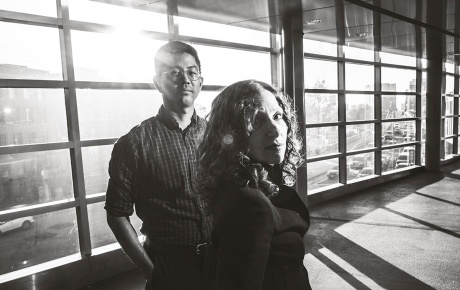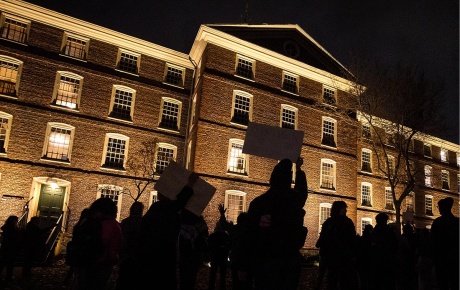

When Jennifer Callahan '87 heard about Hurricane Sandy bearing down on the East Coast during the last days of October 2012, she immediately started to worry about the Rockaways.
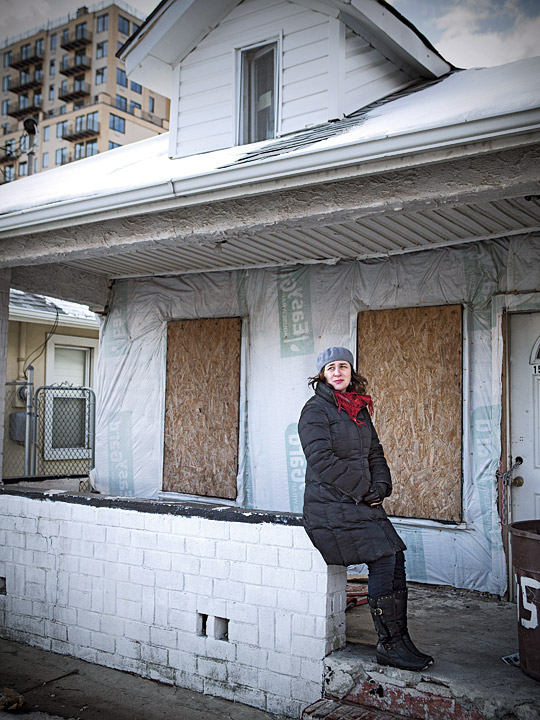
“I was doing what people said on the film,” she says: enjoying an urban oasis by the sea.
As the storm approached the Northeast, officials ordered residents of the Rockaways, a peninsula that’s part of the New York City borough of Queens, to evacuate the area. But Callahan suspected many would not. She phoned and e-mailed the people she knew there, including those living in their small bungalows. Sure enough, many told her they were staying. “It’s a common mentality among people who live on the edges of places,” Callahan says. “They say, ‘I know this place.’” And they weren’t budging.
Callahan rode out the storm with her husband in their Manhattan apartment, relieved that the worst for them meant flickering lights, howling winds, and, she says, “the cat who freaked out.” Afterwards, though, her thoughts returned to the Rockaways. She tried to get news from the peninsula, but it was difficult. True to the neighborhood’s often forgotten role in the region, it was seldom mentioned right after the storm, even though the media showed devastation at nearby locations.
Knowing how close she’d gotten to the Rockaways, Callahan’s friends called and sent her e-mails asking for news. With so many of her New York friends living in a vast swath of downtown Manhattan that had lost power, she turned her attention to helping them, inviting them to her apartment for a shower and a place to recover.
Then disturbing reports about the Rockaways reached her. “I was really worried,” she says. “I really felt I needed to get to the Rockaways to see how it was doing.” She found a ride with someone going out to check on a bungalow only four days after the storm. It was difficult driving that day. Traffic lights were out, and debris was everywhere. There were boats blown onto roadways, and tree limbs piled up in yards and on streets. Given the dwindling supply of gasoline, long lines snaked out from the few service stations still open. Many dozens of buildings in the area were damaged or destroyed by the storm, and tens of thousands of people were suffering without power, including frail elderly trapped on high floors of apartment buildings.
They couldn’t drive around much that day, as the car had little gasoline. But, in the days that followed, Callahan heard more tales of destruction—and also resilience. Many people wanted to help, and volunteers poured into the area. But, due to the gas shortage following the storm, Callahan was unable to drive out to the Rockaways, so instead she went to a Brooklyn church to help collect items for the neighborhood.
Then, in early November, the Queens Museum of Art announced that it
would host a benefit for the Rockaway Waterfront Alliance, whose aim is
to protect the area’s public waterfront. Its founder and executive
director, Jeanne DuPont, is a bungalow owner who is also in Callahan’s
film. The benefit, pulled together in just ten days, featured a
screening of the film, a question-and-answer session with her,
performances by jazz musicians, and a variety of other activities. It
raised about $60,000 and was seen as an important step in helping boost
the community’s spirits.
“City planning and a lot of agencies have given a lot more attention to
these bungalows because of the documentary,” DuPont says.
According to Robert Caro, the Pulitzer Prize-winning biographer of Robert Moses and Lyndon Johnson, The Bungalows of Rockaway is “an incisive analysis of urban policy making, and at the same time a vivid and compassionate portrayal of the injustice that a city’s misguided policies can play in the lives of its most impoverished citizens.”
To Sharon Marcus ’86, professor of English and comparative literature at Columbia University, the film “is an arresting and important documentary.” Callahan, she says, “uncovers a crucial aspect of working-class history and of New York City’s built environment that teetered on the brink of erasure, while also telling a multi-layered story of community activists speaking truth to power as they organize to protect vernacular architecture in a neighborhood returning to life.”
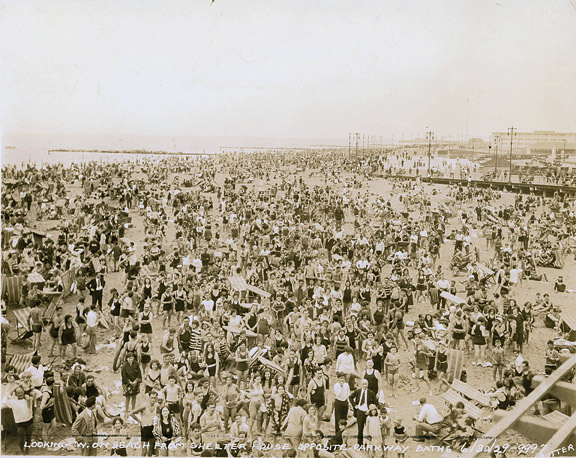
Narrated by Academy Award–winning actress Estelle Parsons, The Bungalows of Rockaway traces the history of a working-class summer resort. The first Rockaway bungalows, which have their roots in a type of structure originating in India in the 1600s, were built in 1905. By the 1930s, they numbered more than 7,000. The bungalows drew summer visitors from the New York City neighborhoods where many immigrant families, particularly Jewish and Irish ones, wanted to get away from their regular lives for a week or two, and sometimes more. In the Rockaways, they could enjoy the wide beaches, the more than five miles of boardwalk, the family-friendly amusement park, and the small-town atmosphere.
Callahan’s film begins with a song that expresses the small but dreamy otherworldliness of bungalows, the 1940s novelty hit “We’ll Build a Bungalow”:
We’ll build a bungalow, big enough for two,
Big enough for two, my honey, big enough for two.
And when we’re married happy we’ll be
Under the bamboo, under the bamboo tree.
The documentary, which also includes many rare archival photographs, captures the extraordinary life of the community. The Rockaways drew the Marx Brothers and their families; it was where New York basketball legends Al and Dick Maguire played on seaside courts, and where, as a boy, John Sweeney, who would later become the longtime head of the AFL-CIO, spent time on the beach. Today the Rockaways are home to about 136,000 people year-round, and three million people visit in the summer.
It was at Brown, Callahan says, that she first developed her taste for such out-of-the-way gems. As a projectionist for the Brown Film Society, she screened Wednesday night Westerns. She was a double concentrator in history and women’s studies, and was drawn to interdisciplinary approaches, taking many courses in semiotics and creative writing. “I’m interested in the margins,” she says, “and that is something in the air at Brown. Thinking about who and what is on the margins of society is a very rich topic.”
After graduating, she worked in publishing, landing a job as an editorial assistant at the venerable Dutton publishing house. But she moved steadily toward film. “I feel in a lot of ways my life in New York is a continuation of my life at Brown,” Callahan says. “Brown people have shaped my life in so many ways.” She says more than twenty alums helped with the Rockaway documentary, her first feature-length film. Among those most involved were coproducer Elizabeth Logan Harris ’84 and the musicians Hanna Fox ’87 and Rose Thomson ‘88. Of the Rockaways project, Callahan said, “Had I not gone to Brown, I’m not sure I would have had the confidence to take on the subject.”
Callahan first became interested in the Rockaways by chance in 2003, when she was working on a totally unconnected project for a foundation and she went to film a bungalow owner there on a beautiful summer day. “I fancied myself a cosmopolitan New Yorker, and I thought I’d been everywhere,” she said—but she’d never been to the Rockaways.
“I fell in love with the bungalows. I couldn’t believe New York had bungalows,” she says, and quickly she started dreaming of doing her own film about them. As she did research and started visiting the area more, her interest grew fast. She learned that the bungalows’ history had rarely been told, and never on film. She got a warm welcome from owners excited to have the bungalow story revealed, and before long she had people eager to cooperate and giving her precious family photos.
Callahan, who began working on the documentary in 2004, at first envisioned a twelve-minute short film about the heyday of the Rockaways. She applied for and received city and state grants, then funding from foundations and individuals. “It kept getting more interesting to me,” Callahan said. The Rockaways were always on the outskirts of New York City, literally and figuratively, and Callahan found a perfect match for her curiosity about “marginalized communities.”
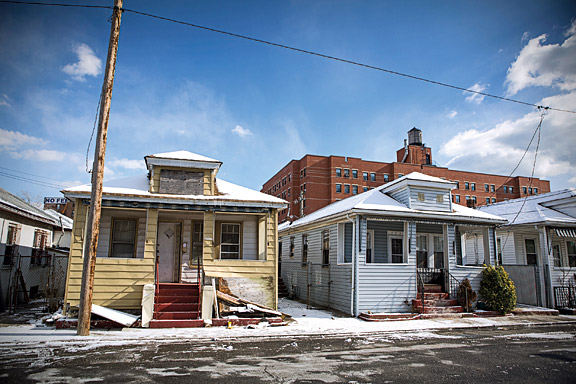
But the idyll didn’t last. As demographic patterns changed, so did the real estate market and ideas about urban planning. Many of the bungalows were eclipsed and replaced in the 1950s and 1960s through often brutal urban renewal policies that replaced small-scale development with high-rise projects for low-income residents moved there from other parts of the city. Rows of bungalows were torn down, leaving unfriendly moonscapes in the neighborhood. By the 1980s, fewer than 400 of the original 7,000 bungalows remained.
But, in the end, Callahan’s documentary is one of renewal. In recent years, local residents and activists began to fight for the preservation of the bungalows. The Bungalows of Rockaway has become a tool in that effort. Years ago, the summer people and year-round residents were somewhat separate and standoffish. But in recent years, as many bungalows have come to be occupied year-round and appreciated as a sort of endangered species, divisions and distinctions have dissolved, Callahan says.
Joining with others in the community, groups like Beachside Bungalow Preservation Association pushed for lower-scale zoning and more parks and open space. Callahan’s film documents their success. In 2008, a significant rezoning plan was approved by New York City, lowering the allowable density of development. Bungalow owners helped win the reduction of the size of a high-rise condominium project near the ocean and have involved the broader community in restoring parklands. “There’s a small piece of paradise still left, and hopefully it’ll still be here for the next generation to enjoy,” Jeanne DuPont says in the documentary, which has been shown on WNET, New York’s public television station, and at many community screenings in the Rockaways and throughout the city. It has also been part of film festivals around the United States and the world.
What will the effect of Sandy be on this renewal? The question was much on Callahan’s mind when she returned again to the Rockaways in late November. The morning was foggy and gray. Callahan had just driven by many piles of debris and had seen “warming tents” for those residents still without power. Free coats proclaimed signs on lampposts. Dozens of people seeking help stood in line at social service agencies. For now, Callahan’s eyes were on the disembodied remains of the beach’s legendary wooden boardwalk, where only a few support structures of broken concrete remained. Nearby, huge construction trucks moved around tons of sand and debris.
“I feel very sad,” she said. “It’s already a neglected part of the city. It had been making progress the last couple of years.”
Like many in the area, Callahan wants to rebuild the pre-storm version of the Rockaways. Given the recent perceptible upturn in the area, there is now a palpable longing to keep that progress going, despite Sandy. Callahan remains optimistic. “For some people,” she says, “the Rockaways are on the map for the first time.”
It seems improbable to her, but for those people fighting to renew the Rockaways, her film has become a key element and has given her stature as an activist. “Now the community needs more help,” DuPont says, and she hopes Callahan will continue working for change in the Rockaways. For her part, Callahan is proud of her documentary: “I feel good that people thought I got it right,” she says. While she’s working on her next documentary—about a Manhattan psychiatric facility for teens who are deemed “behaviorally unmanageable”—she also keeps going forward on future film and book projects connected to the Rockaways.
A bright spot in the outlook for the Rockaways appeared in December, when the New York State Office of Parks, Recreation & Historic Preservation added many of the bungalows to the New York and national registers of historic places. Local activists had sought the move for years, and Callahan’s film helped bolster their case. Although the designation doesn’t grant the official landmark status that would give the bungalows blanket protection—a move that is still being sought—Callahan and many others cheered the action as an important step. “Sandy didn’t knock down bungalows, but they are still vulnerable to bulldozers,” Callahan says, “This is so exciting.”
“When I started, I felt like such an outsider. I never expected that
I’d still be involved,” Callahan reflected. “It’s not ended at all,”
she said of her connection to the Rockaways. All of the boardwalk and
so much more destroyed by Sandy may not be back by this summer, but you
can tell that Callahan, like many in the Rockaways, longs for more warm
summer nights by the sea and will be fighting for them.
Noel Rubinton is a writer and editor in New York City.