
When Ellen Kuras graduated from Brown in 1981, little did she know that she had already found the subject of the film that would earn her an Academy Award nomination almost three decades later. While living in South Providence, she took a job at Providence's Roger Williams Park Museum of Natural History, to which she brought her growing interest in her neighborhood's Hmong community. At the museum she began programming cultural exhibitions focused on the waves of immigrants who were arriving from Southeast Asia during the years following the Vietnam War.
And make a film she did. The Betrayal (Nerakhoon), which premiered at Sundance in 2008 and was nominated for the 2009 Academy Award for Best Feature Documentary, became a twenty-three year obsession. It began when, after a year at the Roger Williams Museum, Kuras was offered a fellowship to attend the Visual Studies Workshop in Rochester, New York. While there she met a local Hmong teenager whose story she decided to film. She moved to Boston to work as a sound engineer at the public television station WGBH, and hired a cameraman to film the Rochester project, but the results left her cold. "I needed to shoot my own film," she says. One day she hired a man named Thavisouk Phrasavath to teach her Laotian for the film, and she realized she had found her real story.
"During those lessons," she recalls, "we'd end up sitting and talking for hours. I became interested in his worldview, the stories he remembered. I asked him all kinds of questions about philosophy and mythology. As I got to know Thavi better, he'd tell me all these things that were happening to his family. I would have been a fool not to film what was going on."
Kuras worked as an electrician and a camera assistant on independent films to support herself as she continued to work on Phrasavath's story. Her big break came while she was working as a crew member for producer Christine Vachon '83. After Kuras showed her early footage of The Betrayal, Vachon was impressed enough to hire her as director of photography for the 1992 film Swoon, which focused on the notorious 1920s murderers Richard Loeb and Nathan Leopold Jr. Directed by Tom Kalin and filmed in black and white, Swoon won five major awards, including the Dramatic Cinematography Award at the Sundance Film Festival that year.
Kuras was suddenly in demand. By the late 1990s she'd become Spike Lee's go-to cinematographer, creating distinctive looks for He Got Game (1998), Summer of Sam (1999), Bamboozled (2000), and 25th Hour (2002). In 2001, she shot Rebecca Miller's debut, Personal Velocity, on digital video. That same year, Hollywood came calling. She filmed Johnny Depp and Penélope Cruz in Blow and Robert DeNiro in Analyze That. She teamed up again with Miller for the 2005 feature The Ballad of Jack and Rose, which starred Miller's husband, Daniel Day-Lewis.
"When other people asked me to start shooting their films," Kuras says, "I realized I had something to say through the camera."
In 2004, Kuras worked with French director Michel Gondry on Eternal Sunshine of the Spotless Mind, which starred Jim Carrey and Kate Winslet. The film won the 2005 Oscar for best original screenplay; Winslet was nominated for best actress. Meanwhile, Kuras became a favorite cinematographer for directors of music documentaries. In 2005 she was one of the cinematographers on Martin Scorsese's multipart documentary No Direction Home: Bob Dylan. She found just the right tone for the 2006 Neil Young: Heart of Gold, in keeping with the understated songs Young was writing after he'd nearly died of a brain aneurysm.
Her film-industry colleagues can't say enough good things about Kuras and her work. Sam Mendes, who hired her to shoot the soon-to-be-released Away We Go, starring Maggie Gyllenhaal and John Krasinski '01, says he chose Kuras after seeing how well she related to cast and crew while filming Eternal Sunshine of the Spotless Mind. "I got to know Ellen through her friendship with my wife [Kate Winslet]," Mendes says. "During filming, Ellen seemed utterly in tune with the actors. Her work has a freedom and a humanity and a lack of preciousness that I love."
Beverly Wood Holt, who worked with Kuras during post-production, says keeping up with her can be exhausting: "We were doing color correction on the movie right up to the last minute before the premiere of Eternal Sunshine of the Spotless Mind. Ellen slips on her clothes and we get to the Academy screening room. I think I'm going to finally enjoy the movie. First reel, Ellen leans over and says, 'I think we could use a half a point more yellow.' Reel two, she says, 'What about a little more magenta?' Finally I say, 'Ellen, shut up and let me watch the movie!' By the end of the screening, Ellen had fallen asleep because she'd been working on it for so long."
I caught up with Kuras when she flew out to Los Angeles from her home in Nyack, New York, last August to put the finishing touches on The Betrayal. Striding through the corridors of EFilm, a Hollywood post-production house, she talks shop with cinematographer Roger Deakins (No Country for Old Men, The Reader) and catches up with cinematographer Emmanuel Lubezki (Children of Men, Lemony Snicket's A Series of Unfortunate Events). Kuras hugs some staffers while greeting others with a "Hi there" or a handshake. She seems to know everyone in the building, which is not surprising considering the long hours she spent there working on other people's movies.
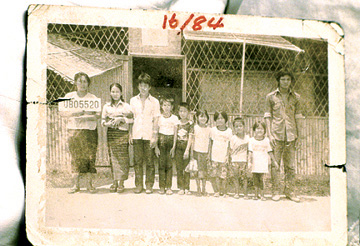
The Betrayal focuses primarily on Thavi Phrasavath and tells the story of his life from his boyhood, through his arrest and escape from his homeland, to his new life on the streets of New York City. During the Vietnam War, U.S. warplanes dropped more than 3 million tons of bombs on the tiny country of Laos as part of its attempt to slow the North Vietnamese. Once the United States had fled and a Communist government had taken over the country, Laotians with ties to the former government or to the United States faced persecution. Phrasavath's father was one of those Laotians.
One day after the family had fled Laos, Thavi's father, long presumed dead, turned up in Miami with a new wife, a new set of children, and no intention of rejoining his first family. In 1998, one of Thavi's half-brothers was murdered, the victim of gang-war violence. The family's crime-ridden Brooklyn neighborhood became so dangerous, in fact, that Kuras, the filmmaker, felt compelled to intervene as a friend. "Thavi and his family became part of my family over the years," Kuras explains. "I became very involved after things got really bad in Brooklyn. We helped them find a house and moved them out."
In 1995, Kuras accompanied Thavi to Laos on a quest to find his long-lost sisters, who'd been left behind when the family fled after the war. Knowing that the government would not allow her to film inside the country, Kuras recalls, "I took the camera apart, hid it in my bag, and managed to sneak it in." Because Thavi's father had been sent to a "reeducation camp" for his work helping the CIA identify bombing targets, Thavi was still viewed suspiciously. "In Laos," Kuras says, "Thavi is still considered a traitor. He was very uneasy. We were supposed to stay in the capital city, but I hired an expatriate Australian, who found us a car and driver. We hit the road and went off on our own, which was pretty dangerous."
Traveling through Laos's backcountry, Kuras captured evocative shots of children playing in a river with water buffalo. Rendered in shimmering bronze and gold tones as a symbol of innocence lost, the lyrical sequence plays like a montage. "I don't think a documentary has to look bad in order to be real," Kuras says. "Some people have said, 'Oh, it's too beautiful, and I'd say, 'Well why does a documentary have to look like crap in order to look real? How does that make it more believable?'"
Three years ago, Kuras quit accepting job offers to focus full-time on The Betrayal. Completing the picture had become a matter of not only personal but political urgency. "Now is the time to get this film out because the Iraq War is so dominant in our lives," she said last August in L.A. "We're repeating the same pattern in Iraq as we did in Vietnam, in El Salvador, and in other places where we've intervened on foreign soil." Kuras says she titled her film The Betrayal to signal "the political betrayal of Laotian soldiers who fought with the Americans and how that betrayal trickled down to cause upheaval in this family."
Despite her long experience as a first-rate cinematographer, Kuras found having complete creative control liberating, if also a bit daunting: "As a cinematographer I can dissect a movie scene for scene, shot by shot, but I rarely step back to put the whole thing together. Being able to complete this movie and see it carry the weight of the story all the way through is a fantastic feeling."
She grabs a few chunks of dark chocolate and gets to work, huddled in front of a monitor with colorist Dale Grahn, going over color corrections so subtle they seem impossible for a nonprofessional to detect.

From the back seat, The Betrayal coproducer Chiemi Karasawa, chimes in. "I've worked with dozens of D.P.s, [director of photography]," she says, "and many of them think they're God—only they can speak to the director. Ellen's different. She's very inclusive. Everybody's part of the family in the way she communicates with the crew, the script supervisor, and production assistants. That changes the vibe on the set enormously."
Kuras nods. "I don't believe that yelling at people makes them work any better," she says. "In fact I think it actually makes people more self-conscious and likely to make mistakes. The people I work with on films end up becoming part of my family. We spend holidays together sometimes and get together at each other's houses. We're very close."
Kuras' devotion to craft means there's not much time left for a personal life. "Besides having incredibly long hours," she says, "making a film usually means going away for five or six months, and that's a huge strain on anybody's relationship. Making movies is such an intense time commitment, it's difficult for people who have families to strike a balance."
Her family life was happy enough while she was growing up in Cedar Grove, New Jersey, from which she left for Brown in 1977. In her sophomore year she signed up for a photography class at RISD. "It changed my life," she says. "That was the first time I looked through a viewfinder and actually looked at light." She had dabbled in sculpture during high school, but it was photography that rekindled her fascination with the interplay between light and form. "It was like a whole 'nother world."
Kuras enrolled in a film program at the University of Paris, auditing classes with anthropologist Claude Levi-Strauss and studying semiotics, structuralism, and the psychology of color. The year abroad piqued a fascination with the notion of propaganda that persists to this day. "Propaganda is manipulative," she explains, "but, when you think about it, all film, photography, and painting convince the audience to look at something from the artist's point of view. I was very interested in how propaganda works in still photography, how our perception of color and composition directs what we see first within a frame."
After returning to Brown, Kuras concentrated in anthropology and immersed herself in Native American cultures. "Studying the American Indian," she says, "I saw this loss of their spiritual selves in the modern world as an analogy for the demise of a civilization. It was interesting for me to think about the way small-scale societies change in the modern world."
It was also a helpful background for making The Betrayal. "I've always been interested in other people's culture and where my world intersects with their world in terms of universal values," she says. "In that sense, the film The Betrayal is as much about me as it is about Thavi."
Back in the parking lot, she heads inside to begin preparing for a meeting with her agent in Beverly Hills. Blinking into the glare of the afternoon sun, Kuras sums up the contrarian streak that informs her best work as a filmmaker. "You have to be bold enough to experiment," she says. "People have to understand where you want to depart from the norm. There are standard color settings, and I like to sway away from that." Working on the color tweaks today, Kuras says, "I had to explain: I like the green, I put it there. Don't take it out, even though the standard is that there be no green. I'm always looking for a way to make the image more artistic."
Contributing editor Hugh Hart reports on the entertainment industry in Los Angeles.