
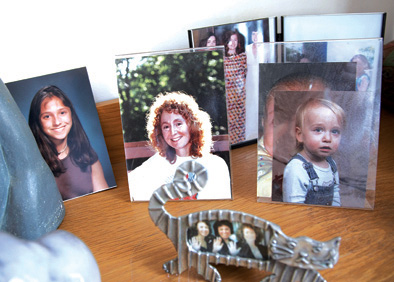
When I first meet Catherine Wolf, she is sitting in the living room of her house at the end of a quiet cul-de-sac in suburban Westchester County, New York. She wears an elegant velour pantsuit with matching brown flats. Nearby are two cats, two dogs and an oversized couch. Pictures of her family are everywhere: framed shots of her with her husband, Joel '73 PhD; their daughters, Erika and Laura; and, most abundantly, pictures of their two-and-a-half-year-old grandson, Ellis. There are at least thirty snapshots of him on the wall, and on a nearby table sits a digital frame with a rotating series of images of his smiling face. Outside the windows, the street is blanketed with snow.
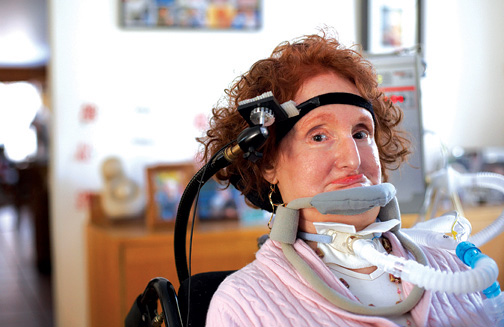
But when Wolf clicks through the internet, she must do so with painstaking slowness. Confined to a wheelchair, she sits as still as a mannequin. Of the hundreds of muscles in her body, she can move only a handful. She breathes with the aid of a ventilator. Yet she types, talks, browses the Web, writes poetry, sends and receives e-mails, conducts research, and peppers the local paper with letters to the editor. She does all this using only her eyebrows.
On a tray attached to Wolf's wheelchair sits a laptop, emitting a soft but steady bong, bong, bong. It is the tether that connects her to the world outside her head. The tones it emits are the sound of the cursor moving through rows of letters on the screen. "Hello," the laptop says, shortly after I walk in, and then, some seconds later, "How are you?"
The voice is Wolf's. She recorded the greetings seven years ago, before she lost the ability to speak. In addition to a few key phrases, she recorded the names of her family members as well as some favorite jokes. (Question: "What's green and hangs from trees?" Answer: "Giraffe snot.") She wishes she had recorded more.Wolf has curly red hair and expressive eyes framed by tortoiseshell glasses. She can still move her eyes and curl part of her mouth into a surprisingly bright smile. Her home-health aide places a chair for me beside Wolf's wheelchair so I can watch her type. It's unnerving to look over her shoulder this way. The image of a modified keyboard, in yellow, is arrayed in front of her. It has six letters to a row, plus punctuation, arranged like this:
e a r d u v .
t o i l g k ,
n s f y x q '
The cursor highlights one row of letters at a time. When it arrives at the row containing the letter Wolf wants, she raises her eyebrows. Click. The cursor then moves along the letters in that row, highlighting one at a time. When it falls on the letter Wolf wants, she raises her eyebrows again. Click. A T appears in a box at the bottom of the screen. Then Wolf starts again. A black band across her forehead lifts each time she raises her eyebrows, triggering an infrared switch mounted near her head. Bong, bong, bong. Click. Bong, bong, bong. An h appears.
One of the great ironies of Cathy Wolf's life is that she built her career on the study of human speech, gesture, and handwriting. Compared to computers, humans are messy, complicated communicators, and Wolf's six patents and more than 100 journal articles and textbook chapters are all aimed at teaching computers to understand us better. But since amyotrophic lateral sclerosis (ALS)—also known as Lou Gehrig's Disease—began claiming her ability to speak, gesture, and write a dozen years ago, she has developed a whole new relationship with language. After leaving IBM on long-term disability in 2004, she began writing poetry. Her poem "Words" was published in the magazine Neurology Now in the fall of 2007. In it, she describes how she types:
Very,
Slow,
Ly,
Moving my head to the rhythm of beeps
Thankful for each tiny movement
Concentrating letter by letter
Squeezing each word out with gargantuan intensity
Like an ancient chiseling words in Aramaic
I will be heard!
The ability to speak is a remarkable thing. That we can move our lips and tongues into certain shapes and force air past our vocal cords in a certain pattern, that this will convey the contents of our heart or make another person laugh, is one of those human mysteries we rarely think about. We all instantly understand hullo, yo, hey, hi, or howdy to mean more or less the same thing, but to a computer these words, like the wave of a hand, are just a mass of disparate data. At IBM it was Cathy Wolf's job to help computers make sense of such things.
At the IBM Thomas J. Watson Research Center, Wolf worked as a research psychologist, designing and testing the interfaces between humans and machines. Collaborating with computer programmers, Wolf observed people in their workplaces to determine how a machine might be used in real-world situations. She led focus groups and tested mock-ups and program prototypes on potential users. One of the last projects she worked on at IBM was a technology called the Conversation Machine, which allowed users to do their banking by talking to a computer over the telephone. (User: "What's my checking balance?" Conversation Machine: "Your checking balance is $925.00. What else can I do for you?")

Wolf continued to work long after she became ill. When she could not use her hands anymore, IBM supplied an aide to help with many everyday tasks. To type, while she still had use of her neck, "I wore a reflective dot on my forehead whose position was detected by the head mouse," she says. "I pointed with my head to the letter I wanted and dwelled on the letter I wanted for a specific time to select it. At one point, I used a switch under my foot and showed up at IBM meetings with one shoe on."
It was in 1996 that Wolf first began noticing problems with her left foot and calf. "She went to a lot of foot doctors and then orthopedic doctors and then neurologists," Joel recalls. With every possible diagnosis, Joel recalls, they would think, "'Oh God, I hope it's not that.'" Then, "'Oh God, I hope it is that, because if it's not that, it's that.' And then when you get to the end of that string, the worst thing you could possibly have is what she had. She went from being a runner to being barely able to walk within a few years."
ALS is a neurological disease that attacks the motor neurons, the cells that the brain uses to communicate with the body's voluntary muscles. Over the course of three to five years, people with ALS progressively lose the ability to move their fingers and toes, their arms and legs. Then they lose the ability to speak, to turn their head, and to swallow food. When the diaphragm and chest muscles give out, they can no longer breathe. They die.
Although it was identified more than 100 years ago, scientists still don't know what causes ALS. There is no effective treatment and no cure. The only thing that can prolong life is a ventilator, which allows patients to continue breathing. But it does not slow the progression of the disease. To prolong life for too long raises the specter of becoming "locked in," of losing the use of every last muscle until patients are trapped inside their own bodies, fully conscious but unable to communicate, unable to blink yes or no, unable to signal when something is wrong, unable to say, Enough. I'm done.
Wolf is among a tiny minority of patients in this country—about 5 percent—who choose to have the surgery to connect them to a ventilator. The emotional and financial cost, to the patients and their families, is too high for most.
"My wife has a will to live that probably exceeds 99 percent of the rest of the world," Joel says. "Her will to live is more than just the desire to be alive; it's a desire to live a full life. As Cathy herself puts it, "as normal a life as possible despite ALS."
Which is why, after finally leaving IBM, Wolf realized that "something meaningful had to replace work." She became involved with PatientsLikeMe, an online community that provides a forum for people with ALS and other illnesses to share information about their experiences and to keep up with the latest medical developments. PatientsLikeMe offers users the opportunity to assess their condition by taking the ALS functional rating scale, or ALSFRS, at regular intervals. Wolf decided to answer the ALSFRS questionnaire:
Compared to the time before you had symptoms of ALS ... have you noticed any changes in your speech? She could no longer speak. Zero points.
Have there been any changes in your ability to swallow? She hadn't swallowed in years. Zero points. (When saliva pools in her throat, she types cmx with her scanning keyboard. The computer says "coughing machine," and one of her health aides suctions out her mouth and throat.)
And on and on. Cannot walk or move my legs. Zero. She couldn't turn herself over in bed or adjust the blankets without help. Helpless in bed. Zero. She couldn't breathe without a ventilator. Zero.
"I was offended," Wolf explains. "I felt it didn't reflect my abilities."
As a research scientist, Wolf's reaction to her rating was to question the methodology. The instrument, she reasoned, was too crude to provide much insight into a patient's true condition. "There's something in psychological testing called the 'floor effect,' when the sensitivity of the measure isn't low enough at its lowest levels," says neuropsychologist Paul Wicks, the research and development director of PatientsLikeMe. "She was trained as a psychologist, so she asked, 'Can we fix this?'"
After analyzing the statistical sensitivity of the ten questions, they settled on three new scale items that focused on the use of fingers, the capacity to show facial emotion, and the ability to get around inside the house. Wolf, Wicks, and a third researcher then coauthored a scientific paper to introduce their new scale. It was published in the March issue of the European Journal of Neurology. "I am most proud of that paper of all my publications," Cathy says.
Wolf's interest in language dates back to her undergraduate days at Tufts, where she read a book by Noam Chomsky proposing that humans are hard-wired for language. "I thought that having an innate capacity for something as complex as language was remarkable," Wolf says. "After all, language distinguishes us from other animals."
Her interest coincided with an early interest in computers, long before they became a ubiquitous part of everyday life. In 1967 she met Joel, then an MIT mathematics student, via one of the two computer services (they squabble over which) that were the precursor to internet dating. "She was very pretty, very intelligent," Joel says. "She had a great sense of humor. She was a very good dancer. I'm a very un-great dancer, but I liked to watch her dance." The couple married in 1968, and both began working toward their PhDs at Brown shortly after, he in mathematics, she in psychology.
Cathy Wolf's interest in language led her to Peter Eimas, the Fred M. Seed Professor Emeritus of Cognitive and Linguistic Sciences, whose pioneering research demonstrated that infants have a far more sophisticated understanding of language than was previously thought. (Eimas died in 2005.) Wolf's research extended Eimas's findings by comparing the way children of different ages perceive particular linguistic nuances.
Wolf's daughter Laura says her parents remember graduate school as a time of hectic contentment. "Sometimes," she says, "they would share a gallon of ice cream for dinner because they were too busy to cook."
Later, cooking became a favorite family activity—Laura still makes the Thanksgiving apple pie each year under her mom's watchful eye—but Wolf never appreciated it as much as she does now, when she can eat only through a feeding tube. She still remembers in vivid detail her last meal, which she ate in 2001 and described in a poem titled "Last Supper":
chocolate mousse
the essence of chocolate
fresh fruit salad
with sweet blueberries, tangy raspberries
and mellow cantaloupe
pumpernickel roll with raisins
and sourdough French bread
baby asparagus sautéed al dente
mashed potatoes spiked with piquant garlic
poached fillet of salmon served with creamy dill sauce
my last supper
food!
aromatic!
textured, tasty on the tongue!
now bypasses my mouth and nose
a bland substance for survival
In "First Snow," a poem she wrote in 2006, she recalled Sneaking cafeteria trays out under bulky parkas/To slide down College Hill/The trays navigating by the avocado moon. In the same poem, she fast-forwards many years, to Rolling soggy snow with husband and daughters to build a teetering snowman/The tallest on the block.
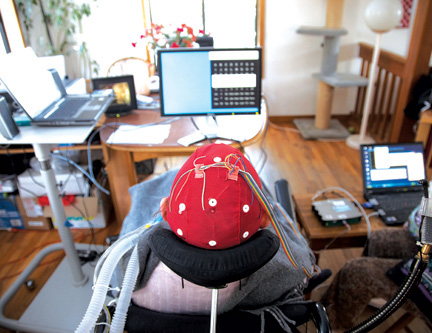
Here is a day in Cathy Wolf's life, in her own typewritten words: "I get up at ten thirty. At the computer usually by one thirty. Read email, check PatientsLikeMe, work on various projects until nine or ten, watch PBS News Hour and Daily Show, go to bed at midnight." Her aides lift her from her wheelchair with a mesh-and-metal pulley and settle her in a hospital bed in what used to be the family room. (I sleep alone now/Not by choice but by disease.) She has to sleep with her bed at a forty-five-degree angle to keep from choking. A nurse must watch her closely all night; if Wolf wakes up and needs something, the only way the nurse will know is to see her eyes moving.
Wolf's family says she is angrier than she often lets on. And sadder. How could she not be? "There have been times in her life when things have been low," Erika says, "but there's always been something big coming up to live for: somebody's graduation, the birth of my son.
"Now it's all about my son."
Erika doesn't know exactly what her son, Ellis, understands about what's wrong with his grandmother, but he loves to sit on her lap. He is exceedingly gentle with her tubes and machines. He calls her "grandcat." His favorite pants are the ones she picked out for him. He calls them his "grandcat pants."
One day Erika visited her mother with her son. Outside, the sky was overcast. The familiar bong, bong, bong of the laptop was the sound track to the conversation between Erika and her mom.
"It's grey outside," she painstakingly typed, "but Ellis is the sun."
Beth Schwartzapfel is a BAM contributing editor.