
After playwright Charles Mulekwa had a gun pointed at him, his house broken into, and his aunt nearly kidnapped during the civil war in his country, he was ready for revenge.
A local militia was recruiting in his hometown of Mbale, Uganda, and Mulekwa, then nineteen, wanted to get a gun and join in. "My grandmother said, 'No way. Over my dead body,'" Mulekwa recalls. "She said, 'Well, if you are ready to kill, I think you should shoot me first. That will prove you are ready.'"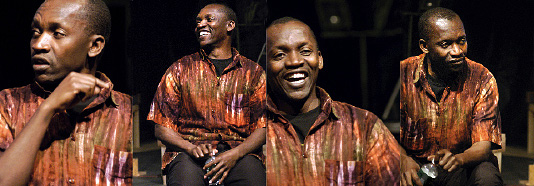
One of Uganda's most prominent playwrights, Mulekwa has relentlessly used the theater to confront his country's most painful moral problems. His 1993 play, The Eleventh Commandment, is about a fifteen-year-old girl whose stepfather rapes her after becoming convinced that she's had sexual relations with boys. Hands of My People looks at female genital mutilation. The radio drama Nothing Against You examines a father's abuse of his dowry to interfere in his daughter's life. "I feel a responsibility to talk about the difficult issues," Mulekwa says.
A Time of Fire had its Ugandan debut in 2001 at the National Theatre and was produced this winter at the Providence Black Repertory Company by executive director Donald King '93. Mulekwa says the play's inspiration came while he was directing The Piano Lesson by the acclaimed African American playwright August Wilson. One of the characters says, "Anything that would give me peace is the thing I want. But I wasn't born to that. I was born to a time of fire." As it happens, a popular song in Uganda is called "Moto Wa Waka," which roughly translates as "a time of fire." In the early 1980s rebels used it to incite ordinary citizens to take up arms against the government.
Mulekwa, however, was drawn by August Wilson's more complicated notion of people unable to find the peace they seek because they live in violent times. Wars have raged in Uganda on and off ever since Idi Amin seized power in the 1970s. "I witnessed a lot of revenge acts after every war," Mulekwa says. "People who the day before the coup were just your neighbors—just a clerk, just a teacher—[and] the next day you see them with a big club pounding each other." But he also saw moments when someone, as he puts it, "found his humanity." The characters in A Time of Fire have moments where they do the same.
Mulekwa thinks he will likely return to Uganda after earning his PhD, which, if all goes as planned, he will receive later this year. Despite its past and some ongoing violence, Uganda is hailed as an African success story with a solid track record of economic growth and a much-admired HIV-prevention program. Ironically, Mulekwa says, theater there was more vibrant and popular during more turbulent times. Playwrights, he says, now live "hand-to-mouth," but he still sees the stage as one of the best ways to bring about social change.
"One secret I know about life, and I learned this through theater," Mulekwa says, "is that often when [people] can put a face to the problem, they put a considerable effort into trying to solve it for themselves while the powers that be are still debating in their offices. There is nothing as immediate as theater."
Lawrence Goodman is the BAM's senior writer.