
It all started in Faunce House. I know, because I was there. Between 2003 and 2005, if you walked past the downstairs lounge, you might have heard the rustle and clatter of poker chips as they were tossed into a pot. The chips were part of what became known as the Blue Room Game, even though it was played in the Faunce basement. I was one of the regulars. I'd sit for a game with a nervous stomach, feeling a mix of anxiety and anticipation, knowing I'd need to play my utter best.
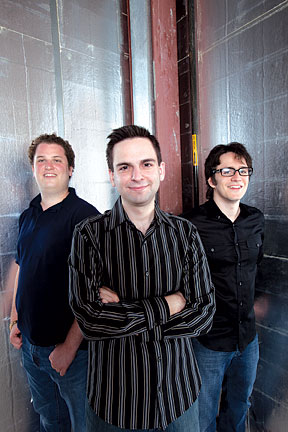
The most successful of these new players is Isaac Haxton '08. Haxton, who grew up in Syracuse, New York, began playing chess at four and later became one of the country's best players in Magic: The Gathering, a complex collectible card game invented in 1993 by a mathematician named Richard Garfield. At eighteen Haxton started playing in small-stakes Limit Texas Hold-'Em poker games at the Turning Stone resort and casino in upstate New York. He approached poker just as he did his academic interests: he read everything about it he could find. At Brown, Haxton occasionally dropped in on the Blue Room Game and began playing in earnest online. He started with twenty-five-cent Limit Hold-'Em games and was soon playing online about twenty hours a week, working his way up to higher-stakes tables. The summer after his freshman year, Haxton devoted himself to poker full-time, earning about $40,000. A year later, his earnings had climbed to $500,000.
Before starting his junior year, Haxton persuaded his parents—his father is a creative-writing professor at Syracuse University and his mother is a doctor—to let him take a year off from his studies to devote himself to poker. In January 2007, Haxton, along with Blue Room Game veterans Scott Seiver '07 and Jared Okun '07, flew to the Bahamas to play in a tournament called the PokerStars Caribbean Adventure. The game was No-Limit Texas Hold-'Em. The No-Limit part means you are free at any time to "go all-in"—that is, to bet your entire stack of chips. The strategy is to put intense pressure on your opponent, forcing him to match your huge bet or to fold his cards. But any hand can be your last.
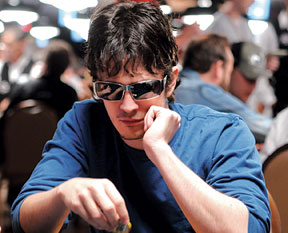
Vying with some of the world's best pros, Haxton progressed through the tournament, amassing a huge chip lead in the $7,800-buy-in event on his way to the final table. The Travel Channel, whose televising of World Poker Tour events helped lead a surge in poker popularity over the past decade, filmed the action. Haxton's long hair, dark glasses, and fearless demeanor briefly earned him the nickname "The Lizard King," for his resemblance to Jim Morrison of The Doors. (He has since cut his hair.) Haxton finished second, earning $861,789. He had arrived as one of poker's newest young guns.
Haxton returned to Brown and finished his degree, switching his concentration from computer science to philosophy with an emphasis in logic and science. He now lives in Las Vegas, where he spends some of his time playing in casinos and most of his time playing online. In May, he began playing in the 2009 World Series of Poker (WSOP), the game's premier tournament (ESPN televises this one), at the Rio Hotel & Casino in Las Vegas. On June 1, only five days into the seven-week-long WSOP, Haxton finished second to Vitaly Lunkin in the $40,000-buy-in No-Limit Texas Hold-'Em event, winning $1,168,566. Three weeks later, in the $10,000 buy-in Pot-Limit Hold-'Em tournament, he finished eighth, winning $82,668. As I write this, the WSOP is still in progress, and Haxton has so far earned almost $1.3 million there. In his short poker career, he has earned more that $2.5 million playing tournament poker. (This doesn't include his online earnings.) He is indisputably one of the world's best young professional poker players.
When I joined the Blue Room Game shortly after it began, I was struck by the characteristics the lower Faunce lounge shared with a casino. The setting was simple and without windows. The rectangular tables fit together perfectly and were covered with dark green felt. There were no clocks, and an ATM machine two dozen paces down the hall stood ready for anyone wanting a do-over. A small television hanging in the corner offered additional entertainment; on Sundays we watched football while playing. Players could buy refreshments at the concession stand; on a slow night the cashier would post a handwritten note saying he'd return shortly and then sit and play for a bit.
"I don't think anybody ever bothered us once," recalls one player. "I can't remember the campus police ever telling us to stop the game. And they definitely walked by."
Most of the players were male and friendly—I'd known several of them since freshman year—but also serious. One of the regulars was Seiver, a computer science and economics double concentrator. At the 2008 WSOP, Seiver won the $5,000 buy-in No-Limit Hold-'Em event, earning him $755,891. More importantly, perhaps, the victory earned him the diamond-encrusted bracelet that is the poker equivalent of a Super Bowl ring. Card players are defined by it, and even Haxton has so far been unable to earn one.
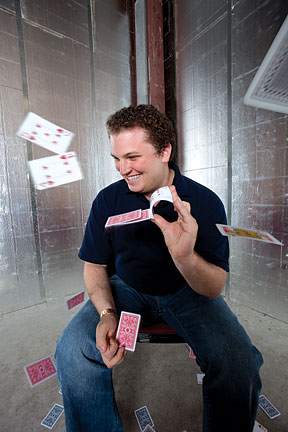
Seiver joined the Blue Room Game midway during its first semester. He had never played poker before. "I knew absolutely nothing," he says. "I was going to Faunce for chess club and saw you guys playing the game." Okun joined several weeks later, after he saw an announcement on the Daily Jolt, the online message board, inviting players to the game. He had played poker a few times growing up in Tampa, Florida, so he joined the game with his roommate. Okun, also a double concentrator in computer science and economics, is not far behind Haxton and Seiver as one of today's bright young players. The high points of his career so far have been a $110,000 purse from an online tournament and his sixth-place finish in a 2007 U.S. Poker Championship event.
Another regular in those early years was Mike Graves '06, who would become the first Brown alumnus to earn a WSOP bracelet. He won it in the $1,000-buy-in No-Limit Hold-'Em event in 2007. The payout was $741,121, enough that he could afford to go to medical school. Now on a break from poker, Graves is about to begin his last year at the University of Texas Southwestern Medical School.
During the 2004–05 academic year, the Blue Room Game grew like a storm on warm and open water. Mirroring the larger popularity of televised No-Limit Texas Hold-'Em, poker swept across campus. The Blue Room Game met four days a week with as many as thirty players sitting at three tables. Friday was most popular; the first cards were dealt at 2 pm, and the game lasted for six hours or more. (One player joked that you couldn't take afternoon classes for fear of finding yourself on the waiting list.) The e-mail announcing the game went out to more than a hundred people.
Mostly we played No-Limit Hold-'Em. Because No-Limit pots can contain all a player's chips, bluffs are especially risky. No-Limit poker players like to say that reading your opponent is much more important than reading your cards. Fearlessness, controlled aggression, and the ability to keep a steely face even as your pulse races are essential. You bet with the knowledge that despite holding inferior cards you can still win a pot by forcing your opponent to back down. Players look for "tells" in the faces and body language of their opponents: tics that can indicate a bluff or a strong hand. This is why so many players wear dark glasses at the table to hide their eyes.
Seiver exuded fearlessness from the moment he joined the game. He was a tremor disturbing a serene environment. He changed the dynamic of the game more than any other player. In the beginning his bravado lost him more chips than he won. But he introduced a more intense psychological component to the Blue Room Game, needling opponents and trying to talk them into folding or calling. He was reckless, fiery, and emotional. More importantly, he was creative and could not be intimidated. He was an original.
"I was being kind of crazy," Seiver admits. "I always tried to come up with absurd ideas to try out. I remember thinking I was hot shit, but I was actually pretty terrible." He adds, "I remember playing silly little mind games with people. I tried to take them out of their comfort zone."
Away from poker Seiver was funny, kind, and eager, often a stark contrast to his poker persona. His wild, curly hair and boisterous personality were the perfect opposite of Okun's long, dark hair and pensive, methodical approach (which was intimidating in its own way). Yet the two became close friends, especially after they realized they were in almost every class together.
Seiver and Okun threw themselves into the study of poker, and they weren't the only ones. By the spring of 2005, many of the players were improving. Poker increasingly became a passion, the glue binding our friendships. After the Friday games, we'd go to Hillel for a free community dinner and then continue on to the Graduate Center bar. All the while we talked poker: who played well that night and who didn't. We dissected hands, and boasted that our winnings on the big stage of tournament poker lay just around the corner. Fortunately, none of us became dropouts losing all of our money online. Somehow we managed to keep our passion from becoming an addiction and ruining our lives.
One reason is that, despite the competition, we kept the games fun. "It wasn't about the money," says Ben Resnick '06, a religious studies and literary arts concentrator who was a regular player. "The Blue Room Game wasn't about the poker. It was a matrix for everything else," such as friendships and community.
Okun was in charge of the game from 2005 until he handed off control in the spring of 2007. He moved it to the lounge of Barbour, the dorm where he lived. Okun says he is more indebted to the Blue Room Game than anyone else. "It has affected my whole life," he says. He met his girlfriend, Brett Abarbanel '06, while playing against her. "I remember the first hand I played against her," he says, laughing. "She bluffed me and Scott out of a big pot." They began dating the following year and now live together in Las Vegas.
In fact, Okun and Seiver turned pro thanks to another chance encounter that grew out of the Blue Room Game. In 2005, while I was attending a College Democrats reception at the tail end of the school year, I met Bill Gazes, an accomplished veteran poker player. He was on campus visiting his girlfriend, a senior, and I recognized him from a televised tournament. When I told him this, he laughed and asked, "Did my girlfriend put you up to this?" I invited him to join me at a poker theory class that the founder of the Blue Room Game had created.
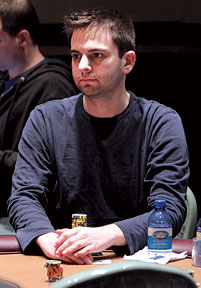
After Seiver graduated, he began to collaborate with Haxton, whom he knew as a fellow member of Alpha Epsilon Pi. (Not surprisingly, Seiver's parents at first opposed his decision to turn pro.) The pair joined three other players—two of them from Brown—and rented a house outside Las Vegas to enter the 2007 World Series of Poker. Haxton used some of the money he had won in the Bahamas to help Seiver pay his way into the events. They played nonstop for six weeks. Every night they deconstructed their play that day. Of the two, Haxton did better, earning $96,768 for a seventh-place finish in the $1,000 buy-in No-Limit Hold-'Em event. They also watched Mike Graves win his bracelet.
Afterward, Haxton and Seiver returned to Providence, renting a house on Williams Street with their friend and fellow player Sam Edwards '08, a math concentrator. While Haxton and Edwards went back to school, Seiver played full-time on the Internet. "It takes a level of near-obsession to get anywhere near the top," Haxton says. "At some point you need to do nothing else for 100 hours a week."
Seiver maintained that pace for a year. Like an owl, he awoke at night and played into the morning. The three men created a poker office on the top floor of the house. It became a chaotic and collaborative laboratory, a Manhattan Project for online poker. "I had a desk," Haxton recalls, "and Sam had a desk, on two sides of the room. Scott stole the printer hutch from Sam's desk and put his laptop on it in the center of the room. His laptop was half off the edge of it. There was garbage everywhere. We were knee-deep in papers. There were half-empty bags of chips and dried fruit lying around everywhere."
Seiver's career had a rocky start. He lost nearly his entire $150,000 bankroll after four months. He went from playing some of the highest-limit online games to some of the lowest. With $6,000 left to his name, he climbed back up, seeking out the toughest player at each level. He would play that person head-on for marathon sessions until his opponent lost enough money to quit. From January to May, fewer than six months, sitting on the top floor of a rented house on Williams Street, Seiver rose to the highest levels of online poker, higher than he'd ever been.
Then, a month later, he transferred his momentum from computer to casino. Nearly two weeks into the 2008 WSOP, Seiver and Okun found themselves sitting across from each other at a table as they competed in one of the events. They knew that only two tables—eighteen players—were left. With midnight approaching in the Rio casino, the friends realized that they could soon be at the final table together. "I thought for sure we're going to be playing heads up," Okun recalls. "I thought, 'Why not?' That's how I had seen it in my dreams."
It didn't quite happen that way. Okun finished seventeenth. After getting knocked out, he walked over to Seiver and told him, "You better win this now that I'm out of the way."
When the final nine players reconvened the next day, Seiver sat with about half of all the chips in play. He says he wasn't nervous—not with the cameras rolling and not even when only one other player sat between him and a WSOP win. He stayed calm even when, as is the custom with televised matches, bricks of one-hundred-dollar bills were dumped onto the table to form a mountain of cash. At age twenty-three, he knocked out the other player and won his diamond bracelet. He had achieved what most professional card players spend a lifetime chasing. "It didn't hit me for a while," he says. "I was definitely somewhat dazed." He wore the bracelet to the casino the next day.
Back home on Long Island for Thanksgiving last year, Seiver took on a high-stakes Finnish opponent known for his hyperaggressive play. Seiver and Haxton spend most of their time playing such pricey heads-up No-Limit Hold-'Em games. At the time, they were pooling their money with other successful young players so each could take advantage of the highest-stakes games—the nosebleed games—without risking all of their own bankrolls.
Seiver's game against the player from Finland was one of the few that turned out well. It lasted two-and-a-half hours. Seiver played on a computer in the room where he'd grown up. By the time the game ended, Seiver had won $800,000. "At this point," Haxton says, "there are not that many people that will play me or Scott."
The poker life—most of it is spent indoors, staring at a computer screen—is not for everyone. There is no shortage of stories about misfits addicted to online play flunking out of school, losing all their money. Poker looks easy, but the best players will tell you that looks are deceiving. Over the long term the skill of the best players will save them, but many players go broke before they get there. In the short term, no matter how skilled a player may be, the luck of the cards can never be eliminated. Bad streaks happen. Seiver and Haxton, for example, have won millions, but they have lost millions as well. They recently played in the biggest cash game ever assembled online: the cost of entering was several hundred thousand dollars. Haxton's luck turned bad, and he lost almost $2 million dollars. Weeks later at the 2009 WSOP, he won nearly $1.3 million.
One of the questions the Blue Room veterans ask themselves is: Why Brown? Even they are astonished at how a small collection of players could so quickly produce such outsized success.
In part, the time was right. When poker reached its burst of televised popularity in 2003, many young and successful players who stormed the scene were from Ivies. Most of these players had the money to play with and the ambition and brains to master the game quickly. Thanks to the Internet, the playing experience earlier generations of players took years to collect in casinos and smoky back rooms now takes only weeks online. The Blue Room Game became the meeting place—the classroom, really—where the lessons of all that experience could be shared and analyzed. "A group to learn with is so huge in poker," Haxton says. "The coincidence of people with natural ability like me, Scott, and Jared learning together—that is why you see a cluster of good players coming up."
To this day, poker remains fun for these players, even though it's a business for them now. The popularity of No-Limit Texas Hold-'Em has slowed in recent years. Tournament enrollment is down, and the thrill of online poker has faded for many players. Although Okun, Seiver, and Haxton don't know how long they'll be playing poker professionally, they have no intention of giving up the competition anytime soon.
After failing to make it to the final table at the Foxwoods tournament this April, Okun waxed nostalgic about his early playing days at Brown. He said he misses the Blue Room Game, with its innocence and lighthearted tone. He misses playing in an environment where everyone supports and pushes one another. He has told Seiver he wants to revive that atmosphere in a regular game in Las Vegas, enlisting other young, successful players. If it works out, he says, it'll be a testament to the Blue Room Game's astounding and enduring impact.
"I totally miss it," Okun says wistfully. "I would love to have the Blue Room Game again."
Ryan Goldberg is a freelance writer in New York City.