
Danah boyd ’00 is an ethnographer of teens. For three to four months every other year, she leaves her office at Microsoft Research in Cambridge, Massachusetts, and heads out to another town or city. She asks parents, teachers, and community leaders to help her identify youths who might make for good interviews. During one-on-one, ninety-minute conversations at malls, convenience stores, fast-food restaurants, sporting events, church services, and wherever else the kids hang out, she asks each of them how they use such social media sites as Facebook, Twitter, or Tumblr. She wants to know about their experiences with cyberbullying, Internet pornography, sex predators, and sexting. “I kind of joke,” she says, “that the topics I choose are what’s giving everyone a heart attack at the moment.”
Boyd is the country’s go-to expert on teenagers, social media, and the web. In 2010, Fortune named her one of the “smartest people in tech.” Companies such as Yahoo! and Google have sought her advice. She IMs with Facebook founder Mark Zuckerberg. In addition to her job as a senior researcher at Microsoft Research, she’s an assistant professor at New York University and a fellow at the Berkman Center for Internet and Society at Harvard. At a time when many of us feel overwhelmed by the onslaught of information and terrified by what our children might encounter on the Internet, she has emerged as a source of calming wisdom and insight, a guru for our tech-crazed times, a prophet of the Internet age. And here is what she wants to tell parents: relax. The Internet is not nearly the revolutionary technology we believe it to be. Yes, it is changing teenagers’ lives, but not as much as we fear. The Internet can’t change what it’s fundamentally like to be a teenager navigating a course between childhood and adulthood. Kids are still going to be kids, with all the joys, setbacks, growing pains, social awkwardness, and triumphs that accompany adolescence. “What I want to do is help parents see the world from their child’s perspective,” she says. “I’m like, ‘Calm down, because I’m trying to help you understand your kids.’”
You might think of boyd—more about the lowercase spelling of her name later—as a kind of translator between today’s tech-savvy teens and the befuddled rest of us. In scholarly journals, she reaches academics by using the jargon of ethnography and media studies to decode adolescent web-speak. In the countless press interviews she does, she provides parents with the context they need to better understand their kids’ online activity. She has become one of the most visible experts on the societal impact of Web 2.0, a kind of Dr. Spock for our digital age.
Boyd’s overarching point is that the Internet hasn’t changed teen behavior so much as made it much more public. The Internet magnifies the difficulties of teenagers, she says, by “making visible many of the issues we hoped would disappear.” In her opinion, cyberbullying, for instance, is not new. It’s the same kind of bullying that happens in the playground. What is new is that the bullying now takes place in a public digital space where everyone can see.
Even sexting, the practice of texting sexually suggestive photos, is nothing new, she says. “In going through a box of Polaroids that I took in high school,” she told a gathering of tech experts in New York City last year, “I stumbled across a series of photos that I took after having acquired a copy of Our Bodies, Ourselves. Taking a picture seemed like a much more reasonable way of figuring out what was ‘down there’ than trying to get a mirror angled right.” If anything, she added, the hue and cry over sexting may tell us more about parental hypocrisy than it does about the depravity of today’s kids. “Teen sexting is a very rational act with very irrational consequences,” she said. “Teens are absolutely flabbergasted to learn that it’s legal for them to have sex but not to take naked pictures of themselves.”
Boyd has also probed trends in social media. In 2009, when Myspace was on the decline and Facebook was becoming more popular, she posted a blog entry on the trend. (She later turned it into an academic paper.) She argued that the teens ditching Myspace tended to be affluent white kids who perceived Myspace as becoming too black. One teen told boyd that the pictures users posted of themselves and the music they uploaded suggested that Myspace is “more like ghetto or whatever.” Boyd described the exodus from Myspace as a cyber version of white flight. Boyd was criticized for her analysis and for what she later recognized as legitimate questioning of her data. But her critics still missed the larger point: the Internet doesn’t change kids nearly as much as we think. It merely gives them a new outlet for expressing the social, economic, and cultural differences they bring to their computers in the first place, the kind of tensions that surface every day in school cafeterias across the country. “The Internet isn’t positive or negative,” boyd says. “It just is.”
When I first met with boyd last spring, she sat gobbling down a container of egg salad on a couch in a conference room at Microsoft Research’s Cambridge headquarters. She’d missed breakfast that morning. Her legs were crossed beneath her. A wraparound window afforded views of the Charles River.
Boyd’s name first changed when her mother got remarried and the family took the name Beard. Her mother later divorced and, at age 22, she decided she wanted to use her maternal grandfather’s name, Boyd. But she also took the extra step of legally changing it to all lowercase letters—danah boyd. When she was born, her mother had added an ‘h’ to her daughter’s first name to achieve a certain typographical balance; she wanted an equal number of letters before and after the ‘n.’ Boyd says lowercasing the letters in her name honors her mother’s desire for balance. No letter stands out among the rest. It also has the advantage of fitting in nicely with the punctuation used for Internet chatter, where nobody has the time to hit the Shift key.
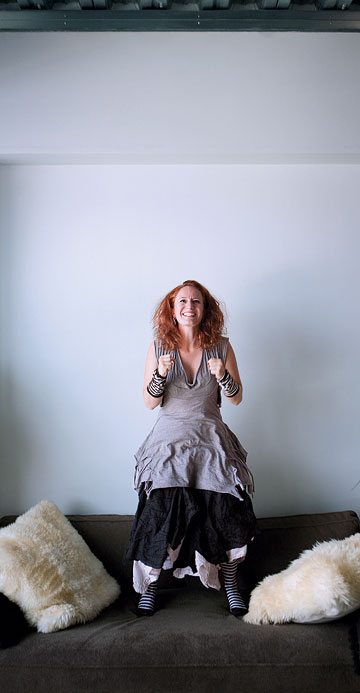
Her wardrobe has also varied over the years. As a teen, she wore pajamas and slippers to school, usually carrying around a box of cereal and a two-liter bottle of soda. At Brown, she became “obsessed with fuzzy things,” she says. Her trademark became red, black, white, and gray fuzzy winter hats that she wore with fuzzy arm warmers. Over the years, she has dyed her hair a variety of colors and pierced different parts of her body. During my meeting with her, her hair was light red. She wore a white dress over brown corduroy pants, a wispy scarf, and stylish brown boots. When she spoke, you could just make out a piercing at the back of her tongue.
Even boyd’s sexuality is fluid. “I very much identify as a woman, but a lot of my partners over the years have not identified clearly as male or female,” she says. She prefers being called queer rather than gay. Queer, she says, adds an extra political dimension. So it’s no wonder that boyd, as she says, “loves hanging out with teens.” Like her, they are in the perpetual act of becoming, of making and remaking themselves. And like her, they use social media as a means to do this. A member of the first generation of Americans to grow up with social media, she understands how adolescents struggle as they move awkwardly between cyberspace and the real world. She recognizes the contortions they’re put through trying to maintain privacy when they’re expected to tweet about what they had for breakfast that morning and to constantly update Foursquare with their whereabouts.
Boyd grew up in Manheim Township in southeastern Pennsylvania, a one-time farming community now dotted with suburban housing tracts and shopping centers. Religion in Manheim Township was very important. It wasn’t long before boyd began rebelling against the town’s social strictures. In fourth grade, she staged a one-girl protest against teachers, carrying around a sign that said they couldn’t teach. “I am very loud,” boyd says. Her mother still calls her abrasive. “I would swear and yell, and she’s very polite and proper,” boyd says. After her fourth-grade protest, she was promptly placed in a class for deaf students, where, it was presumed, she would have less motivation to talk. The first computer in the house belonged to boyd’s younger brother, Ryan, who had problems with hand-eye coordination. His doctor thought that playing video games might help. He soon progressed from gamer to programmer, and by the time boyd and her brother were in high school— these were the days of dial-up modems—they were racking up hundreds of dollars in monthly phone bills for all the time they were spending online.
Usenet became boyd’s means of escape. There wasn’t much in the way of sex education in Manheim Township’s schools, so boyd, who was beginning to come to terms with her sexual orientation, befriended a transgendered woman online who was willing to answer all her questions. Because it was a cyberspace relationship, boyd never felt a need to ask the woman her name or where she lived. To this day, she doesn’t know. From the start, then, boyd found that online relationships could be as rewarding as face-to-face ones.
Boyd excelled academically at her high school and got into Brown early. Shortly after she arrived, she went to the office of her adviser, computer science professor Andy van Dam. “Who the hell are you, and what are you doing in my office?” she recalls him saying when she appeared in the doorway. Boyd knew they would become close. “I thought, ‘Oh, you’re yelling at me. I understand that,’” she says. “I got yelled at a lot.”
Van Dam also says he knew they would hit it off. “From the beginning, I could see she was bright and lively and interesting,” he says. “She seemed like a fun person and someone worth investing in.” She chose to major in computer science and went on to work as one of van Dam’s teaching and research assistants. The Dutch-born van Dam took it upon himself to teach his protégé about the finer things in life. “He wanted to turn me into a lady,” says boyd. He introduced her to wine and fine food and told her to stop cursing so much. He says he was merely offering her some strategic advice about how to win friends and influence people. “I sort of reined her in a bit,” he says. “I said sometimes it’s better not to be quite so extravagantly in people’s faces.”
At the time, the computer science department was heavily male-dominated. Van Dam says that among a few of the department’s students and faculty, there prevailed an “adolescent white geek male culture.” The outspoken boyd, one of the few women in the department, quickly drew resentment. Someone hacked into her account, and dozens of e-mails to her mother found their way online. She says a friend of hers in the department received a phone call one night in which the unidentified caller threatened to rape the friend. They were both “pretty savagely attacked,” van Dam recalls.
Boyd fought back. She demanded meetings to discuss what was going on. She posted online comments about what was happening to her, and, when someone in the department suggested they shut down the server entirely, she objected. “I was like, ‘No, it will just pop up somewhere else,’” boyd explains. Van Dam says boyd got the department to confront its “dark side.” “We thought the department was inclusive and inviting,” he says. “Danah made us realize we were drinking our Kool-Aid too much.”
In November 2009, boyd traveled to New York City to deliver what she expected to be a major address at the Web 2.0 Expo, one of the year’s most important gatherings of Internet professionals. Her topic was what she terms “living in the stream,” or how not to drown in the flood of information that comes at us all the time. Teens, she believes, are especially good at this. The most web-savvy of them manage to stay open to all the digital stuff without having to process everything. They take what they can handle and remain untroubled that much may elude their grasp. It’s a kind of cyber-Zen.
“The goal is . . . to be peripherally aware of information as it flows by, grabbing it at the right moment, when it is most relevant and valuable, entertaining or insightful,” she said at the Expo. “It is about a sense of alignment, of being aligned with information.” She talked about the high some Twitter users get “feeling as though they are living and breathing with the world around them, peripherally aware and in tune, adding content to the stream and grabbing it when appropriate.”
Boyd had expected the podium to be slanted so she could prop up her laptop and glance at her crib notes. Instead, the podium was flat and the event’s organizers told her she couldn’t bring her computer. She wound up with her head bent, reading from her printed notes. “The more nervous I got, the more I looked at those notes,” boyd says. “This spiraled out of control.” There was also a spotlight aimed right at her face. She couldn’t see the audience. As her anxiety rose, she began talking faster and faster. Already a fast talker, she pushed her pace to warp speed. To allow discussion of her speech in real time, the event’s organizers had placed a screen on stage that displayed the Twitter messages audience members posted as she talked. Unfortunately, the comments weren’t aimed at what she was saying, but at how she was saying it. “Not saying danah’s not smart, I just think she’s not from Earth,” went one Tweet. “Wow this is the longest sentence, someone clap and allow her to breathe,” went another. The audience started to laugh. Boyd, who faced the audience in front of the screen, had no idea what everyone found so funny. Boyd later described herself as “devastated.” Two days later, a video of her talk was posted on YouTube. It soon got more than 2,000 hits.
There was no question about how boyd would respond to her humiliation. Much as she did at Brown when she was attacked, she confronted this latest episode head-on, publicly, and through the medium of the web. She blogged about it. In response to the laughter during her talk, she wrote, “I retreated into myself .… I was reading aloud while thinking all sorts of terrible thoughts about myself and my failures.… I hated the audience. I hated myself.” Her readers may not have known this, but she used to vomit before she gave public lectures. She doesn’t do that anymore, but, she blogged, she “still can’t eat…and I visit the bathroom a bazillion times.”
Maybe in the pre-Internet days, boyd would have sought solace with friends and relatives or written a lengthy entry in her diary. But boyd says those who immerse themselves in the world of social media become in effect mini-celebrities, with intimate details of their lives exposed to anyone around the globe who finds them interesting enough to follow. Our private lives are now much more public. In the past, our social interactions were “private by default, public by effort,” boyd says. Now, they are “public by default, private by effort.”
This winter boyd took on yet another project, this time for Lady Gaga. In January, the pop diva announced she was creating the Born This Way Foundation to promote youth empowerment, reduce bullying, and find new ways to reach and support teens. The MacArthur Foundation and the California Endowment, a nonprofit health organization, have signed on as Lady Gaga partners. Boyd will codirect the Foundation’s research wing, setting priorities for the organization and deciding where to allocate resources. She sees her new position—part of which is devising ways to reach schools and teachers—as the logical next step in her work with teens.
Shortly before her Gaga gig was announced, though, boyd took a three-week vacation to Easter Island and Patagonia. On her blog she announced she was on “e-mail sabbatical.” Not only wasn’t she responding to digital messages while she was away, she was going to delete them unread when she returned. “What this means,” she wrote, “is that my INBOX will not be receiving any e-mail. None. Zilch. All headed off to /dev/null for a cruel digital death.” She was saying “good-bye to e-mail and, more importantly, not letting myself anxiously worry about all that’s waiting for me when I return.” Even danah boyd sometimes needs to sign out.
Lawrence Goodman is the BAM senior editor.