
“There are two things you are not allowed to do,” her mother said.

Deborah Heiligman ’80 was sitting in her dorm room, talking on the phone with her parents in Pennsylvania. She had just told them she was planning to concentrate in religious studies.
“You are not allowed to be a rabbi,” her mother continued. “And you are not allowed to marry a rabbi.” So Heiligman did what any self-respecting Brown student in this situation would do: she decided to be a rabbi.
Truthfully, she didn’t really want to be a rabbi. She wanted to be a writer. But she did find herself increasingly preoccupied with religion, a preoccupation that would become most apparent three decades later with the 2009 publication of the biography Charles and Emma: The Darwins’ Leap of Faith, the book that cemented Heiligman’s place as one of her generation’s best authors of books for young people. Charles and Emma is one of those books whose subject matter is so suited to its author that there’s really no one else who could have written it. Heiligman draws from the Darwins’ letters and papers to tell, in novelistic style, the true story of the long and happy relationship between the scientist who seemed to take God out of evolution and his deeply religious wife.
In August, Heiligman returned to the subject of religion in her first novel for young adults. Intentions is a coming-of-age story narrated by sixteen-year old Rachel Greenberg; the book chronicles Rachel’s crisis of faith and of self, sparked by an unnerving experience at her family’s synagogue. Although Judaism is front and center in Intentions—the book draws its title from the rabbi’s instructions to pray with kavanah, or intention—the particular details of the religion itself are secondary. At the heart of the book are questions that all teenagers grapple with. Intentions, says Judy Blundell, a close friend of Heiligman and a National Book Award–winning young adult author, is about “a basic part of adolescence, which is, finding out that something you totally believed in is a lot more complicated than you ever thought.”
Heiligman’s lifelong preoccupation with religion began at Brown with just such an experience. After reading Peyote Hunt: The Sacred Journey of the Huichol Indians for a religious studies course, she found herself obsessed with the book, and as she dug deeper into the Huichol and their religious rituals and beliefs, she says a light bulb went off: You, little Jewish girl from Allentown, Pennsylvania? Your religion is not the only religion. You’re not the chosen people. As unnerving as it was, the realization, she says, was a relief: There is no one right way.
She began to ask more questions. “Why is it that we think there is one right way?” she asked herself. “And what does that do to us as a people? And do to religions? And what has that done to the world?” Twenty-eight books later, Heiligman is still circling these questions. Her books, written for kids as young as two and as old as eighteen, have been her way of searching for their answers.
Heiligman’s first job after graduating from Brown was at the Jewish magazine Moment. There she met Jonathan Weiner, the writer who had held her job before her. The two fell in love and married. Weiner then went on to write such acclaimed science books as the Pulitzer Prize winner The Beak of the Finch, his 1994 account of scientists who study evolution on the Galapagos Islands.
Heiligman often tells audiences of students that, when she and Weiner met, “I looked at the world kind of through the lens of somebody thinking about religion. And he looked at the world through the lens of somebody thinking about science. Does this sound at all familiar to you?”
It would be easy to say that Charles and Emma was inspired by Heiligman and Weiner’s own marriage of science and religion, but Heiligman says the explanation is bit more subtle. It was only after Charles and Emma had been published to critical acclaim, nominated for a National Book Award, and awarded the Young Adult Library Services Association’s Printz Honor for Excellence in Young Adult Literature that Heiligman says she realized what the book was really about. “In this case it hit me hard, my one liner for Charles and Emma,” she told the audience at the Printz Awards ceremony: “It really matters who you marry.” (By “marry,” she was quick to point out, “I mean choose to spend your life with, whether it’s recognized by the government or not.”)
She went on: “Who you marry influences everything—especially how and if you grow into the person you were meant to be. If Charles had not married Emma and settled in the country surrounded by a houseful of boisterous children running in and out of his study; if he had not suffered, with Emma, deaths of three of those children; if he had not had in Emma a challenging AND devoted partner, what would he have become? Marrying Emma was the most important decision he made. It shaped the man, the scientist, and the writer he became. His marriage to Emma changed history.”
Heiligman went on to tell the Printz audience about a yarn she used to spin in her head as a kid when she lay awake nights, unable to sleep. It was an ongoing saga, a love story, in which the main character—a stand-in for Heiligman herself—was a poet. “And the boy is—you can guess this, right?” She paused. “No, not a science writer. A prince!” She threw up her hands as the audience laughed. “As cheesy as it sounds, the story was a reflection of the big questions that teenagers ask themselves and I was asking myself over and over again: Who am I? What do I believe? How much do I have to compromise? Do I have to compromise at all? What is the meaning of life? What is the meaning of my life? What is my place in the world?”
These are precisely the questions that drive Rachel Greenberg, the teenage girl who narrates Intentions. Set in a small Pennsylvania city resembling the Allentown where Heiligman grew up, Intentions opens with Rachel’s parents fighting, which they have been doing often. “I am so out of here!” Rachel announces as she takes off early for her weekly religious studies class.
But when she arrives, she witnesses her rabbi, on the bima, doing something very un-rabbi-like. As she comes to terms with what she saw, Rachel must navigate two competing love interests, each intriguing in his own way: Jake, a sweet, smart, but somewhat nerdy, boy-next-door type, and Adam, the rabbi’s son, who is edgy, brooding, and mercurial. Alexis, meanwhile, who until recently was Rachel’s best friend, has lately has been acting mean and distant. Deeply shaken by what she saw in the synagogue that day, Rachel doesn’t always approach this difficult situation maturely—despite her best intentions.
A typical teenager, Rachel experiments with smoking pot, takes tentative steps toward losing her virginity, and sends text messages constantly. She loves her parents and craves their approval but is also learning that some problems you must fix yourself—and some you simply cannot fix. Heiligman has an uncanny ability to get inside Rachel’s head, to capture exactly what a sixteen-year-old might think or do in a given situation. “Before,” Rachel says, early in the book, “I thought that most people were basically good, and I was sure that holy people were, well, holy. I just had the crap beat out of that stupid idea.”
Michelle Frey ’94, the executive editor at Knopf Books for Young Readers, edited Intentions. “Going from the black-and-white of childhood to the grey of adulthood is something Deborah looks at in a very authentic way,” she says. “I couldn’t believe a middle-aged woman had written this book.”
Heiligman’s own family was an unusual blend. In some ways she was an only child, born to her mother and father when they were forty and fifty, respectively. In a weird way, she says, she was also a youngest child and an oldest child. Her mother had two children from a previous marriage, and her half-sister and half-brother, who were fifteen and thirteen years older, had moved out by the time Heiligman entered grade school. Heiligman was only four when her sister, who lived nearby, married and five when she began having children. “I had these three little girls who I would baby-sit for and hang around with,” she says; Heiligman became their older sister. Much like Rachel in Intentions, the young Heiligman was also very close to her grandparents, and the family was involved in their local Reform synagogue.
Judaism, Heiligman says, “meant family to me, it meant friends, it meant community, it meant ritual that I enjoyed, songs that I enjoyed, food that I—mostly—enjoyed. Rachel is growing up in the kind of happy religious atmosphere that I grew up in. That is a direct lift from my childhood.”
Yet Heiligman says that she was aware even as a kid—and her experience at Brown crystallized this sense—that her family’s way of doing things was just one way in a universe of choices. “That was actually such a happy feeling, rather than the opposite, for me,” Heiligman says. “That we are all part of humanity—we can be different but in it together.”
This, she hopes, is the take-home message of many of her books—and a reason that writing for young people is particularly powerful. She cites Celebrate Ramadan and Eid al-Fitr, one of the ten books in her Holidays Around the World series, as an example. Illustrated with vibrant National Geographic photographs, the series, aimed at ages six and up, also includes books about Diwali, Independence Day, Thanksgiving, Halloween, Christmas, Easter, Passover, Rosh Hashana, and Yom Kippur. “So if you are a little kid, and you’re growing up in Iowa, and you pick up my book about Ramadan, and you don’t know a single Muslim in your community,” Heiligman says, “you see: ‘That’s a kid who looks a lot like me, and that kid is playing soccer, just like I play soccer. But he’s Muslim?’ Then that’s going to stick with you in a way that it might not when you’re an adult.”
More so than most other adults she knows, Heiligman is deeply in touch with her childhood. From the peanut butter-and-baloney sandwich that prompts the main character in her 1998 Mike Swan, Sink or Swim to conquer his fears to the “mean best friend” whom Rachel must confront in Intentions, Heiligman draws from childhood memories to shape her characters and the situations they face.
“Whenever I write a book,” she says, “I write it for me at the age that I would have wanted to read that book. When I write my little rhyming picture books about dogs, I write for the five- or six-year-old in me. When I was a young adult, up through college, that’s when I wanted to read the books that addressed the big questions: science, life, death, meaning.”
Heiligman never planned to write for children. When she and Weiner met, she was at Moment in Boston and Weiner worked at The Sciences in New York City. She wanted badly to move to New York to be with Weiner, so when a contact in the human resources department at Scholastic told her there was an opening at the fourth-grade magazine, Heiligman told herself, “I’ll just do this until I can find a real job writing.” But when she sat down to complete the trial assignment after her interview, she was shocked at how natural it felt to write for fourth graders—and how fun. “It was like I fell off a log,” she says. “It was that easy for me to write on a fourth grade level. I had more fun than I had any right to have applying for a job.”
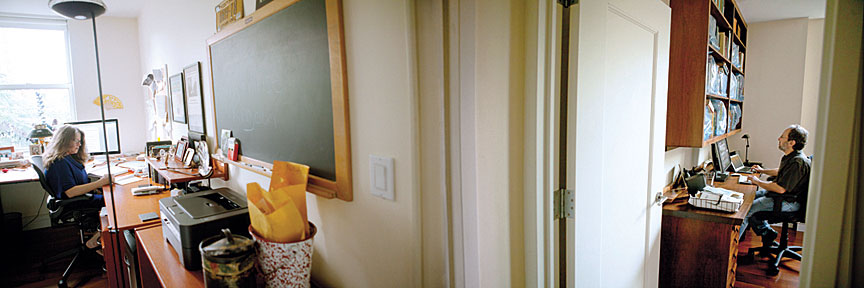
Just as Charles Darwin’s marriage to Emma changed the course of both his life and his career, the defining thread in Heiligman’s and Weiner’s lives and work is the decades-long love story that is their marriage and their family. They are extraordinarily close to their sons, who are now in their twenties; the four of them vacation together and collaborate on various projects. The family still has Sunday night dinner together along with other family and friends. (The couple’s younger son, Benjamin, says that even when he was studying abroad his parents still invited his friends over to dinner.) Thirty years on, Heiligman and Weiner are still each other’s first reader and most supportive critic. They dote on each other, play practical jokes on each other, and talk late into the night about the Big Questions.
Heiligman stands only five feet four inches tall, but her presence is large. She is known to whoop and scream in public. (“This is Deborah,” her son Benjamin once introduced her while the family was playing a game of one-liners. “She screams. Casually.”) Heiligman laughs at herself freely and loudly. She talks to strangers, listens intently, and asks probing questions. “In conversation, you really can’t get away with fuzzy thinking with her,” says her friend Judy Blundell. “She’s so curious about everything. I’ll say something, and she’ll say, ‘Why do you say that?’ and then you have to circle back and look at your own information and motivations.”
These days, Heiligman says, religion both attracts and repels her. “I waver between being an agnostic and an atheist. And yet, I wish I didn’t. I wish I believed.” Her desire to believe is undercut by the horrors religious people can perpetrate in the name of religion.
Heiligman began writing Intentions in the late 1990s, when the Clinton-Lewinsky sex scandal was emerging. Her kids were about ten and thirteen. Suddenly, she discovered, “I had to explain to my children how grown-ups do bad things.” She worked on the book for a while, then put it away. “Every time I started working on it again, there would be another scandal like this in the news,” she says. In 2002, a New Jersey rabbi was convicted of killing his wife. Then the Catholic sex abuse scandal broke. It seemed so appropriate that the emerging novel was “about that moment when kids go, ‘Whoa. Grown-ups are, like, messed up.’”
One day this winter, on a visit to Hunter College Elementary School, Heiligman was fielding questions from students. “How do you face writer’s block?” one boy asked.
“I don’t think that I actually have writer’s block,” she began. In fact, she told him, she has the opposite. “I’m writing two books right now. Which kind of means I’m writing zero books. And I’m finishing another book,” she said. The one she is finishing, The Boy Who Loved Math, due out next year, is a whimsical picture book about the eccentric and brilliant mathematician Paul Erdös. Also published next year will be Snow Dog, Go Dog, the third in her series of rhyming picture books about a mischievous dog named Tinka.
One of the books Heiligman is writing now is another young adult novel tentatively entitled Spirits. Set in Rhode Island, Spirits was inspired by an experience Heiligman had shortly after her mother passed away. Her father, along with a caretaker named Mary, was still living in the house where Heiligman grew up. One day, Mary’s grandson—like Heiligman at the time, he was in his thirties—emerged from the basement and asked, “What’s that woman doing downstairs?” What woman? his grandmother wanted to know. “There’s a white woman in a white dress,” he replied. But when they went downstairs, there was nobody there. Spirits, Heiligman says, is a love story that crosses the boundaries of time and space, life and death.
Heiligman is also working on another nonfiction book for teenage readers, this one about the relationship between Vincent van Gogh and his brother, Theo. “Just as I believe Charles Darwin wouldn’t have been Charles Darwin without Emma,” Heiligman says, “Vincent would not have been Vincent without Theo.” Heiligman splits her time between the two books, working one day on Spirits and the next on Vincent and Theo. “If it’s Tuesday,” she posted on Facebook recently, “it must be Vincent.”
But one of the aspects of van Gogh’s personality that keeps Heiligman engaged is that “he is so teenage.” Wading through the artist’s voluminous correspondence, she is struck by how even when “he’s thirty-something, he feels like a teenager: ‘I want to do the thing that I can do best in the world.’ He’s a very all-or-nothing kind of person, very emotional. Which I relate to. ‘Things are terrible! Things are wonderful!’ So it just immediately puts me in touch with that part of myself that is still a teenager inside.”
Back at the Hunter elementary school, two dozen third graders sit on the floor in the library. Books are all around them: packed into shelves, lined up in baskets, propped on tabletops, and piled onto desks. The children have been sitting cross-legged, their faces tilted up towards Heiligman, but now that she has asked them for questions they are climbing up on their knees, waving their hands wildly in the air, and grunting with excitement. Heiligman nods at Sophie, a girl in a red shirt whose brown braid is held in place with a matching red rubber band.
“Um,” Sophie begins. “How do you know you’re a writer?”
Heiligman smiles and points a finger at Sophie. “You mean how do you know you’re a writer?”
Sophie nods, beaming. “Yeah.”
“I think,” Heiligman begins, slowly, “that if you love to write, and it gives you pleasure and joy, you’re a writer. Now that I’ve said that, most writers I know hate to write, and it gives them grief and agony. So.” She pauses again to reconsider. “I think, if you asked me that question…” She puts her hands on her knees and leans over so her forehead is just inches from Sophie’s. “…You’re a writer. That’s what I think. And I think if you’re a reader, and you love to read—”
“That’s me!” Sophie interrupts.
Heiligman smiles. “—you may grow up to be a writer.”
Beth Schwartzapfel is a contributing editor.