
Bill O'Brien ’92 may have the worst timing of any college football coach. Ever.
When he was first approached to interview for Penn State’s head football job, he was distracted by helping prepare the New England Patriots for the Super Bowl. Then, less than six months after O’Brien succeeded Joe Paterno ’50 as the Nittany Lions head coach, the NCAA responded to the Sandusky pedophile scandal by handing the school the severest sanctions the organization had issued in twenty-five years. These included a four-year postseason ban, which, O’Brien knew, would make retaining his best players difficult and recruiting new players a daunting task. When asked whether, while considering the job, he’d understood the NCAA might deal the team such a major blow, O’Brien says, “I knew that it was out there, but to the extent that it came down, no, I had no idea it would be like this.”
It's possible that Bill O'Brien could have packed up his bags and fled State College for another job coaching in the NFL. But that would be inconsistent both with O'Brien's character and with the lessons he has learned in a football career that started at Brown and, before the Penn State job, flourished as offensive coordinator for Patriots head coach Bill Belichick, from whom o"Brien has absorbed important lessons: "He's got a great ability of boiling things down: 'These are the five or six things that we have to do to beat this opponent,'" O'Brien says of Belichick. "And he's not a guy who just stands up there and gives speeches. He shows them examples of it on tape. There's an introduction to the meeting, and then it's right to film. Here are the five things you have to do to win this game, and if you only do four of them you're not going to win."
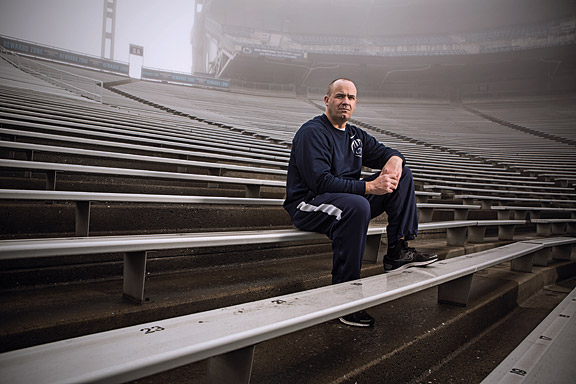
Boiling things down to their essence and keeping players focused on that is precisely the lesson O’Brien has applied during his disheartening first months at Penn State. Having watched Belichick keep players focused on football, no matter the distractions or controversies swirling around them, O’Brien is trying to do the same thing with his Nittany Lions. Except that he also acknowledges that at Penn State some things are even more important than football.
“We need to continue to do things the right way,” he says. “We’ve got to contribute to the community. We’ve got to do a great job showing that we care about children. We’re going to reach out to different child-abuse organizations, like PCAR, Pennsylvania Coalition Against Rape. On the field, we’re still going to try to field the best team possible and try to win every game that we play. Hopefully, in three or four years, people will have a good feeling about Penn State football because of all the good things that have gone on both on the field and off.”
In addition, O’Brien emphasizes that in the end most of his players are not at Penn State exclusively to play football. “This will be a place,” he says, “where they play really competitive football, but they also learn values and appreciate the importance of a great education to their lives. Those values will never be sacrificed just to win.”
The importance of a great education has never been lost on O’Brien. He believes that his four years at Brown laid the foundation of his future success as an assistant coach in both college and the NFL. In fact, O’Brien goes so far as to describe Brown as a “coaching cradle.”
That may sound like crazy talk to many middle-aged alums whose primary memories of Brown football are the team’s fourteen-game losing streak in the late 1980s or the imperfect 0–9 season in 1971. But then O’Brien rattles off a list of Brown alums who have achieved notable coaching success. There’s Ron Brown ’79, who is the running backs coach at the University of Nebraska. O’Brien’s former teammate Brad Sidwell ’92 is head football coach and athletic director at Franklin (Mass.) High School, where he earned the Boston Herald’s “Coach of the Year” honor in 2009. Mark Whipple ’79 was the starting quarterback on two Bears teams and later returned to Brown as head coach, compiling a 23–16 record from 1994 to 1997 before joining the NFL coaching ranks. Whipple is now quarterbacks coach with the Cleveland Browns.
“For an Ivy League university, that’s a lot of coaches,” O’Brien says. “I think the bigger point is that Brown attracts so many different types of people that it helps prepare you for your next step in life. Whatever career you’re going to go into, you’ve already had to open up your mind.”
Raised in Andover, Massachusetts, O’Brien grew up in a Brown family. His parents are John O’Brien ’55 and Anne Murphy O’Brien ’55. “My dad still says he was the best Brown football player in the family, and he’s probably right,” O’Brien says. Oldest brother John Jr. graduated from Brown in 1982, and middle brother Tom, another football player, was class of ’85.
O’Brien is less complimentary when talking about his own playing career. “We weren’t very good,” he says. “I was always a team guy, and I was disappointed we didn’t win more games.” O’Brien played outside linebacker as a junior and defensive end his senior year. “I wasn’t terribly athletic,” he says. “But I was tough and didn’t miss a lot of practices—your typical grinder.”
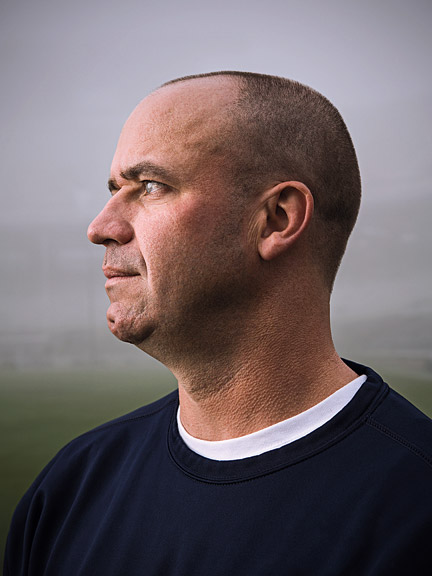
Intensity is the polite way to describe O’Brien’s former on-the-field demeanor. Bill Hamilton ’92, one of O’Brien’s Brown teammates and fraternity brothers, says O’Brien would expend so much energy screaming at opponents and urging on teammates—often in the saltiest language imaginable—that his voice was usually reduced to a scraggly rasp by the fourth quarter. Asked about this, O’Brien laughs. “I’ve calmed down a lot since then,” he says.
Maybe, maybe not. Until he was hired by Penn State, the casual sports fan probably knew O’Brien best for the fiery sideline argument he had with Patriots star quarterback Tom Brady last December, following a late-game interception Brady threw against the Washington Redskins. The Patriots were on the Redskins four-yard line at the time and needed only a field goal to put the game out of reach. After the interception, a CBS camera caught O’Brien screaming at Brady. Eventually the coach and quarterback had to be separated by Patriots head coach Bill Belichick and several players.
Hamilton, who was watching the game live, wasn’t nearly as stunned by O’Brien’s outburst as most viewers. “Seeing him yelling at Brady was like a flashback,” Hamilton says. “I remember him doing the same thing all the time during halftimes of Brown games whenever we were getting beat—which was most of the time.”
O’Brien says that he and Brady are actually good friends and that the only unusual thing about the argument was that it was caught on camera. “Really, it was no big deal—other than my mom being mad at me because she could tell I used some bad words,” he says. “I grew up in a house full of brothers, and it was nothing more than two brothers going at it. What the cameras didn’t show was two minutes later when Tom and I were sitting next to each other on the bench preparing for what could have been overtime.” The Patriots wound up winning the game, 34–27, after the their defense snuffed out a potentially game-tying drive.
O’Brien says he knew he wanted to be a football coach since his playing days. He jumped at the opportunity when in 1993 Kwiatkowski offered him an entry-level position on his coaching staff. Whipple, who took over the following year after Kwiatkowski was fired, says he was glad he kept O’Brien on staff. “Billy is smart and he’s a hard worker,” Whipple says. “He’s also not afraid to voice his opinion, which is important in this business.”
O’Brien parlayed his coaching apprenticeship at Brown into more senior coaching gigs at Georgia Tech, Duke, and the University of Maryland. O’Brien was Georgia Tech’s offensive coordinator in 2001, when the Yellowjackets averaged thirty-one points a game and were 9–4 for the season. But his stint in Atlanta was even more important off the field. When O’Brien celebrated a victory at a local sports bar with fellow coach Doug Marrone, Marrone introduced him to his girlfriend’s college roommate, Colleen Corran. Bill and Colleen immediately hit it off and were married in 1998.
The couple has two children, Jack, 10, and Michael, 7. Jack is a special-needs child who was born with a brain malformation called lissencephaly. “He’s dependent on Colleen and myself—mostly Colleen—for everything. In the off-season, I try to help out as much as I can, but during the season, it’s really all her. He can’t talk, he can’t walk, we have to feed him and bathe him. But he’s a great little boy with a great demeanor. He communicates to us by nodding yes or no, and he can choose things by pointing them out.”
Asked how Jack’s disability has affected his own outlook, O’Brien tries not to get too philosophical. “Everybody’s got problems, and obviously we’re not the only parents with the challenge of having a special-needs kid. But as it relates to being a football coach, I think my perspective probably is a little different because of Jack. I’m going to do the best I can for these kids and this university, but at the end of the day there are a lot more important things out there than just winning football games.”
O'Brien joined the Patriots staff as an offensive assistant in 2007. He took over play-calling duties in 2009 following the departure of offensive coordinator Josh McDaniels to the Denver Broncos. O’Brien was named offensive coordinator in 2011. He compares working for Belichick to “getting a PhD in football.” Much of what he’s doing coaching players and managing assistant coaches at Penn State he says he learned from Belichick. “As an assistant,” O’Brien says, “he gives you the parameters, but he lets you be creative and coach.”
Belichick rarely has anything interesting to say to the reporters who cover the Patriots, but O’Brien says that behind closed doors, Belichick is actually a master motivator with his players. “He’s a great guy with a very good sense of humor,” O’Brien says. “To me, he’s really a player’s coach because he tells them the truth. He’s not a sugarcoat-it guy. When he talks to them about football, it’s with a purpose. They’ll run through a wall for him because he’s all about trying to make them better.”
During his pre-game press conferences, Belichick is famous for talking up the talents of even the lowliest of opponents. This, says O’Brien, is no act. “Wednesday morning is the first team meeting when we’d talk about that week’s opponent. It didn’t matter who we were playing—every time, Brady and I would walk out of that meeting feeling like we were getting ready to play the 1985 Chicago Bears. But Belichick is right: he understands that there are so many great players in that league that you can’t just roll the ball out there and expect to win.”
O’Brien says he was first contacted by Penn State about the head coaching job in mid-December. The Patriots were on their way to their fifth Super Bowl appearance of the Belichick era. With little time to prepare, O’Brien would have to wing it during the Penn State interviews. “As you rise up through the ranks, you have your little black book of notes and potential coaching staffs, just in case,” he says. “But I wasn’t really looking for a new job. I loved working for the Patriots. I’m from Massachusetts. I could have seen myself staying there for a long time. But when this job came up, the first person I talked to about it was Bill. His reaction was, ‘Wow, that’s one of the top five college jobs. I don’t care what’s gone on there, you need to interview.’”
O’Brien had hoped to arrive in State College with a Super Bowl trophy in tow, but it was not to be. As content as O’Brien may be in his new job, it’s obvious that the Patriots’ 21–17 loss to the Giants in the Super Bowl still gnaws at him and always will. “That sting will stay with us the rest of our lives,” he says.
O'Brien flew back to Boston with the team the following day. On Tuesday he arrived in State College to begin his first job as a head coach. He immediately began recruiting players, while keeping an eye on the upcoming Jerry Sandusky trial. On June 22, Sandusky was convicted of forty-five charges related to the sexual abuse of ten boys. On July 23, the NCAA announced its sanctions, which ranged from a $60 million fine to scholarship restrictions and the four-year ban on postseason play. Penn State players were free to transfer to another school without penalty until the beginning of the academic year. By September, O'Brien had lost five players from the scandal: "sanctions transfers," he called them.
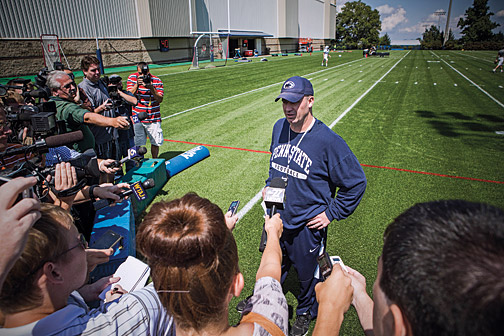
One of the coach’s responses to the sanctions was to throw open the doors to the Penn State football program, to remove as much secrecy as possible from what he was doing while protecting his players as much as he could from the media frenzy. Two days after the sanctions were announced, he sat down for a live chat on ESPN.com, taking questions from anyone who wanted to ask him anything. During the week leading up to the first game of the season, he gave a reporter from ESPN.com complete access to the football building to observe the team and coaches.
“We have been through a lot in the last two months,” O’Brien told his team the day before the home opener against Ohio. “Nobody begged you to stay. Nobody begged me to stay. You guys have conditioned and practiced your asses off and you do everything we’ve asked you to do. Keep understanding what’s important, so that when we get into that locker room after the game, we are celebrating a win. Is everybody on the same page?”
On the day of the game, O’Brien told the reporter that he knew the emotions would be unprecedented for the players and for the 100,000 fans at Beaver Stadium. But, he emphasized, in the end the event is a football game, nothing more. “It is not life or death,” he said. “I think about my son [Jack] a lot. I picture his face and what he’s doing right now. My wife and my other son [Michael], too. That definitely helps.… The players are nervous. The coaches have to be calm. We’re the adults.”
Months earlier, long before facing the pressure of his first Penn
State game day, O’Brien had been more philosophical. He was still
feeling his way through the Sandusky crisis, still trying to find just
the right focus. “As it relates to football,” he said, “the only thing
that matters is what goes on in this building, on these fields, and in
this stadium. As long as we have respect for each other and care about
each other, whatever anybody else says about our football program has
nothing to do with us. All we can control is how we play, how we lift
weights, how we go to class. I’m constantly telling our players to
ignore the noise and just focus on the task at hand. Do that, and
everything else will take care of itself.”
Jon Birger is a Contributor at Fortune magazine.