
If you drive into Baltimore from BWI airport, among the first sights you pass are the Orioles’ Camden Yards, the Convention Center, and the award-winning National Aquarium, a sail-like glass pyramid that seems to float on the water. Tourists stroll along Harborplace, snapping pictures of one another before the USS Constellation, the first U.S. naval vessel commissioned to intercept slave ships after the Emancipation Proclamation. A little further north you pass Mount Vernon Square, where the historic 1815 monument to George Washington stands watch over cobblestone streets, brownstones, art museums, and restaurants.
These economic and demographic shifts have radically changed the climate in Baltimore’s schools. According to Robert C. Embry Jr.—who heads the Abell Foundation, a major supporter of school reform in the state—the city’s schools are almost as racially segregated today as they were in 1954, when the Supreme Court in Brown vs. Board of Education declared separate schools for blacks and whites illegal.
“But unlike 1954, when the schools were segregated racially but not economically,” Embry says, “today they’re segregated racially and economically.” Of the 84,000 students in Baltimore’s schools, 88 percent are African American, and 84 percent are poor enough to qualify for free or reduced-price meals. With that poverty has come a culture of diminished expectations. “The children go to school with children who don’t assume they’re going to college,” Embry says, “who don’t assume they’re going to show up every day, and who don’t assume they’re going to do homework.”
Things weren’t always so bleak. In the 1960s, Baltimore boasted top-notch public high schools that regularly sent graduates on to college, graduate school, and professional and middle-class jobs. Many of those graduates became teachers in the same school system that produced them. By the 1980s, though, half of the city’s schools were threatened with state intervention, and by 2005 they were among the worst in the country. More than half of Baltimore’s students were dropping out, far too many to join gangs and the drug trade. The city’s 2011 violent-crime rate was 1,417 per 100,000 people—“in the top fifteen U.S. cities for all violent crimes but forcible rape,” Forbes reported that October.
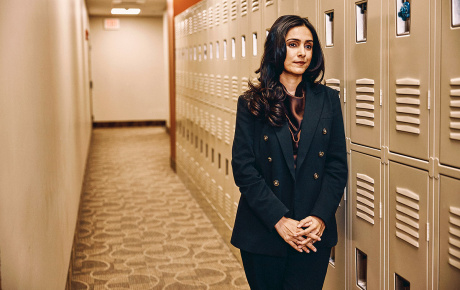
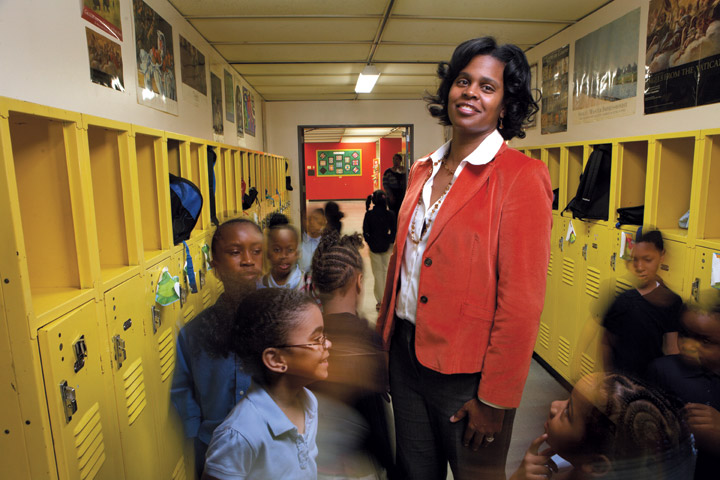
In 2010, Sonja Brookins Santelises ’89 joined a radical campaign to reform Baltimore’s schools. As chief academic officer, not only is she responsible for improving the curriculum taught in the 194 city schools; she must also give teachers the guidance and support they need to implement it and persuade students they can succeed at it. As a bureaucrat, Santelises may be a member of a much-maligned profession, but if you spend any time with her, you can’t avoid the conclusion that she is really a crusader on behalf of urban children—especially those whose abilities have been too often underestimated because of their skin color or economic status. An eloquent and forceful advocate, she aims to give Baltimore’s poorest and least powerful population the academic skills and self-confidence they need to realize their potential. In a school system long mocked, in a city plagued by poverty, violence, and unemployment, she is demanding that teachers set the bar high—really high—so students can learn what it takes to excel and believe in their own academic potential.
Last spring, Santelises riveted an audience at her alma mater with her account of the bold steps she and others are taking in Baltimore. On campus to celebrate 120 years of women’s education at Brown, she spoke at a panel discussion on school reform, where she presented a laundry list of achievements made since 2007, when her boss, Andrés Alonso, became the CEO of the Baltimore City Public Schools. The district’s seventh CEO in as many years, Alonso started by clearing brush: he reviewed all 198 schools and closed twenty-six nonperformers. He also replaced three-quarters of the school principals.

Maryland was one of the first states to adopt the Common Core State Standards (CCSS), and this fall Baltimore City schools implemented a new curriculum designed to meet its guidelines. A collaboration between governors and state education officials, CCSS aims to identify the skills schoolchildren need to succeed in today’s work world and to adopt the best practices for teaching them.
“Sonja’s biggest job is to change what teachers teach and students learn—not just the process but the content,” Alonso says. For example, he and Santelises believe that students need to be familiar with the classics in order to understand common cultural references. But most importantly, teachers must use high-quality content, no matter where it comes from. Under the CCSS, Santelises says, “teachers are now focusing on the complexity of texts instead of battling about the canon,” whether that text is Lincoln’s Gettysburg Address or Martin Luther King Jr.’s Letter from a Birmingham Jail. It’s equally important, she says, to apply these standards consistently over time. Teachers have seen too many new and supposedly innovative programs from central administration come and go over the years. “The key to implementation,” she says, “is to stay focused and deep, rather than wide and sporadic.”
Statewide tests have long exposed serious weaknesses in Baltimore’s academics. Elementary students have lagged badly on literacy and on comprehension of such basic math concepts as fractions, which are critical to understanding high school math. Santelises and her staff are now training teachers to teach those concepts differently. Instead of piling more and more material onto kids, she says the goal is to slow down and increase the depth of their understanding. With fractions, for example, she says she’d like to see children introduced to them earlier, through real-world applications: by having kindergarten and even pre-kindergarten pupils cooking and measuring ingredients, for example.
It’s still early to judge the effectiveness of Santelises’s reforms. Baltimore schools still perform poorly, particularly when compared with the wealthy Montgomery County schools just outside Washington, D.C. But attitudes are beginning to change. The recent improvements instituted by Alonso and Santelises are sparking hope for the first time in decades. Enrollment in the city schools has risen to 85,000 from 81,000.
“We’ve had four consecutive years of enrollment increases after four decades of decline,” Alonso says. “We are competing better with the parochial schools. We’ve stemmed the dropout problem.” He attributes the latter to a policy shift that pushed schools hard to replace the practice of suspending misbehaving students and sending them home with keeping them in school, where they are accountable to a mediation process and get more help from counselors.
The effectiveness of the new strategies became clearer when Maryland implemented a statewide longitudinal data-collecting system. The new technology—which was required in order for the state to qualify for a $250 million Race to the Top competition—makes it possible to track individual students’ progress through the schools. It also enables administrators to follow cohorts of students as they move from grade to grade, and to mine that data for trends and correlations. For instance, the longitudinal data collected showed that the four-year graduation rate for students who entered Baltimore high schools in 2007 was 65.8 percent, a jump of more than 4 percent over the previous year. After five years, the graduation rate for the same group was 70.6 percent, an improvement of about 4 percent over that of the group that entered in 2006.
Even more encouraging is the early trend in dropout rates. Of the students who entered high school in 2007, 82.5 percent either had graduated or were still pursuing degrees four years later, a 30 percent increase over the previous class. Most of that rise was in the ninth and tenth grades, the grades when most dropouts leave school as they give up on the difficult transition from middle school to high school.
In January, Baltimore’s school board will vote on a $2.4 billion, ten-year plan to renovate or rebuild its aging classroom buildings. According to the Baltimore Sun, the proposal, which Alonso and Baltimore’s mayor presented to the public in late fall, “represents the most far-reaching and ambitious program the city has yet come up with to break out of its cycle of poverty and disinvestment.”
Sonja Santelises never intended to work in education. The route to her passion was a circuitous one. But the importance her family has always placed on education is obvious in the northern Baltimore City townhouse she shares with her husband, Luis, and their three daughters—all of whom attend public schools. Hanging in the foyer of their home are framed family portraits, including one of two young women in doctoral robes—Santelises and her sister, Shahara Brookins Drew ’94 AM, ’01 PhD.

In high school Santelises was dead set on going to Duke until she visited the Durham, North Carolina, campus. “I didn’t connect,” she says with a shrug. She looked at Brown on a rainy spring day when protesting black students were outside, demanding that the University hire more minority faculty and divest in companies doing business in South Africa. The student volunteers who hosted her visit said Brown admission officers feared the protests would discourage African Americans from coming to Brown. The protests had the opposite effect on Santelises. While other campuses were wrestling less visibly with racial issues, she says, “There was a level of transparency on Brown’s part that says something about the institution even to this day.”
At Brown, Santelises concentrated in international relations and literature. She says her outspokenness and her habit of arguing both sides of an issue sometimes put her at odds with more politically correct peers. But she craved the adrenaline rush she got “from being around people who were just as jazzed” by ideas as she was. Plus, she says, after being in mostly white schools, “I really liked being around so many really smart black students.”
Santelises had always been a churchgoer, but she says, “Brown was where I found God.” Although her extended family feared she’d lose her faith in Brown’s liberal and secular environment, she says the University made her more religious. Away from her parents’ expectations that she’d attend church, she found a much more personal relationship to Christ, singing with the campus Gospel choir, Voices of Inspiration.
After graduation, she traveled in Europe and applied for posts in West Africa. She figured she’d work there for a bit and then apply to graduate schools in international relations. But her parents wanted her to get a job, and, while she waited to hear about positions in Africa, she signed on as a substitute teacher in the Peabody public schools.
“I fell in love with teaching,” she says. One of her mother’s friends had read about the fledgling nonprofit Teach for America, and Santelises signed on, moving to New York City to develop placements and then driving from Florida to Texas to recruit college students interested in teaching. Over time, she came to realize that her future was not in international relations but in the classroom. “I came to peace with it, and after a period of prayer I told my parents,” she says. “My mother gulped.” Her mother, in fact, later sent her photos of Condoleezza Rice as a hint of the wider stage awaiting her daughter. “My mother blamed herself for giving me a chalkboard when I was a child,” Santelises says. “But my dad was thrilled.” As a younger man he had taught black history in night school, and, she says, he had never liked the thought of his daughter joining the black bourgeoisie.
While she was at Teach for America, Santelises began work on a master’s in education administration at Columbia, and in 1991, she joined a group starting the Decatur Clearpool School, a year-round K–8 school in the Bedford-Stuyvesant neighborhood of Brooklyn. She taught there and was the school’s curriculum specialist. “I didn’t know what I was doing,” she says now. “But I was young.”
Santelises left that job to become executive director of the New York City Algebra Project, the local branch of the national math reform program, which is founded on the idea that quality education is central to civil rights. And in 1998 she decided she needed to get her doctorate, so she enrolled in the urban administration program at Harvard’s Graduate School of Education.
One of the six students in her group was a Cuban American immigrant named Andrés Alonso, her current boss. Throughout the intense regimen of internships and coursework, the two discovered that they shared many of the same values. Both were motivated by a commitment to social justice, and, Santelises says, “The absolute foremost goal is doing what’s right for kids, for underserved kids. We share that.”Also, she says, “We both know the power of education and believe in its potential.”
Santelises may not have grown up poor, but she has some understanding of how difficult it can be for poor African American children to develop confidence in their own intelligence and potential. Even a child of highly educated parents must deal with the notion that black kids get into good colleges not because they’re smart but because they’re black.
Santelises arrived on College Hill in 1985, when David Klinghoffer ’87, a conservative columnist for the Herald, regularly wrote a column attacking Brown’s political correctness, including admission policies that favored blacks. Santelises read his columns and wondered. Rationally, she knew she was as smart as anyone, but the columns and the heated discussions they sparked made her secretly wonder whether she was granted a pass because of her skin color.
“It took awhile before the fact that I was getting A’s sank in,” she says facetiously. However unpleasant, the experience proved helpful. Santelises went on to read Richard J. Herrnstein and Charles Murray’s The Bell Curve and other studies of race and intelligence, and her Harvard dissertation was entitled “Being Smart, Being Black: African American High Achievers in the Context of High School.”
Santelises now credits those unsettling first months at Brown with teaching her what urban schoolchildren are up against every day. “I want to thank David Klinghoffer for writing all those crazy editorials,” she says. “In [Baltimore] we have thousands of African American kids, poor kids, immigrant kids, who are hearing that same message—that they aren’t good enough—and not only hearing it but believing it.”
After graduate school, Santelises consulted with urban school districts around the country and taught at Harvard until 2006, when Boston Schools superintendent Tom Payzant, for whom she’d interned while in graduate school, hired her as assistant superintendent for teaching and learning. Two years later she became assistant superintendent for Boston’s twenty-three pilot schools, a network of schools with a strong record of improving achievement among low-income students, especially students of color.
While in Boston, she also met Luis Santelises, a graduate of Providence’s Classical High School who’d heard her sing with Voices of Inspiration while she was at Brown. A businessman and entrepreneur, he’d heard through a mutual friend that she was back in Boston; they began dating and eventually married. While she was raising a toddler and was pregnant with twins, Santelises ran into Andrés Alonso at a conference. He had just become CEO of the schools in Baltimore, and he asked if she’d like to join his staff. The timing was all wrong, she says. She and Luis didn’t want to move, and what’s more, Santelises didn’t want to commit to working with Alonso until he established a team.
Three years later, in 2010, Alonso approached Santelises again. Baltimore’s longtime chief academic officer was retiring; would she be interested in joining the reforms that were now well under way? “I felt I needed somebody whom I trusted,” Alonso says, “who had similar values and intentions to mine, in the role of chief academic officer.” Alonso hired a search firm to recruit candidates and urged them to consider Santelises as well. He asked a team of trusted colleagues to come to Newark, out of the public eye, to interview the finalists, including Santelises.
“When she left the room,” Alonso says, “people turned around and said, ‘Do you think we can get her to come?’” What so impressed the team, he says, was Santelises’s “core values—her passion for the work. She’s remarkably eloquent about why she does what she does and her journey and her belief system and how that belief system impacts what she does.”
While Sonja and Luis Santelises miss the Boston area, they are enjoying life in a predominately African American city. Baltimore has a vibrant professional black community, she observes, and they have found a church in Timonium, northwest of Baltimore, where they’ve befriended other like-minded families. “Baltimore is a great place to have my downtime,” she says. “People have you over. The pace is different. Here you really feel the value of family.”
They’re also finding it a surprisingly rich place to raise children. When their oldest daughter, Katriel, was four, Sonja took her to see The Nutcracker at the Baltimore School for the Arts, one of the top schools in the city. “I got teary-eyed,” Sonja says. “It hit me that my daughter’s first Nutcracker had a racially diverse cast, and the girl who played Clara was black.”
Last October, at a Brown TEDx talk on the value of a liberal arts degree, Santelises described a vexing scheduling conflict she faced during her final semester of college. She’d been invited to join Phi Beta Kappa, but the induction ceremony was at the same time as a key Commencement event for African American students. When she asked a professor for advice, he told her, “Surprise people. Do the surprising thing.” She attended the Phi Beta Kappa ceremony.
That advice, “Surprise people,” seems to have been pivotal, guiding not only her personal choices but also her ambitions for the children whose education she directs. In her TEDx talk, she recounted a second conversation, this one with one of her middle-school students from Bedford-Stuyvesant. On a school trip to skate in Central Park, he asked her, “Why do you do this?”—meaning, Why do you teach kids like me, when you could do so many other things? Santelises’s answer was revealing: “Because I want to be in the room when you surprise people. I want to see it.” She wants to see students surprise those who expect them to fail.
Santelises knows that lasting educational change does not happen overnight. Quicker success would come with more modest goals. But on this subject Santelises likes to quote former Brown president Ruth Simmons, who has observed that genius resides in the poorest of communities. “If you aim to produce a Nobel Prize winner,” Santelises says, “you might get ten more engineers. Or college professors. Or ten more doctors. When you ask people to shoot for the moon, and you don’t get it, you at least get a star that’s really close.”
Charlotte Bruce Harvey ’78 is the BAM’s managing editor.