
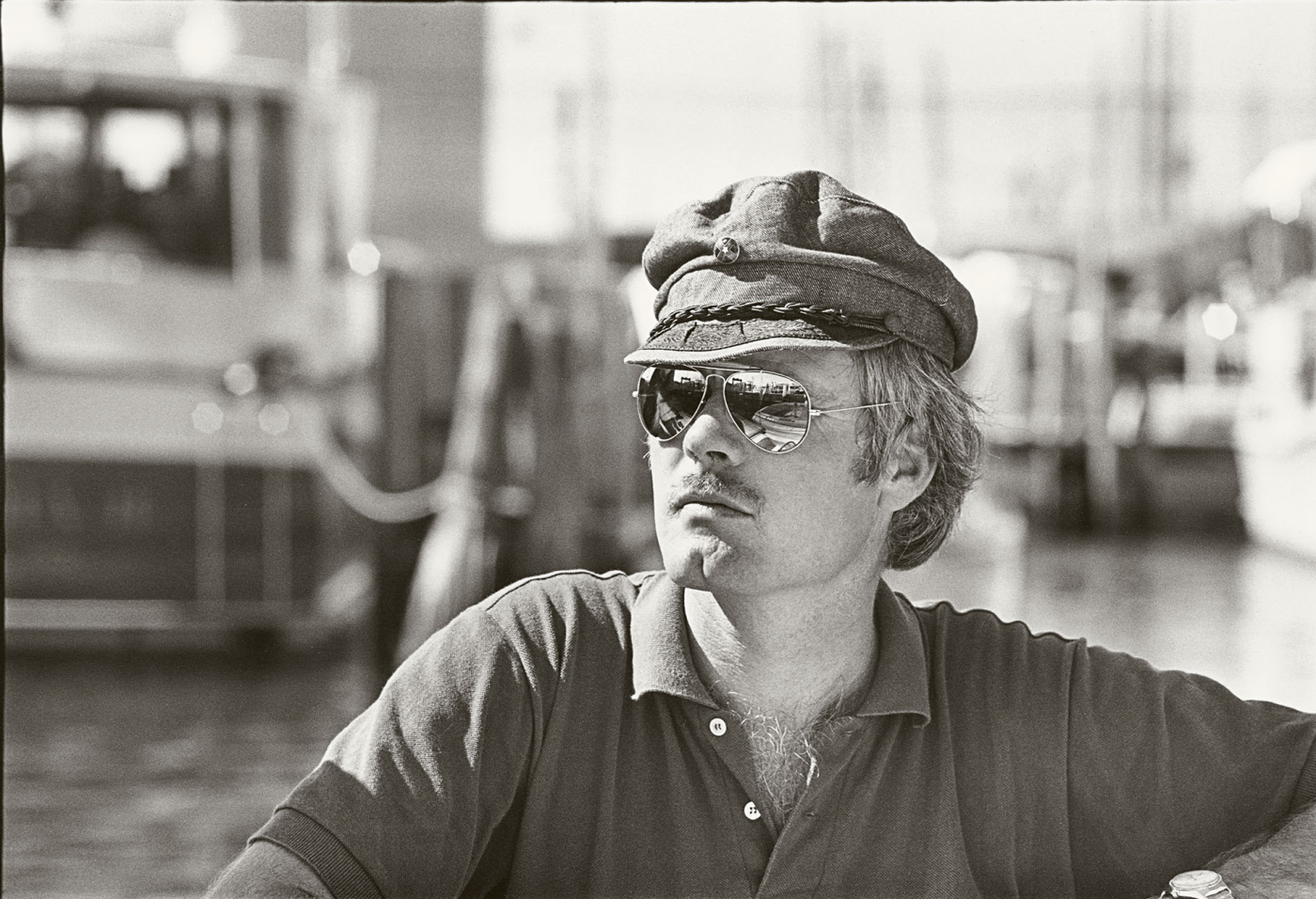
Robert Edward “Ted” Turner III ’60, the media mogul, sportsman, and philanthropist, passed away on May 6, 2026. He was 87. Known affectionately as “The Mouth of the South,” Turner transformed a struggling billboard business into a multibillion-dollar media empire, leaving an indelible mark on media, culture, and conservation.
Long before he disrupted the global media landscape through the Cable News Network (CNN), Turner brought his rebellious streak to Brown. He entered with the class of 1960, becoming the vice president of the Brown Debating Union and sailing with the university’s yacht club, a portent of his future status as a world-class yachtsman. His collegiate career took a turn when his father, a conservative businessman, objected to Ted’s decision to concentrate in Classics. Turner switched to Economics, but he was ultimately expelled from the university after being caught with a woman in his dorm room.
Despite that ignominious ending, Turner retained an affinity for Brown. He was inducted into Brown’s Athletics Hall of Fame in 1974, said to be “the Bobby Orr of his profession, probably the top ocean racer in the world.” In 1989 the university awarded Turner an honorary baccalaureate degree, followed by an honorary doctorate of laws in 1993. He also served on the Corporation of Brown University. Turner would recount his Brown days with a mixture of humor and gratitude, acknowledging that the intellectual rigor and fierce independence he cultivated on campus served as the bedrock for his success.
Turner garnered widespread backlash in 2002 when, speaking at Brown, he described the September 11, 2001, hijackers as “a little nuts,” but “brave at the very least.” He also said, “The reason the World Trade Center got hit is there’s a lot of people living in abject poverty out there who don’t have any hope for a better life.” Turner later said that his comments were taken out of context.
Turner entered the family business, Turner Advertising Company, after his expulsion from Brown. His father died in 1963, and Turner took over and expanded the company. In 1970 he purchased a failing UHF television station in Atlanta and changed its call sign to WTCG, representing Turner Communications Group. Utilizing revolutionary communications satellite technology, Turner beamed the station’s signal to cable systems nationwide, inventing the concept of the superstation (later rebranded as TBS). This move democratized television access, bringing regional sports and entertainment to millions of American households.
On June 1, 1980, Turner launched CNN, the world’s first 24-hour all-news television network, dismantling the traditional evening news format. It has been on the air ever since. CNN broadcasts major world events such as the protests in Tiananmen Square; the fall of the Berlin Wall; and the 1991 Gulf War, during which CNN offered live, unedited broadcasts from Baghdad that changed how the public consumed breaking news and how governments reacted to geopolitical crises. Time magazine named Turner its Man of the Year in 1991.
CNN’s obituary of Turner quoted Wolf Blitzer, who said on-air after Turner’s death that he was “a legend, he revolutionized the television business by creating the first 24-hour news channel right here at CNN.”
Journalist Christiane Amanpour told CNN, “He was the original. He made us all proud, he made us all hopeful, and he made us all strive for his vision of a better world.”
After CNN’s launch, Turner’s media empire continued to expand rapidly, capturing the imagination of audiences of all ages. He founded Turner Network Television (TNT) in 1988 and launched the Cartoon Network in 1992. His acquisition of New Line Cinema and Castle Rock Entertainment cemented his status as a Hollywood heavyweight, bridging the gap between independent filmmaking and mainstream broadcasting.
Beyond the boardroom Turner possessed a ferocious competitive drive that yielded historic victories. An elite sailor, he defended the America’s Cup in 1977, skippering the yacht Courageous, a feat that earned him the cover of Sports Illustrated. His sailing philosophy was simple: “Get a good boat, put a good crew on it, and then go out and sail the devil out of it,” he said in the documentary The Best Defense: America’s Cup.
In 1976 Turner purchased the Atlanta Braves baseball team, using the power of TBS to transform the regional franchise. His investment culminated in World Series Championship titles in 1995 and 2021. Turner purchased the Atlanta Hawks basketball team in 1977, and founded the Goodwill Games in 1986, a multisport event designed to ease Cold War tensions through athletic competition.
In his later years Turner channeled his vast wealth and boundless energy toward his philanthropic work. In 1997 he made headlines by pledging an unprecedented $1 billion to support United Nations causes, leading to the creation of the United Nations Foundation. His philanthropy focused heavily on environmental sustainability, nuclear nonproliferation, and population control. His vision for global unity extended far beyond the media, as he actively used his platform to promote international peace and understanding. Furthermore, his groundbreaking work with the Nuclear Threat Initiative drastically reduced severe global risks, proving his absolute commitment to human survival.
As the owner of over two million acres of land across the US and Argentina, Turner became one of the largest private landowners in North America. He dedicated his ranches to eco-restoration, spearheading the preservation and reintroduction of the American bison. Through the Turner Endangered Species Fund his conservation efforts have saved countless native species from extinction. Friends and colleagues remember Turner not just as a bold, unpredictable disruptor but also as a deeply compassionate leader who cared about the entire planet’s future. His immense legacy will continue to inspire future generations of fearless journalists, environmentalists, and global leaders worldwide.
He is survived by his five children—Laura Turner Seydel (Rutherford), Robert E. (Teddy) Turner IV (Blair), Rhett Turner, Beau Turner (Georgia), and Jennie Turner Garlington (Peek)—and 14 grandchildren and two great-grandchildren.