
Related Issue

Fall 2026
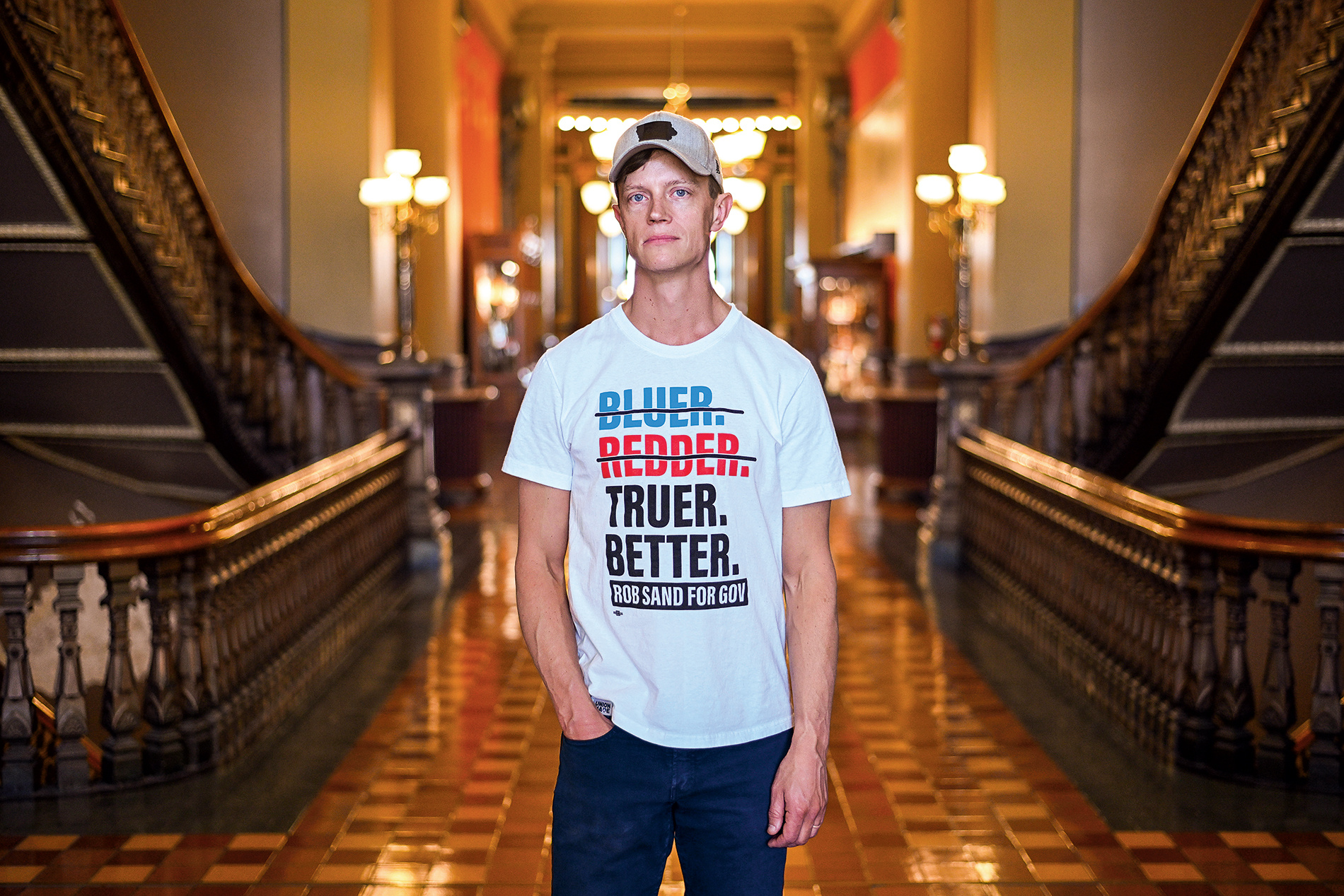
Rob Sand ’05.5 was profoundly disappointed when Republican President George W. Bush won reelection on November 2, 2004. But Sand had a keyboard and a plan.
Under the headline “Reclaiming the moral high ground,” Sand wrote in the Brown Daily Herald (BDH): “For too long, Democrats have advocated positions, proposals, and policies without relating them to the fundamental values from which they are derived. This needs to end; Democrats need to start talking hearts, not minds. Many of these values are Christian values, but are widely held outside of religion.”
Sand had frequently criticized Republicans for slashing aid to the needy, but now the Brown senior from rural Iowa was begging his own party to look in the mirror, then look ahead. “The presidential election has been over for a week. I’m talking now about 2006 and beyond.”
Flash forward to way beyond. September 12, 2025, to be exact.
In comfortable brown shoes and a stylish sports jacket that evoked his brief college sabbatical as a European fashion model, Sand, now in his early 40s but still sporting boyish looks, paced in front of a stone fireplace at a town hall meeting in Winterset, Iowa. His audience paid rapt attention, some with large “Rob Sand—Governor” placards at their feet.
“When I was growing up, my dad would take me hunting, my dad would take me fishing,” Sand told the audience, introducing himself and adding that his passion for bowhunting has extended into adulthood. “We would also go to church pretty much every Sunday… Some people want you to think those three things belong to one political party or the other. I just think they belong to a lot of people who were born and raised in small-town Iowa, and it doesn’t really matter what your politics are.”
This is unlike most Democratic campaign events, and not just because Sand is famous for opening his town halls by leading the crowd in a verse of “America the Beautiful.” He sings the anthem “to push back against the people who want us divided from [one another].”

Sand never mentioned President Donald Trump, nor did the crowd hear a laundry list of liberal policy ideas. Sand stressed the public-service aspects of his record as a corruption-
hunting assistant prosecutor and now state auditor—Iowa’s only statewide elected Democrat. He also offered a plague-on-both-their-houses view of the two political parties.
He’s “reclaiming the moral high ground.”
Sand’s politics are unconventional in that he dismisses partisanship and highlights faith. In town halls, he says that he doesn’t want to do politics. He wants to do public service. “Someone who is just trying to solve problems for people.” To solve problems, he says, “You have to work with people who disagree with you and may have even opposed you.”
Pollsters and online prediction markets have had the Democrat with a slightly better-than-even shot of winning the governorship in November’s election, even in a state that went comfortably for Trump in three presidential elections. The last time Iowa elected a Democratic governor was in 2006 (Chet Culver), just months after Sand graduated from Brown.
Reexamine Sand’s time as an outspoken campus leader at Brown, and you can see the rough blueprint of his current political philosophy sketched out in the lines of his BDH columns or in his work to launch a seminar class explaining the underpinnings of modern conservatism just as it was taking root back in Iowa. Sand’s nontraditional march on Des Moines, Iowa’s state capital, certainly began to take shape during his four-year detour in Rhode Island.
“I watched the run-up to the [2003 Iraq] war, and it seems plain and apparent that our leaders were willing to lie to us to get us into a war,” he said when asked about his undergraduate years. “Here we find ourselves again in this conflict with Iran, doing much the same thing.”
Iowa Roots
The roots of Sand’s political identity had been planted in Decorah (pop. 7,454), his isolated hometown near the far northeastern corner of Iowa, known for its dramatic limestone bluffs and waterfalls, and for its healthy dose of Scandinavian heritage. Sand’s ancestors, like many folks in Decorah, were Norwegian immigrants, and he jokes, “I’m in a mixed marriage,” because his Iowa-born wife, Christine Lauridsen, CEO of a health and nutrition company, comes from Danish stock.
A longtime observer recalled the first time he met Sand, at a 2019 forum. “He came in [wearing] a Carhartt jacket and jeans and it was a worn Carhartt jacket and jeans,” he said. “It wasn’t, you know, neatly pressed.”
Decorah was where Sand learned at an early age to get big things done, like working with other skateboarding kids in the 1990s to convince the town elders to build a skatepark. He developed his sense of morality in weekly Sunday-school classes at the Ossian Lutheran Church.
“When I was in high school, I was watching the Westboro Baptist Church”—an anti-LGBTQ and antisemitic hate group—“allegedly represent Christianity in the national media, and I remember an abortion doctor … in Kansas being murdered for doing [his] job, and being confused at the time, thinking, ‘Are we reading the same Bible?’”
Sand decided back then to be both honest and vocal about his ideal of the Christian faith, which he says “is about love, and … about justice, and I don’t think those things were being represented at the time.”
In the 1990s, Sand attended a summer camp at the University of Iowa that attracted kids from around the nation. Several fellow campers, seeing Sand was already an outside-the-box thinker, told him he’d be a good fit for a university he knew nothing about: Brown. Some months later, Sand and his mother, on an East Coast college tour, pulled up to one of Brown’s new dormitories in a pouring rainstorm, and he “just had a gut feeling this was a place I’d like.”
The future politician certainly played the part by personally introducing himself to everyone in his first-year dorm. Sand left Providence a few times, to intern in D.C. with then-Senator Tom Harkin, Democrat from Iowa, and also to travel to Paris and Milan to work as a model, which he doesn’t highlight on his current résumé.
Still, he made a name for himself at Brown writing thoughtful columns about national affairs for the BDH, where he frequently critiqued the Bush administration for neglecting the needy here at home. “There is no justification,” Sand wrote in March 2005, “for the world’s richest nation to have full-time workers being paid wages that keep them and their families in poverty.”
But he didn’t want to just write about modern conservatism. He wanted to understand it. One night in early 2003, he swung by the dorm room of Stephen Beale ’04, also a BDH columnist and a rare conservative voice on campus. (Beale edited the Brown Spectator, a right-leaning publication.) Sand had a proposal: What if they started an independent-study class on conservative thought? Beale developed the syllabus for the class. “I just felt that I wasn’t getting a good underpinning of the genuine intellectual ideas under conservatism in the classes that I was taking, and I wanted one,” Sand said.
Now a journalist and freelance writer, Beale recalls when they discussed The Bell Curve, the still-controversial 1994 book, co-authored by political scientist Charles Murray, which argues that intelligence has a strong genetic component that also leads to racial differences. “I do remember Rob showing up to that [class], armed with a whole counter-argument,” Beale said. “And I don’t think anyone was willing to take the pro-Bell Curve side of that debate. We just let him have his say on it. And he was very passionate.”
Sand was awarded a prestigious federal Harry S. Truman Scholarship while at Brown, and after graduation he could have gone anywhere. He went back to Iowa, earning his law degree at the University of Iowa after spurning an acceptance letter from Harvard.
“Bowhunting Influencer”
Sand made the most out of his first job out of law school, as an Iowa assistant attorney general. A tip that something wasn’t right about a last-minute claim for a multi-state lottery prize worth $16.5 million led to an investigation, headed by Sand, that uncovered the largest lottery-rigging scandal in American history. The young lawyer parlayed the high-profile case into the book The Winning Ticket: Uncovering America’s Biggest Lottery Scam, co-authored with Reid Forgrave. Sand’s investigation was also a key selling point when he took on the GOP incumbent state auditor and won in 2018, an up year for Democrats.
Political experts see the real advantage for Democrats like Sand and Talarico as their embrace of morality: Both talk about their faith as a path toward helping the disadvantaged, not as a source of aggressive nationalism.
Within months of his taking office as Iowa’s only statewide elected Democrat, the state’s presidential caucus, the nation’s first major contest of the primary season, was crawling with the top Democratic candidates—all of them seeking Sand’s insights as a kind of a horse whisperer for their party in a state that had swung heavily to Trump in 2016. A flattering 2019 New York Times profile called Sand the party’s “bowhunting influencer.”
Dave Peterson, an Iowa State University political scientist and a longtime observer of local races, recalled the first time he met Sand, at a 2019 forum attended by several presidential hopefuls. “He came in [wearing] a Carhartt jacket and jeans, and it was a worn Carhartt jacket and jeans,” Peterson said. “It wasn’t, you know, neatly pressed.” When Sand addressed the crowd, Peterson sensed a real connection. “He’s an Iowa boy and he’s authentic to his core and it comes across that way.”
Sand’s authentic connection to Iowans is why Iowa conservatives fear that Sand has a shot at the governor’s mansion. In 2023, the GOP-dominated state legislature and Republican governor Kim Reynolds enacted a bill that severely crimped Sand’s power as auditor, barring him from investigating state agencies.
But Republicans couldn’t outlaw Sand’s knack for being in the right place at the right time. Reynolds, who has angered teachers’ unions and public-school advocates with her strong support for vouchers to attend private schools, decided not to seek a third term, and Trump is especially unpopular with farmers who’ve been hurt by the president’s unconventional trade policies.
Polls at the beginning of summer showed Sand ahead of his potential Republican opponents. That included the GOP primary winner, businessman Zach Lahn, who brands himself as a farmer critical of what he calls “Big Agriculture.” He blends traditional conservative views on social issues, such as support for a total abortion ban, with more unconventional ideas (in a farming state) about pesticide bans as part of the “Make America Healthy Again” movement associated with Health and Human Services Secretary Robert F. Kennedy Jr.
In contrast, Sand’s policy ideas lean heavily into the process, including, in the immediate wake of America’s two oldest presidents, a call not just for term limits but even age limits and cognitive testing for office holders. His opposition to GOP-created educational tax credits is couched in the language of fiscal conservatism, branding it a waste of state revenue. Sand also opposes liability shields for pesticide manufacturers and is pushing to combat rising cancer rates linked to environmental and agricultural toxins.
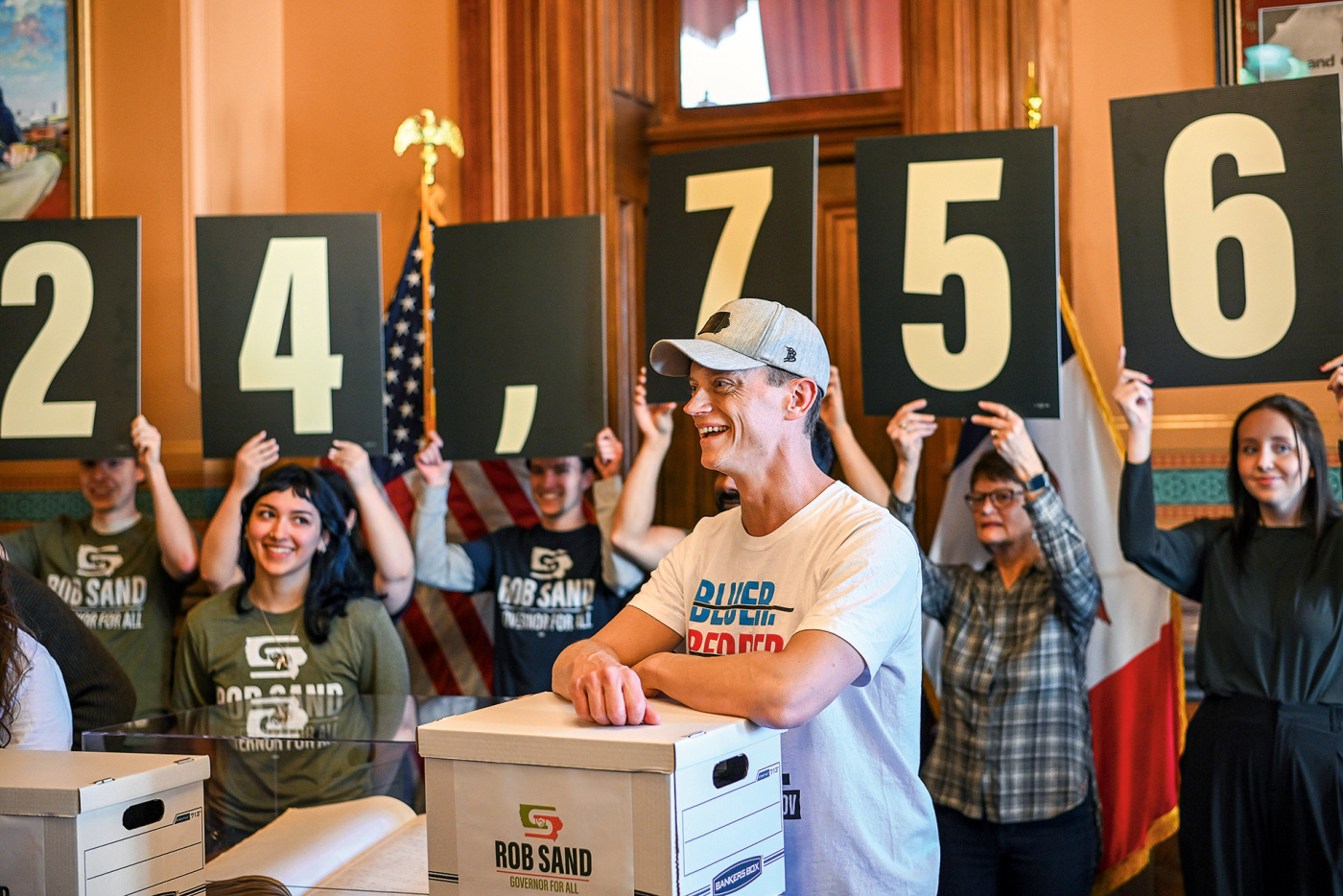
Political experts, though, see the real 2026 advantage for Democrats like Sand and Texas U.S. Senate candidate James Talarico as their embrace of morality: Both talk about their Christian faith as a path toward helping the disadvantaged, not as a source of aggressive nationalism.
“I want the true message of the New Testament and the true message of Jesus to shine through for people, which is about love, and it’s about justice,” Sand said, describing the spiritual course he says that he’s remained on since high school.
But in politics, there are always crosscurrents. Is Sand’s bipartisanship really the right approach when polls suggest that the Democratic party rank-and-file electorate has never been so angry over what they see as Trump’s corruption and authoritarian overreach?
Laura Belin, who has covered Sand extensively as the Iowa political reporter for the progressive website Bleeding Heartland, said the small but spirited left wing of Iowa Democrats can find Sand’s singing or his social media posts about his favorite gas-station pizza as “corny,” yet there are also policy concerns that he’s not aggressive enough about dismantling the school voucher program or tackling Iowa’s water-quality issues. But Belin added: “My sense is that most Iowa Democrats like Rob Sand and are excited to have a candidate with a solid chance of winning a statewide election.”
Sand insists that he’s very much in tune with voter rage, which he feels is aimed at both sides.
“We’re centering this campaign on the idea of ending the special legal privileges of the Democratic and Republican parties,” Sand said. “We’re centering this campaign on the idea that a system that only gives you two options is actually more interested in controlling you than listening to you, and there’s a lack of accountability precisely because the vast majority of voters are voting for someone they feel trapped into voting for, rather than someone that they’re excited about.”
He added, “We also need to be flipping the tables of the money changers of the temple.”
Will Bunch ’81 is a national opinion columnist for the Philadelphia Inquirer and the author of several books, including 2023’s After the Ivory Tower Falls.