
Related Issue

Fall 2026
Lachlan Kirby was nearly 300 miles into a cross-country bicycle trip when he pedaled into Chattahoochee, Florida. He had ridden 45 miles that day in unforgiving summer heat. He was tired and lonely. Then he heard beautiful music.
Following the sound, Kirby found himself standing in a packed gospel church in sweaty cycling gear. “Everyone was so nice, and it was such a cool insight into a community that I would never otherwise interact with,” Kirby said. After the service the pastor offered his card, telling Kirby to call if he “needed anything at all.”
This summer Kirby biked more than 3,000 miles across the Southern United States as part of a self-designed research project, “Cross-Country for Community Care,” which will serve as his senior thesis. To examine community care in public health, he volunteered at Southern nonprofits for two weeks each, conducting 20 oral history interviews and raising funds for the nonprofits.
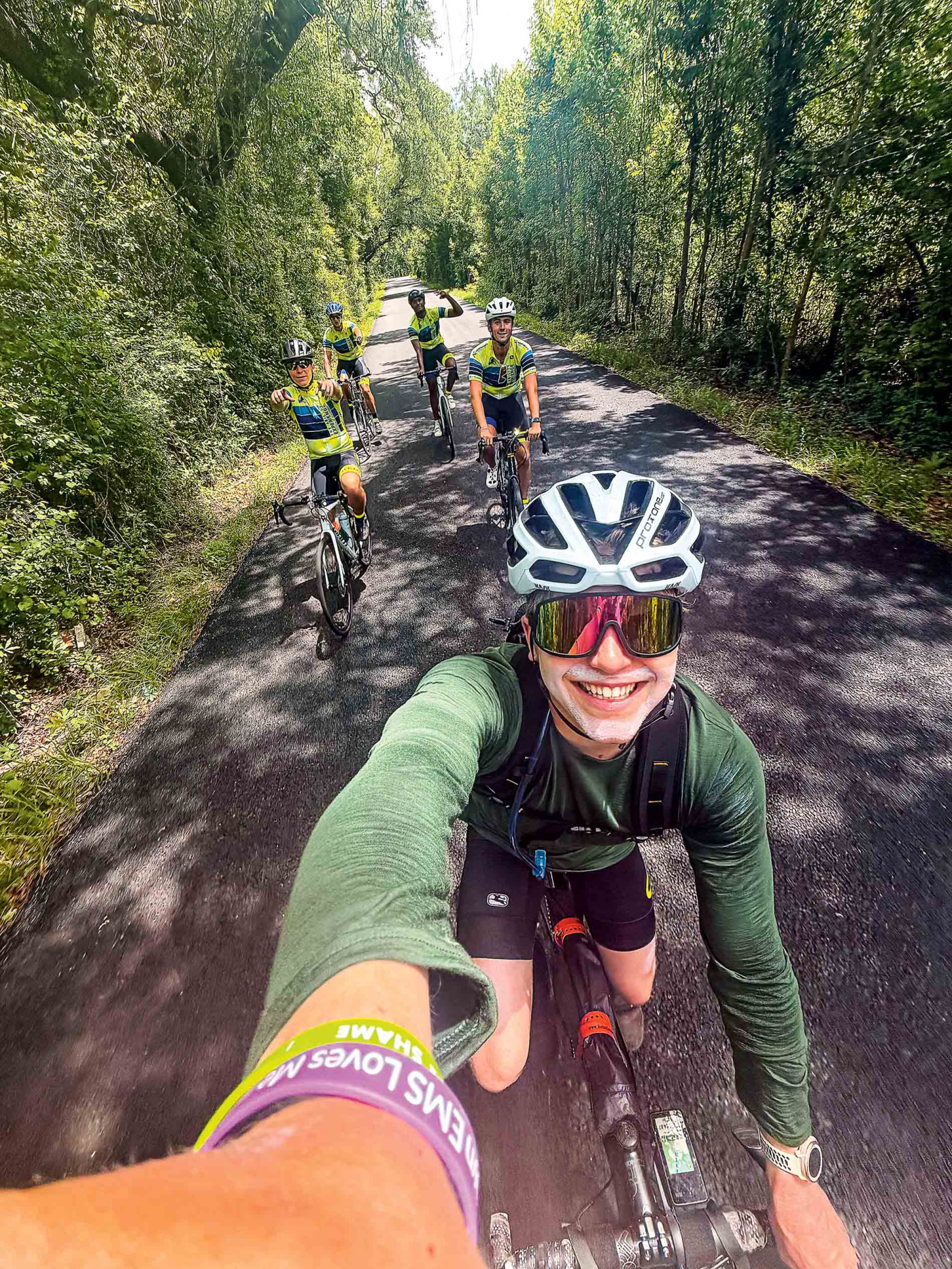
“There was a limit to what I could do from my classroom in Rhode Island,” said Kirby, who is majoring in public health and plans to attend medical school after Brown. The varsity swimmer works for Brown Emergency Medical Services, and he is also an EMT and a crisis counselor.
Kirby’s first stop was the Spectrum Center in Hatties-
burg, Mississippi—the state’s only LGBTQ+ community center. Run entirely by volunteers, the center provides a free food pantry and a clothing closet. Kirby helped organize a Pride Month cookout, installed flooring, co-led a first-aid skill-sharing session, and sorted donations.
As a queer individual, Kirby was “struck by how [the LGBTQ+ community] responded to the problem of not being cared for by the system,” Kirby said. “It was like, ‘Okay, if you’re not going to support us, we’ll do it ourselves.’”
During his trip, Kirby battled extreme weather, navigational hiccups, interrupted routes, mechanical issues, and a series of flat tires. However, Kirby frequently found himself on the receiving end of community care. Firefighters let him sleep in stations, a stranger paid for a hotel during a tropical storm, and drivers often cheered him on.
His second volunteer stop was in Eagle Pass, Texas, where he spent time with the Frontera Federation, a grassroots organization focused on borderlands health-care access and mutual aid. Utilizing his EMS background, Kirby assisted the town’s only primary care provider making house calls.
“The challenges [Frontera Federation faces] are so great that I know, realistically, I’m not going to make a profound difference in my short time here,” Kirby said. “But if I can make a patient feel more comfortable or be the reason someone is smiling … those micro-moments of care kept me going.”
What also kept Kirby going were the unexpected detours. En route to Eagle Pass, Kirby joined a 40-mile pilgrimage organized by Tsuru for Solidarity, a Japanese American advocacy group. Walking from a former World War II internment camp to an ICE family detention facility in Dilley, Texas, Kirby served on the medical team.
“I want to take the lessons I’ve learned and bring them back to my life,” Kirby reflected. “There’s no way I can just sit on the sidelines and call it a day. I need to be involved.”