
Related Issue
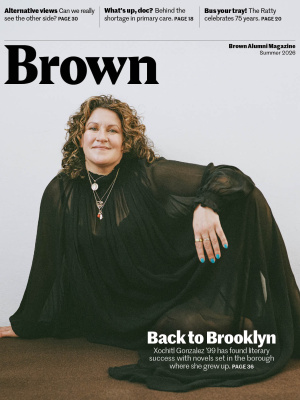
Summer 2026

Xochitl Gonzalez welcomes the noises she hears in Brooklyn’s Fort Greene Park: cicadas buzzing among still-green oaks, rackets thwacking tennis balls, and baby stroller wheels squeaking. Gonzalez contributes her giddy, raspy laugh to this urban soundtrack.
While some writers might eschew the public din, Gonzalez feels at home surrounded by it. It’s in this park, in fact, that the author wrote part of Olga Dies Dreaming, her debut novel, a New York Times bestseller. Growing up in Brooklyn’s working-class, immigrant-rich Sunset Park, just four miles away from Fort Greene, taught her to write through any ruckus.
“I had to learn to be productive amidst noise,” said Gonzalez, whose first name is pronounced so-CHEEL. “We could be anywhere, and I could write.”
Noise has been a recurring theme for Gonzalez, a contributing writer (former staff writer) at the Atlantic and a finalist for the 2023 Pulitzer Prize in commentary. In a piece for the Atlantic, she remembered the “shame and anger” she felt when she and other students of color at Brown were told by white students to dial down the hip-hop music and late-night talking.
“It took me years to understand that … these students were implying that their comfort superseded our joy,” she wrote in her essay, “Why Do Rich People Love Quiet?”
“I had taken the sounds of home for granted. My grandmother’s bellow from across the apartment, my friends screaming my name from the street below my window. The garbage trucks, the car alarms, the fireworks set off nowhere near the Fourth of July.”
After Brown, Gonzalez moved back to Brooklyn only to find neighborhoods filling with young, usually white professionals—who often complained about noise. To Gonzalez, all that urban din was “ceaseless music.” She loves music, particularly the freestyle, hip-hop, disco, and salsa hybrids that arose out of New York City’s Latino and Italian neighborhoods in the 1980s.
“Clearly, I should’ve been a DJ. Music is the most beautiful noise.”
Out of the music of her childhood Gonzalez has written three successful novels. Olga Dies Dreaming is about an eponymous heroine who chafes under the judgy weight of a largely absent revolutionary activist mother (similar to Gonzalez’s own mother) and increasingly resents the entitlement of the wealthy (mostly white) clients for whom she is a high-end wedding planner (as Gonzalez once was). According to the Guardian, “This deeply satisfying and nuanced novel shines a light on political corruption and the limits of capitalism. It’s also a study of the psychological fallout of poor parenting and a tender exploration of love in its many forms.”
In 2024’s Anita de Monte Laughs Last, protagonist Raquel Toro is a Brooklyn-born Puerto Rican woman studying art history at Brown; the book contains autobiographical elements as well as details from the real life of Ana Mendieta, a Latina conceptual artist whose promising career was cut short in 1985 by a fatal and mysterious plunge from a window, prompting questions as to whether she fell or was pushed by Carl Andre, her famous sculptor husband.
“When you ask a Puerto Rican woman, ‘What did you get at the store?’ the answer is like, ‘Well, in 1990, at my sister’s first communion …’” Gonzalez said, laughing.
Gonzalez’s latest book, Last Night in Brooklyn, brings The Great Gatsby to her neighborhood—but with Gatsby as a dazzling, up-and-coming Brooklyn fashion designer named La Garza and Nick Carroway in the form of 26-year-old Alicia Canales Forten, who is entranced by the crowd of La Garza–adjacent artists of color who mark Fort Greene’s first wave of gentrification in the 2000s.
Gonzalez was also entranced by these artists when she lived in a rent-stabilized, fourth-floor walk-up in Fort Greene. During her 16-year stay, she became so abreast of neighborhood bochinche, or gossip, she earned the nickname “The Fort Greene Press.” She recalled: “I was who people wanted to go and hang out with to see what was going on.”
Gonzalez embraces a distinctly Puerto Rican form of storytelling, one that braids past and present. “When you ask a Puerto Rican woman, ‘What did you get at the store?’ the answer is like, ‘Well, in 1990, at my sister’s first communion …’” Gonzalez said, laughing.
To Gonzalez, Brooklyn is a palimpsest, where current residents live atop layers of buried social history. She is aware of how her own trajectory so far contributes to the layering, having brought her from Sunset Park to Fort Greene to the posh enclave of Brooklyn Heights, where she bought an apartment in 2023. Her novels form a loose Brooklyn trilogy and feature overlapping characters, establishing her as the latest in a line of storytellers whose works feature a borough with long-held mythic status.
She was raised by her grandparents, a janitor and a lunch lady at the same Sunset Park school. Gonzalez has written in the Atlantic about her parents, a Puerto Rican mother and a Mexican-
American father who were Socialist Workers Party activists and sent her to live with her maternal grandparents at age three while they continued organizing at home and abroad.
Freeing herself
Whether the tale is A Tree Grows in Brooklyn or The Cosby Show or Do The Right Thing, or any of the novels of Paul Auster and Jonathan Lethem, the setting of Brooklyn is synonymous with steep stoops leading to sometimes crumbling brownstones, races and ethnicities living cheek by jowl in a fractious fraternity, and ambitious hustlers desperate to live anywhere but Brooklyn.
But in the past 25 years, that exodus has reversed as the borough has flooded with youth, money, and—in many neighborhoods that were once almost entirely Black or Hispanic—whiteness. Gonzalez returned to Brooklyn to find that not only was the borough freshly populated with a tide of recent college graduates with the luxury of choices but that she was one of those privileged residents.
Gonzalez has felt the tension of upward mobility. After leaving Brown with an art history degree, she worked in a store in Manhattan’s SoHo that sold and framed French posters. She wanted to work at a real art gallery, but very few offered a living wage. When she ran into people from Brown, they’d tout book deals or fancy jobs. “I was embarrassed by my station in life,” she said. “They were like, ‘I just sold a book,’ and I was like, ‘Wait, what?’ It would be years before I would realize, ‘Oh! Your father is blah blah blah.’”

Driven by her grandmother’s fear of abandonment when Gonzalez left for Brown, the author spent years playing it safe in career paths like wedding planning rather than pursuing her passion for writing. That changed in 2017, when her grandmother offered a final, liberating message: “Whatever you want to do, you can do.”
“She let go of all her fear,” Gonzalez said of those final moments. “And then I think my fears went away.”
Gonzalez gave up the 24-7 demands of event planning for a nine-to-five as a Hunter College administrator so that she could write on weekends and early in the morning. By the time she decided to leave Hunter and pursue her MFA at the famed Iowa Writers’ Workshop, she had written over 100 pages of Olga Dies Dreaming.
Yet she doubted herself. The publishing industry felt impenetrable. Then, in the locker room after a fitness class, her high school best friend introduced Gonzalez to a literary agent—who read those 100 pages and agreed to represent the book when it was ready.
Gonzalez realized that even though she hadn’t been rich, growing up in New York had afforded her the asset of a dense network of connections. She acknowledged another asset: her own natural openness. “You have to love human beings,” she said. “You have to be like, ‘I didn’t know who this agent was. But sure, I would love anybody to read 100 pages of this book. Yes, let’s get coffee.’”
From that coffee date with the agent, a division within Macmillan Publishers bought Olga Dies Dreaming; it led to the book’s massive success. The novel was selected for the One Book, One Chicago initiative, which aims to get the whole city reading and talking about one book simultaneously. The Brooklyn Public Library, of which Gonzalez is a trustee, now carries bookmarks bearing Olga’s cover.
“That makes me really emotional,” Gonzalez said. She can’t believe that a story so informed by what she calls her “very strange, fringe-y” experience has become part of the contemporary literature landscape.
“You have to love human beings,” she said. “You have to be like, ‘I didn’t know who this agent was. But sure, I would love anybody to read 100 pages of this book. Yes, let’s get coffee.’”
The first neighborhood—and then Brown
Gonzalez remembers her experience at Brown as solitary, despite being elected class president her senior year. She ran for president after a friend convinced her it would look good on her résumé. She received enough votes to win thanks to friends from the Third World Center (now named the Brown Center for Students of Color). She only survived her freshman year, she said, because she blared freestyle beats through her Discman.
“I do extrovert drag,” she said. “But I’m not an extrovert naturally.”
While on College Hill, she held in anxieties about leaving her grandmother behind. “I’d think, ‘Oh my God, she’s all by herself—is she eating?’” And then there were what she perceived as slights from other students. Once, she remembers, she was the sole member of the senior council not invited to a gathering on a rich classmate’s yacht.
“They probably just thought I was this poor girl,” she said. “Trashy, for lack of a better word. I was such a city girl, in the rawest way. When school was out, I worked at fucking Century 21,” she added, referring to the New York City discount department store.
While writing Anita, she was surprised by how often her undergraduate alienation came up. “Raquel’s traumas weren’t my traumas, but writing Raquel’s traumas made me realize that Brown was a very difficult, lonely experience,” she said.
In the novel, Raquel is confronted by a gang of art history girls who tell her she only got into Brown because of affirmative action. Gonzalez said that nothing quite that cruel
happened to her but that the literary incident was meant to dramatize something at Brown “in the ether all the time” that left her feeling that she didn’t belong there.
Today a new form of discomfort comes from walking the line between her working-class past and her commercially successful life as an author. She’s aware of herself as a person with money and privilege. Part of that angst is her nature—“Everything torments me,” she said, laughing—but she admits that she feels guilt about her new wealth. Her mother, after all, worked in bra factories and later put cars together for a living.
If Gonzalez is somewhat uneasy with her new perch on the class ladder, she’s certain that she wants the literary landscape to include people from all those rungs. In her own work she strives to show that “everyone has some kind of value” and to make the working class visible again in pop culture, as she feels it was decades ago.
She now has the opportunity to bring more attention to the working class. The actor and producer Eva Longoria signed on to direct the film version of Anita, with a script by Gonzalez, who hopes these types of projects give a Hollywood leg up not only for her but for other Latinas. Not that she wants to write Latino stories only, but Gonzalez feels that “I have to Trojan-horse them until [Hollywood] people will be like, ‘This woman’s a good storyteller.’”
Mathew Rodriguez is currently writing a young adult graphic novel as well as a forthcoming memoir.