
Related Issue

Fall 2026
Last year, Jessica Vega couldn’t see a way out of drinking. She found herself on the street, homeless. “I lost my job; I lost everything,” she said.
Vega had turned to alcohol more than two decades ago when she learned her oldest daughter had been the victim of abuse. She tried to stop—attending multiple treatment programs—but nothing worked. Then, more recently, a botched surgery left her with chronic pain and severely limited mobility. She started drinking again, and her daughter asked her to leave.
She secured housing and support services through Open Doors, a Providence-based nonprofit dedicated to helping formerly incarcerated and homeless individuals, where Nick Horton ’04 serves as co-executive. While Vega was living in the organization’s shelter, Horton and his colleagues launched a GLP-1 pilot program to combat addiction as part of a broader initiative—She Thrives—which offers supportive services and housing to women who are rebuilding their lives after facing trauma and incarceration.
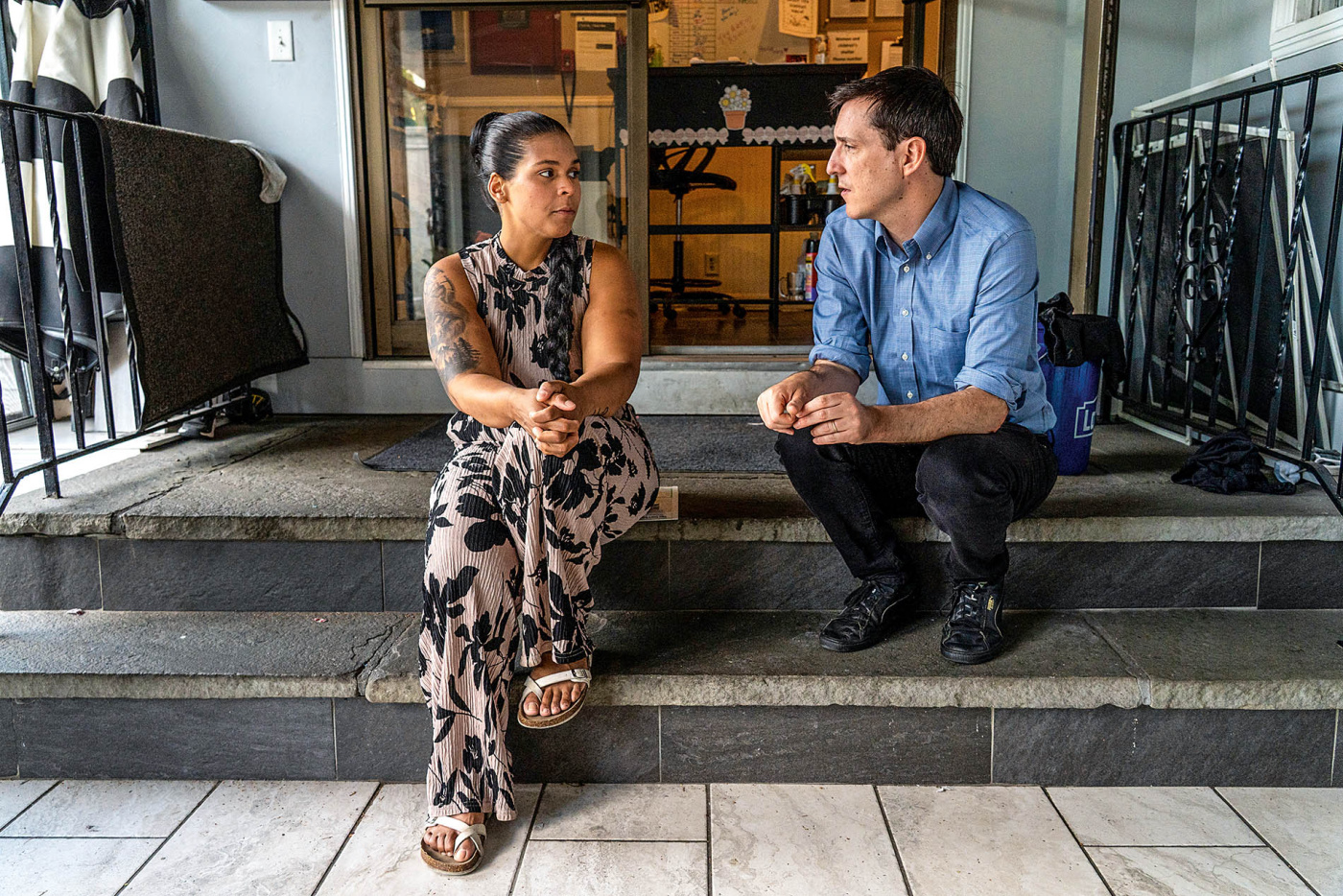
“We’re the first social service agency [in the state] to provide access to GLP-1s for addiction,” Horton said.
Vega enrolled in the program, which administers monthly injections of a GLP-1 medication—a diabetes drug like Ozempic now widely used for weight loss—to help curb cravings.
“The first day that I started the injection, something happened. It was different,” Vega said. “Before, I needed to run to the liquor store. Now I can pass by and it does nothing for me.”
Horton describes Vega’s turnaround as “miraculous.” She was the only participant using a substance when she enrolled. “This is someone who’s fairly deep in active use as an alcoholic,” he said, “and she just stopped drinking day one.”
Vega is one of several women who’ve seen results. An evaluation of the program published in late April found a 119% improvement in self-reported well-being after three months and
a 72% reduction in self- reported cravings at eight months.
“What mattered the most was that this medication was clearly safe, and it also clearly had some additional health benefits,” Horton said.
She Thrives was co-developed with Nick Reville ’01, a college friend of Horton’s and co-founder of the Center for Addiction Science, Policy, and Research, which provided $50,000 in seed funding. Horton and Reville also connected with Dr. Steven Klein, an addiction medicine physician with Caron Treatment Centers in Philadelphia, who prescribes the medication to Open Doors participants.
“We were particularly interested in GLP-1s because they have this broad anti-
craving effect that works across substances, and we believe that they will be the biggest breakthrough in addiction medicine in decades, maybe ever,” said Reville.
The pilot’s initial success has laid the foundation for a large-scale, randomized controlled trial. Horton connected with Brandon Marshall, professor of epidemiology at Brown and founding director of the People, Place and Health Collective, to expand the program. The goal is to enroll 580 people and track them over five years. Seeking funding, Marshall has submitted a $6.3 million proposal to Arnold Ventures, a philanthropic organization focused on evidence-based policy reform, and is awaiting news.
If the data holds, the goal is to push drug manufacturers toward FDA approval of GLP-1s for addiction treatment and with it, insurance coverage.
“Substance use disorders are complex and multifactorial, often driven by things like housing instability,” Marshall said. “The question is how to best position GLP-1s within other evidence-based strategies that support people through their journeys.”
Vega wants others suffering from addiction to know about her experience so they can “get the help they need,” she said, “because there’s help outside.”