

A mysterious longhaired figure named Nam lands on the Ruth J. Simmons Quad. He has lost his memory and needs students’ help piecing together how he ended up at Brown—and he has nothing in hand but snapshots of his home city, Hoi An, Vietnam. Working together, the students will aid him in regaining his memory and cultural identity via cards called “memory shards”—collected by students through reading, writing, speaking, and listening “quests” in the real-life class Beginning Vietnamese.
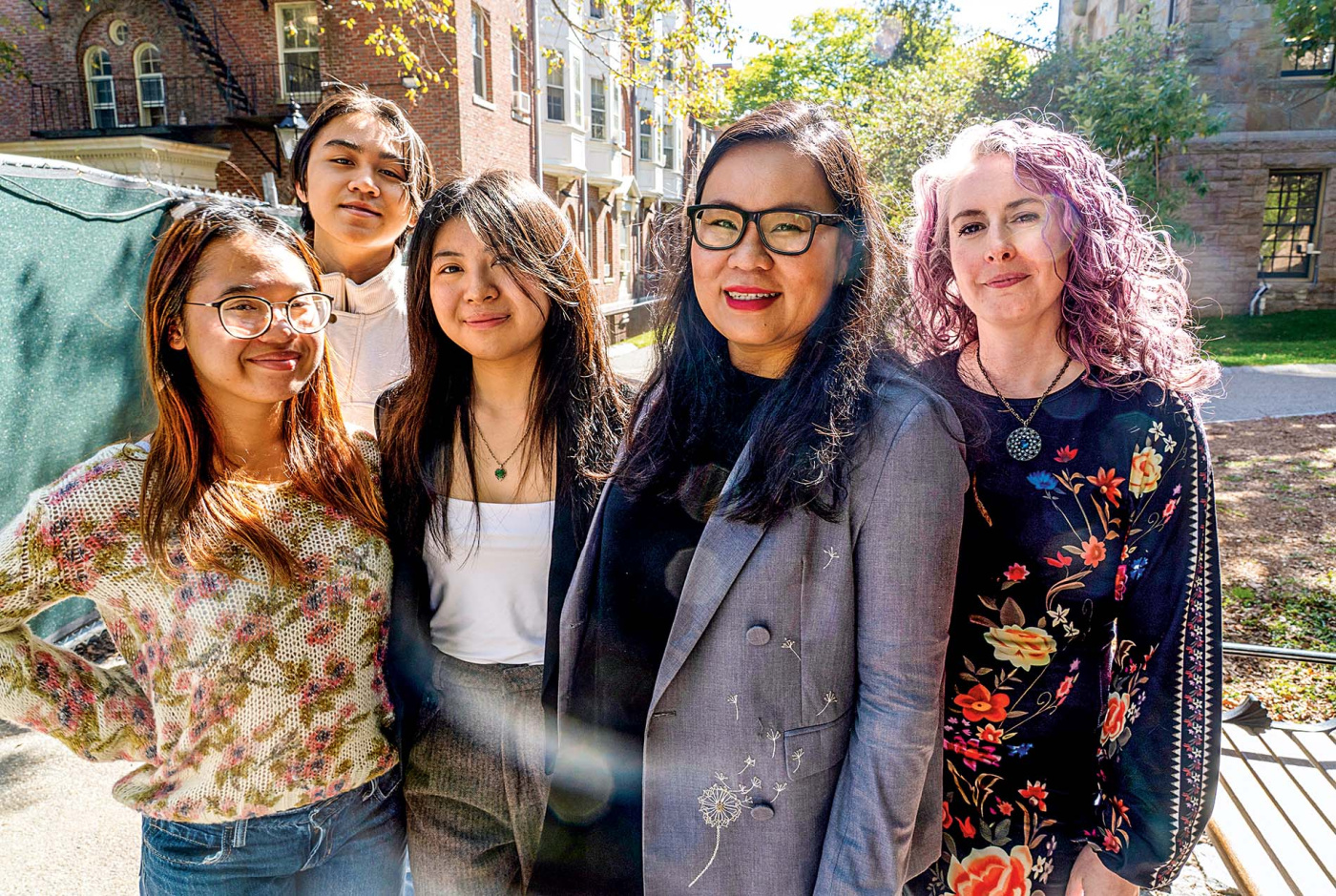
In other words, yes—this course for students who want to learn Vietnamese is no ordinary class but one that has been “gamified” by class Professor Trang Tran, Brown’s Sheridan Center Senior Learning Designer Naomi Pariseault, and students Que Tran Tran ’28 and Natali Chung ’26, who applied for UTRAs (Undergraduate Teaching and Research Awards), which support students’ work with faculty on a research or teaching project.
Chung, a senior and biology concentrator who has taken all the Vietnamese classes offered at Brown, was drawn to the project because of her love for story-based games. Tran, a sophomore and prospective comparative literature and gender and sexuality studies concentrator who grew up speaking Vietnamese, was looking for a writing-based summer opportunity and was interested in being more involved in the Vietnamese program.
In the game, each successfully completed “quest” (or lesson, really) gives players more memory shards, which can be used to help Nam regain his memory. Students can obtain the first memory shard by introducing themselves in Vietnamese in a video. Earning three memory shards leads to the reveal of one of Nam’s “memory fragments.” The quests are split between tasks in reading, writing, speaking, and listening.
Tran was largely responsible for writing the game’s storyline and quests, while Chung focused on visuals and character design. Chung also used her experiences in Brown’s Vietnamese classes, including the intro one, to help design aspects of the course. “A lot of my first Brown friends came out of that class,” she says, “so for the game I wanted to make a story about people from very different backgrounds coming together and hanging out.”
Pariseault, who provided gamification expertise and feedback throughout the project, said that learning via games could be intensely impactful: “There’s a misconception that [gamification] dilutes rigor, but that’s absolutely not true. When people are in flow state and motivated, they can really immerse themselves and do more than they would expect.”