
Related Issue

Spring 2026
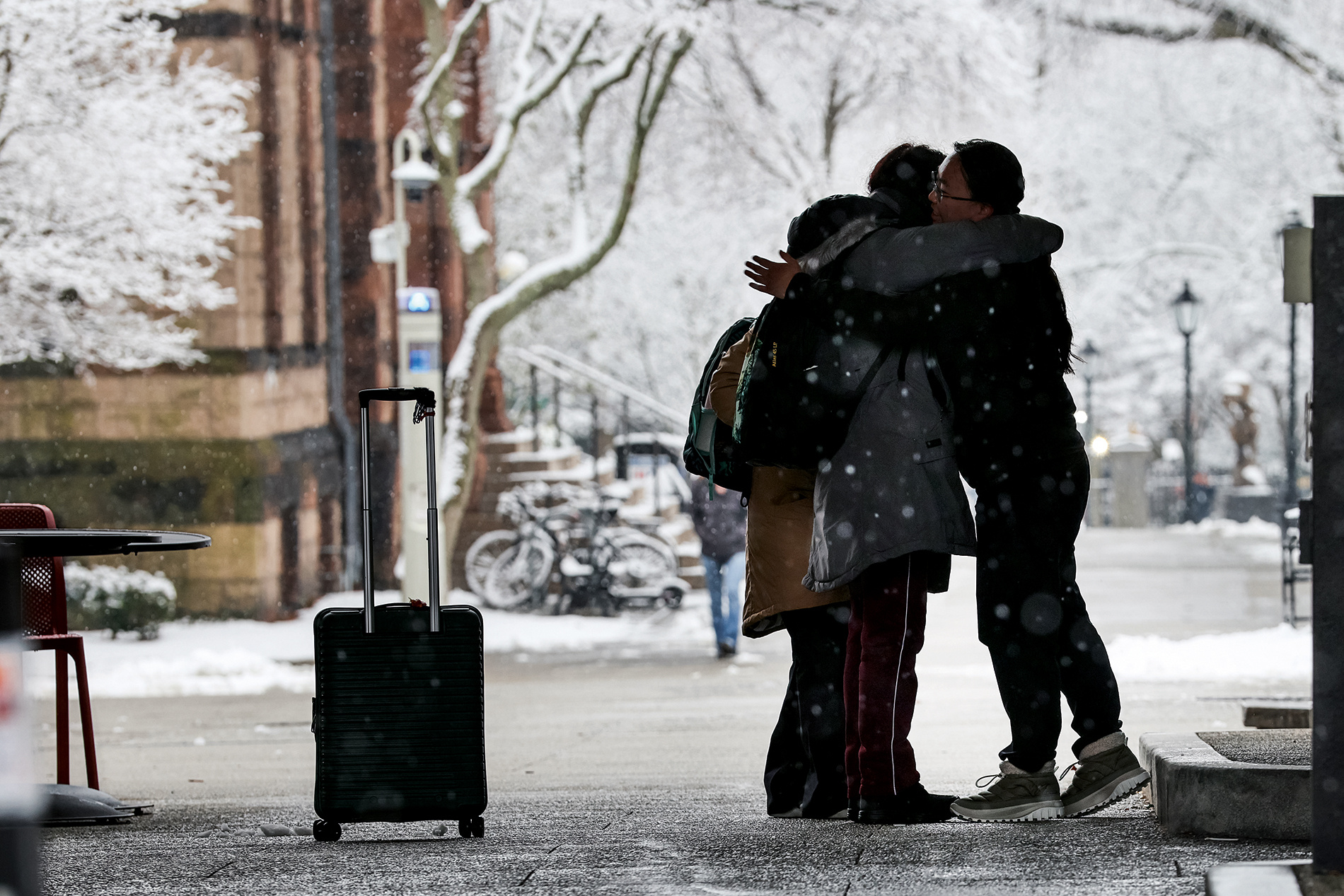
Content warning: This article contains references to the mass shooting at Brown University, including discussions of gun violence and the loss of life.
Those Bangs Were Gunshots
I was in the B&H computer lab on the first floor with about five other people. The noises sounded like loud bangs against the wall. I made eye contact with a woman seven computers away. “Were those gunshots?” we asked each other. We decided they weren’t. I even remember saying, “Only in America would we assume a noise is gunshots.”
Then, a TA sitting a few rows behind me got a phone call. I heard him say, “Are you serious?” before he left the room. Within a minute, someone in the back of the lab got a call. I heard her repeat what she was hearing: “active shooter.” I put it all together and told the woman next to me, “Those bangs were gunshots.”
I recognized one of the guys in the room, Solomon; we had gone to the same high school. I ran over to him. “Those were gunshots,” I said, though a part of me still didn’t fully believe it. Solomon ran to the door and said, “I think we should leave.” He waited for me while I grabbed my backpack—one of many moments of kindness to come.
None of us knew enough to run yet. We walked past the engineering café, where laptops and papers sat abandoned on the tables. It turns out we were so late to evacuate that we missed the rush of students running out. There was even a window of time after the shots when we had all just continued to work, right up until the phone calls started.
Outside, we saw police cars and officers charging toward B&H. They were shouting, “Where were the gunshots?” So I told them what I’d heard. I took a photo of the police response at 4:15 p.m.
I headed to the SciLi—I’d lost Solomon when I stopped to talk to the police—and immediately found my roommate. Moments later, we were rushed into the basement and the doors were locked behind us. About 200 of us ended up down there. We weren’t hiding or terrified because the police were present, but we were all on our phones trying to make sense of it. Some people were crying; I went over to a friend who looked distraught and we hugged. There were a lot of hugs in the 24 hours to follow.
Within an hour, I heard that two students had been killed and nine injured. It felt real the moment I heard an upperclassman in the basement describe walking by MacMillan and seeing two people on the ground—one wounded in the chest, the other in the leg.
We stayed in the SciLi until 9:40 p.m., then were bused to the OMAC [Olney-Margolies Athletic Center] until 2 a.m. The women had to wait outside much longer because there weren’t enough female staff to perform the police pat-downs. Inside the OMAC, every person who was visibly upset was surrounded by a group of people supporting them.
The next day, a friend’s parents rented a car to bring five of us home to New York. It freaks me out to realize how close I was to the center of it. I had gone to the bathroom just 10 minutes before the shots. I’m feeling survivor’s guilt now—something I never thought was logical before. Why feel bad for surviving? But I understand it now.
Amid all this, I have only love for Brown. It made me thankful for my life and the lives of those around me, even as I mourn the students who died. In the basement of the SciLi, I spent a long time talking to a student who had come down from the 13th floor; when we finally left the OMAC, he and another friend were barricaded out of their dorms, so they stayed with us. That connection—helping each other through it—is a special bond.
—Susana Sharp ’29
We Were Once These Kids
My immediate reaction was, “We have got to get those kids out of there.” These are students who can’t at the drop of a hat in a moment of a mass shooting pay for a new Amtrak ticket or a new flight, or even an Uber to the airport. I figured, I have this Instagram following from being an author. What is the point of having so many people read my writing if it isn’t to help my family in a crisis? And Brown is my family.
I initially wrote something very simple: “If you are a Brown student and you need help getting out of Providence, message me and let me see what I can do.” I personally paid for a couple of tickets right away. Then I put out an ask: “If you are a Brown alum who wants to get students home, message me.” And so instead of doomscrolling, I spent the first night, the next day, and the next night playing travel agent matchmaker on Instagram.
For every student who wrote to me, there were two or three alums to match them with. There were a few bigger items—for international students who were first-generation and low-income who needed a $1,000 plane ticket. It was quite easy to crowdsource, to get a bunch of people to give $50 or $100.
I approached this as, we were once these kids, and now these are all our kids. I don’t know how many we helped. Many.
My book club in Brooklyn is 70 percent Brown grads. I went to them with the Instagram DMs first. I’m thankful to alums who work for ride-sharing companies and airlines who all tried to figure out a way to get these kids home, and to students and alums who work in advocacy for gun control and common-sense gun reform. Direct action is important, but I believe this is an urgent call for widespread legislative change. The urgency of gun reform has hit home in a new way for many members of the Brown community.
Brown is where I met my husband. Our children exist because of Brown. Both of our mothers went to Brown. The Brown community has now shown up for one another in the way a family does—which is, in a crisis you drop everything to help.
—Bess Kalb ’10
I Was Working at Coffee Exchange [on Wickenden]
A customer came in and told me there was an active shooter. When I looked at my phone, I had missed calls and messages, all from friends and family asking if I was safe. That’s when I started to panic a little bit, even more so when I went to the breakroom and saw women from Brown hiding.
Later, I heard that the Trader Joe’s was hiding people in their breakroom. We had at least 20 people from Brown at Coffee Exchange in our breakroom, in the basement, and on the stairs. We barricaded the doors. We hid in the dark for about four hours, hearing sirens and helicopters.
I felt incredibly safe here before this happened. I would leave my laptop at B&H and go get food and come back. I’m sure Brown will take more security precautions, but I think this will definitely change how Brown feels for a lot of people. I want to go back to a Brown that doesn’t exist anymore.
I’m heartwarmed by all the GoFundMes for victims’ hospital bills and family costs. There are flowers on B&H and the Van Wickle Gates. People [invited students to stay] in their homes and [provided] home-cooked meals.
Brown is one of the strongest communities I’ve ever encountered, and it’s making that known right now.
—Ava-Celeste Matos ’25, ’26 ScM
At Louis the Next Morning
My sister insisted we open on Sunday at 6 a.m., and it was a busy day, with a lot of students coming in and hugging and crying. I’m glad I was there to see them have a chance to be with one another. [Ella Cook, one of the students who died,] was a regular customer here—the life of the party, very likable and friendly. We’ve been part of the Brown family for decades, so this hits us hard—but we know Brown will come through it because it’s a very special place.
—John Gianfrancesco
Owner, Louis Family Restaurant
A Mutual Aid Form Went Viral
I spent the entire night messaging people to make sure they were okay in their different shelter-in-place areas and trying to connect people who were alone to others, or to connect them to food. Students who were within a certain perimeter were brought together eventually by police into OMAC.
Shortly after lockdown ended, we at the UCS started a community assistance/mutual aid form that went viral. It was to let folks outside the Brown campus community offer anything to students in need, which could be food, a place to stay, funding to rebook flights. Within about 24 hours we had roughly 2,000 responses from students, alums, and parents.
Brown as a physical space doesn’t feel quite the same anymore. I’m not sure of the next time I’ll be able to walk into B&H or even be on South Campus. But I haven’t felt this much pride for Brown and our community in a while, because we’ve seen how beautifully people are coming together.
—Alexa Theodoropolous ’27
Treasurer, Undergraduate Council of Students (UCS)
A Brown Magnet on the Car
We got Grace home on Sunday night. It was great to put my arms around her at the airport. Now, I mostly feel intense heartbreak, heartache. There’s probably not a place on earth with a bigger concentration of really nice people than Brown. These kids just care so much about each other. They care about learning. For those of us who were fortunate enough to have lived on College Hill, we know how amazing the place is. As alumni, it’s up to us to do everything we can to make sure the kids who are there now still get to have that experience.
I keep thinking that many kids at Brown will go on to run our country and the world. If there are any kids who are going to figure out how to make sure this never happens again, it’s probably the kids at Brown.
Brown is not the kind of school where when you graduate you hang a big Brown flag from your house. But it’s funny, at Parents’ Weekend I bought a little magnet for the back of my car. I hadn’t put it on. This weekend, I pulled it out of the bag and put it on the car.
—Amy Rosenfeld Berry ’97
Mother of Grace Berry ’29
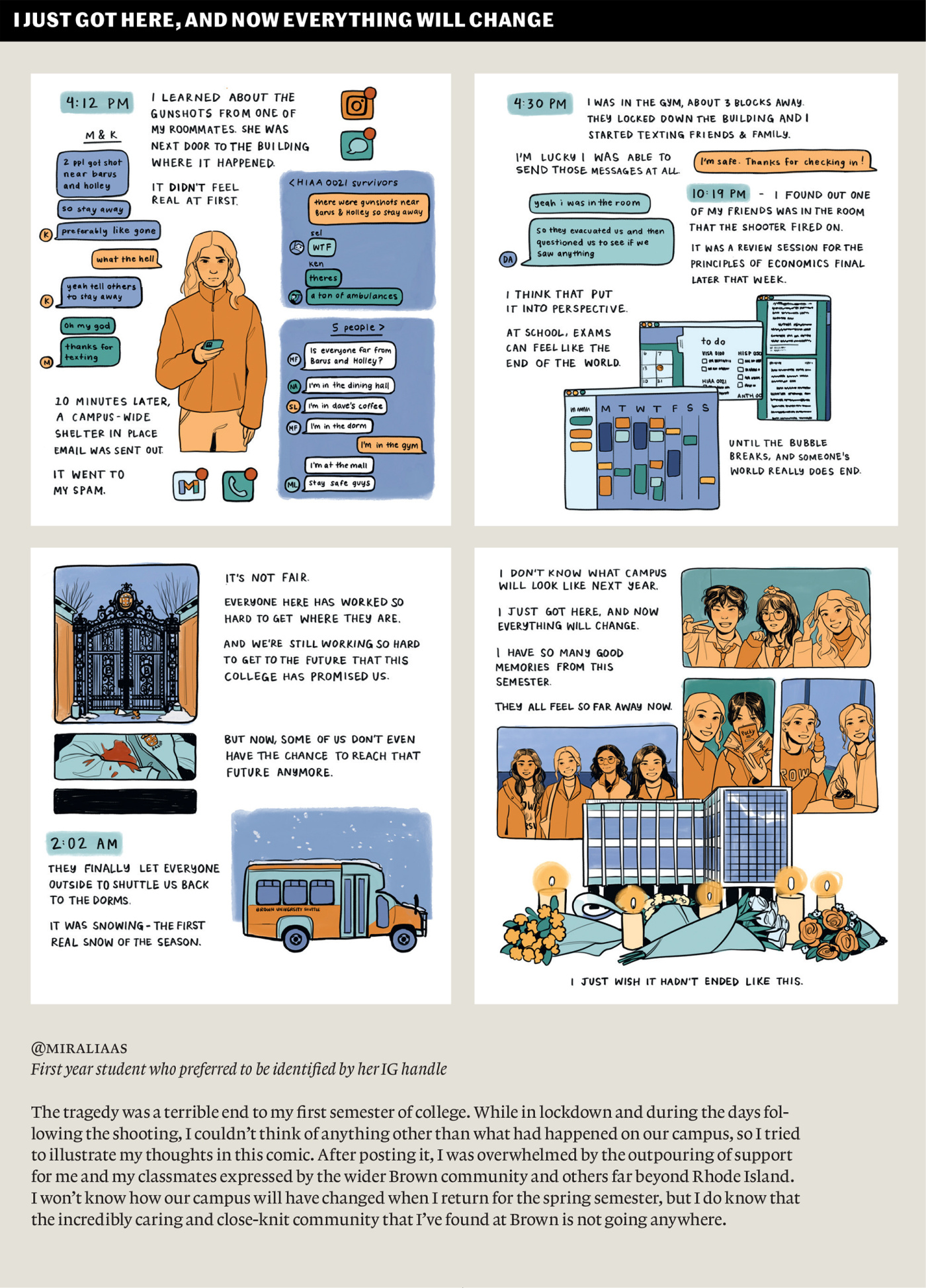
Bystanders Can Save Lives
I’m not a politically active person, but when the focus of the conversation is on how many cameras there were or someone’s nation of origin, it deflects from the fact that the real issue here is that we have a gun problem.
As an emergency physician, as an educator, as somebody who trains both medical people and lay people on lifesaving skills, I thought a lot about the students [in the classroom] who were suddenly called into action to provide first aid to their peers who were injured. At any given second, any of us could be asked to turn from bystander to lifesaving care-giver. I help train people to feel empowered to administer CPR, use an AED [a defibrillator], apply a tourniquet, give Narcan. These are skills that I think all of our young people should have. Sadly, these events will probably continue. A couple of years ago, I came up with a training program, a half-day workshop. In our simulation center, we have mannequins, equipment, and lots of technology to help recreate medical emergencies. We obviously have one on penetrating trauma and how to use what we call a tactical tourniquet to stop bleeding.
It’s really about getting participants in the mindset that no one else is going to be coming in the next 30 seconds, so you’ve got to step up and act.
—BRIAN CLYNE ’97 MD, ’18 EMHL
Brown Professor of Emergency Medicine
What Can I Say to Help Their Healing?
I was angry and politicizing the event in my mind until I remembered that two family friends’ daughters were freshmen. I immediately reached out to see if they were okay. Luckily, they were not shot. However, one was in Barus & Holley. I had just hosted an event in Oakland, California, for the 25th anniversary of the Inman Page Black Alumni Council. How quickly we can go from euphoria to sadness and dismay. I’m racking my brain thinking of what can I say to the freshmen to help and not hinder their healing. I suppose it’s to do more listening than speaking.
—RICH JONES ’82
Unfortunately, I Was Not Surprised
Everytown is the largest gun violence prevention organization in the U.S. My job is to think about horrible shootings, but this one felt different. I took Principles of Economics with Professor Rachel Friedberg my freshman year. I can picture that exact classroom in Barus & Holley. It’s a horrific reminder of how unacceptable America’s gun violence crisis is. Every person, student, and teacher deserves to feel safe in their school and in their classroom.
Unfortunately, I was not surprised. I mean, it’s jarring, because Brown does feel like such a safe community. I remember walking home at 1 a.m. and thinking, “I’m totally fine. This is such a sanctuary.” But no place is safe. Until we have federal laws protecting us, people can carry guns into states that have bans on assault weapons. We need the federal government to step in.
—KATRIANNA OKAMOTO ’19
Associate Director of Donor Advancement, Everytown for Gun Safety