
Over a Zoom call from his home in Athens, Greece, Andreas Laras ’92 PhD shows off several examples of his great love—cacti. “See, this one looks like a sea urchin,” he says. “And this one looks like an artichoke .... I grew this one in 1995.” He holds up one that looks like a white Louise Bourgeois sculpture, then another that looks like a small, sinister octopus or Medusa’s head.
Laras’s passion for his spiky sidekicks started as a teen, when he walked into an Athens florist and saw what he recalls as “a tiny little globular cactus. I was hooked. Its shape, its symmetry—they’re just marvelous plants.”
Laras would go on to earn degrees from the University of Massachusetts and Brown and become a molecular biologist who currently studies the hepatitis B virus at the University of Athens—specifically a molecule within the virus called cccDNA that, if properly targeted, he says, could lead to a breakthrough cure.
Yet it’s only when discussing cacti that he comes alive on the Zoom. He has two greenhouses filled with 2,000 of them—which he says may well be one of the world’s largest non-institutional cactus collections.
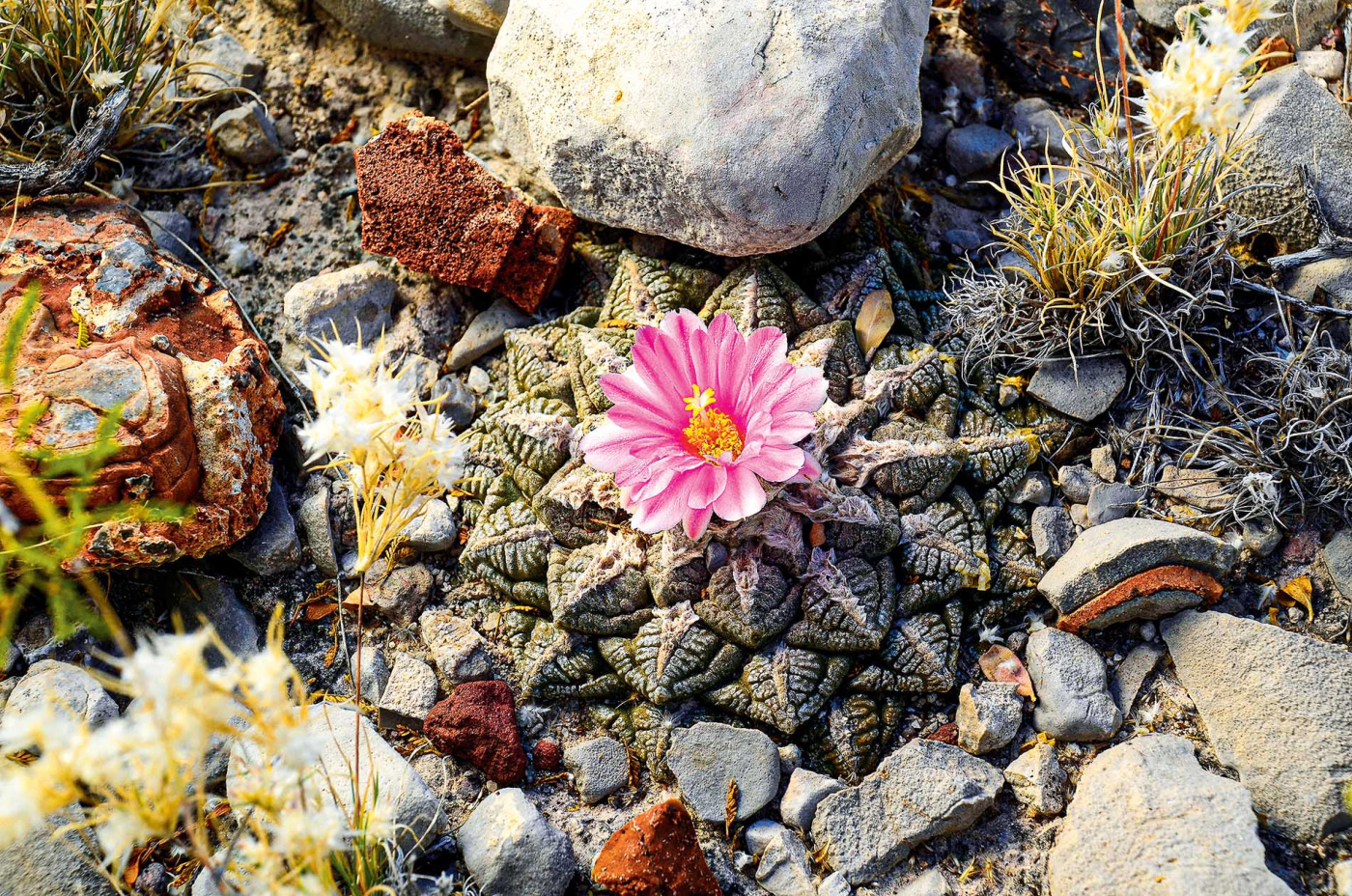
That Medusa cactus is a member of Laras’s favorite genus, ariocarpus, which is a succulent that tends to blend into the rocks it grows on in Mexico and Texas but betrays itself with distinctive, colorful flowers. He discovered them in 1999, following a Dallas hepatology meeting when he spent a week in Texas’s Big Bend National Park near the Mexican border. “It was embedded in white rock and it marked me,” he says. “The visual strangeness of these plants is impossible to forget.”
Since then, Laras has been on 13 cactus trips to Texas or Mexico, a country that he says has fully half of all cactus types in the world. “It has nine different bioclimatic zones, from jungle to alpine, so this creates a huge number of cacti.” His best trip was a week in Mexico during which he slept under the desert stars. “I discovered many new cactus populations that I think nobody had ever seen before,” he says. On another sleeping bag trip, again in Big Bend, “I woke up to see that a big boar and her nine pups were eating my nachos.”
He hopes to go to Chihuahua and Coahuila in fall 2026. On his trips he measures, photographs, and takes copious notes on the cacti he finds. But unlike with the hep B virus, his obsession with cacti seems more aesthetic and spiritual than purpose-driven. He feels very protective toward ariocarpus plants, which he says are endangered and vulnerable to animal trampling and human poaching. “They feed the bees and they’re big water reserves for many different insects,” he says. Can they teach us something important? “Why should they?” he retorts. “They’re living creatures who deserve our love and affection.”
His trips to commune with these ouch-y objects of his affection are “a way to escape life,” he says. “We always have this curiosity of living another life.” Does he wish he had made cacti his profession? He pauses and sighs wistfully, then says: “I wish I could live more than one life.”