

Related Issue

Summer 2026
It can be said that Peter Howitt’s journey to receiving the Nobel Prize in Economic Sciences began when he was a teenager working weekends with a wool broker in Ontario, Canada. Fascinated by watching the price of wool from around the globe rise and fall on the office teletype machine, Howitt’s interest in economics was piqued.
After receiving a BA in economics from McGill University and a PhD from Northwestern, he began teaching at the University of Western Ontario. By 1987, he’d earned a reputation as an influential monetary economist when an almost-chance encounter with the French economist Philippe Aghion at MIT changed both of their careers.
Howitt was at Cambridge on sabbatical, planning to con-duct research on unemployment. Aghion was a newly minted assistant professor. Their offices were adjacent, and the scholars began talking about developing a new model of growth built around the Austrian economist Joseph Schumpeter’s ideas of “creative destruction,” coined in 1942, which said that new innovations render existing methods outdated.
Before long Aghion and Howitt were going back and forth between offices, scribbling equations on the blackboards, their research eventually leading to their 1992 publication of “A Model of Growth Through Creative Destruction,” which demonstrates that creative destruction is at the heart of economic growth.—JANE SASSEEN
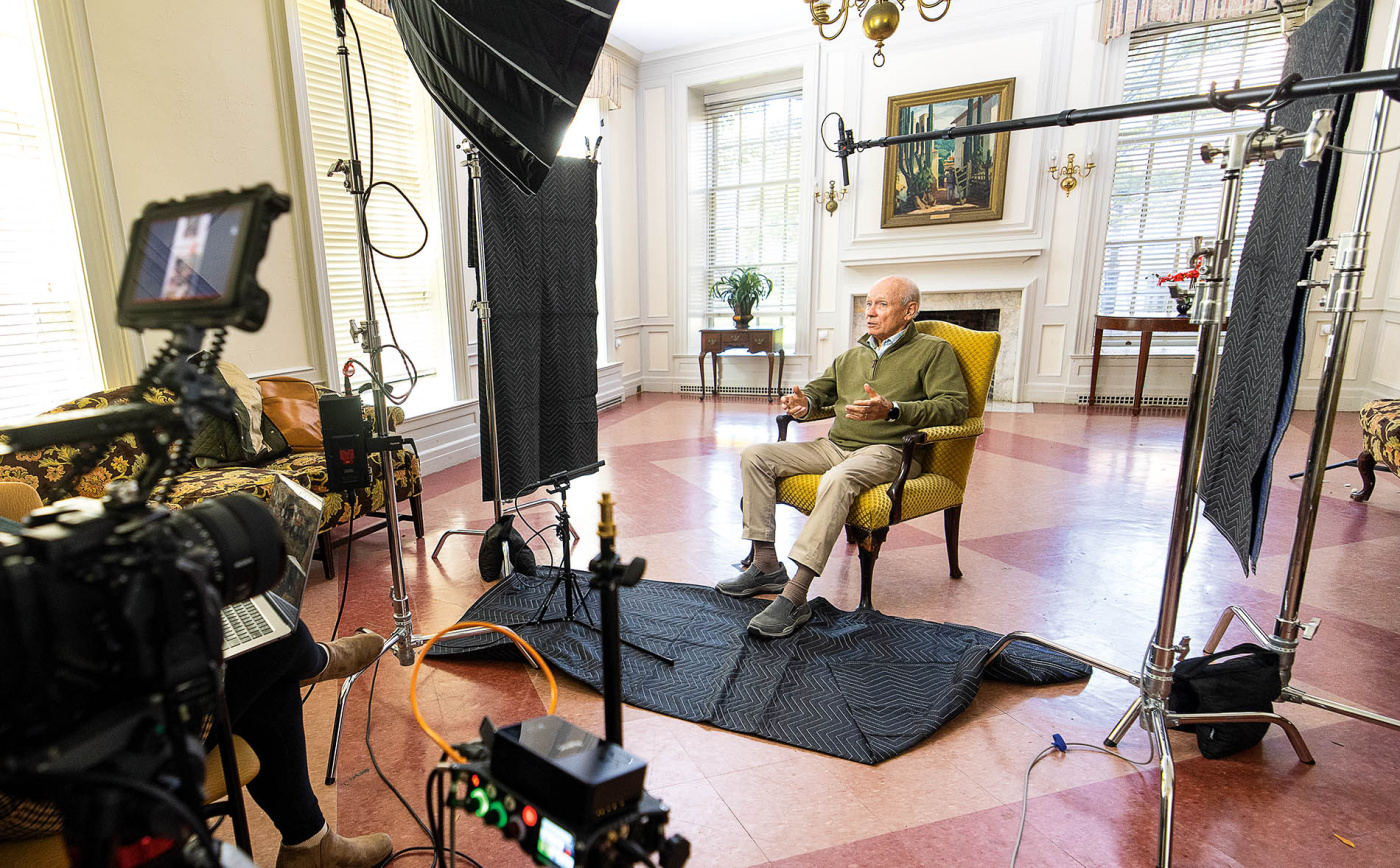
Can you explain creative destruction and the research for which you and Aghion received the Nobel Prize?
It refers to the fact that economic growth is driven by technological progress in the long run—and that technological progress in turn is driven by innovations, new ideas, new products, and new processes that are created by people engaging in research and development, which can be expensive activities.
Some of that research is done at universities, some of it is done in government agencies, and a lot of it is done within businesses—and it will only be done if there’s a profit to be made. This creates benefits for much of humankind, but it also creates losses for some people, because it renders old products and processes obsolete.
That means that at the heart of economic growth there is this conflict: Economic growth does not naturally benefit everyone in society uniformly. And in this conflict, the losers don’t just take this passively. They can undertake activities to try to block the introduction of new technologies; it’s in their economic interest to do so. But no one knew how to capture that in a mathematically formulated model that could be used to estimate the size of different effects, to measure how much, say, incentives to do research and development would foster economic growth, and to test the various hypotheses associated with it.
What Philippe and I managed to do was create a coherent, mathematically precise model of the process that could be taken to the data and used to try to learn more about the growth process.
These predictions so far have never come true, and the reason is because general-purpose technologies have indeed rendered a lot of human skills obsolete, but they’ve also greatly enhanced productivity. In some cases, they’ve introduced new jobs and new tasks to be performed that didn’t exist before the new technologies came around and that turned out to be much more productive than anything people might have done in the past. And we can only hope that will be the case with artificial intelligence. For a long time, a new general-purpose technology seems to have nothing but negative effects on most people, and when it finally starts to pay off, it often does so in ways that people have never expected before. We’re still in the early stages of it right now, and it’s a scary ride. But openness to competition and new ideas is really important. It’s a value that many people cherish, but I think it’s one that also has tremendous economic value for a country.
Should the concept of creative destruction inform current economic policy?
There are a number of policy implications that follow from this way of looking at economic growth. One of them has to do with competition policy and antitrust policy. When Schumpeter first wrote about creative destruction, he concluded that it would be wise for governments not to try to break up monopolies or break up trusts or enforce competition laws very strictly. Why? Because that would reduce the profits that monopolies could make, and one of the incentives to create new products and processes was the prospect of having something that your competitors couldn’t match so that you can actually capture and monopolize a market because what you’ve got is so much better than [what] anyone else [has]. If you enforce these policies too rigorously, it would reduce the prospective profits that an investor might anticipate and therefore reduce incentive to come up with new products.
That was what people used to think of as one of the implications of creative destruction. But one of the things that we managed to come up with by having created a formal model was that there was another effect that turns out to be just as important—and actually, in most cases, even more important—which is what we call the “escape competition” effect. If you allow young upstarts more access to new markets, you make it easier for people to compete with established firms. You raise the prospects for potential innovators to break into a market, and you also increase the incentive of the established leaders to continue innovating in order to stay ahead of the competition.
If it’s difficult to enter an industry, then the established leaders don’t feel threatened. They don’t have to undertake what for them would be disruptive innovations, and they continue to enjoy their nice, quiet life as monopolists reaping lots of profits. But with people nipping at their heels all the time, they’ve got to continue to innovate, and this is what we, with our model, managed to estimate with some help from econometricians: We found that, indeed, in many markets, it’s this “escape competition” effect that’s the dominant implication of our theory with respect to competition policy.
So, I think that in the United States and in other industrialized countries, the implication is that we should probably be more vigorous in our enforcement of antitrust policies than we have been in the past.—JENNA PELLETIER
This interview has been edited for space.
WHY BROWN?
A lot of the ideas that Philippe and I came up with at first were somewhat challenging to previous theories of economic growth—and this was a very supportive environment in which to come up with new ideas that weren’t yet part of the mainstream.—PETER HOWITT