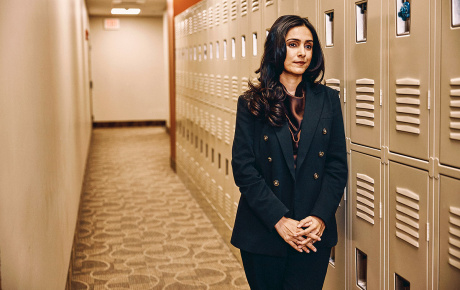

Glioblastoma is among the most difficult cancers to treat; less than 5 percent of patients survive five years beyond their diagnosis. Dr. Linda Liau ’87, chair of the department of neurosurgery at UCLA, saw such devastation firsthand when her mother died at 51 of a brain tumor from metastatic breast cancer. That’s what made Liau decide, in the middle of her UCLA residency, to go back to school for her PhD in cancer biology and immunology related to neurosurgery. Around 2000, she came up with a theory: if the body’s white blood cells were unable to get into the brain to fight tumor cells because of the blood-brain barrier, what if—outside the brain—the patient’s white blood cells were exposed to tumor cells derived from surgery, then reinfused as a vaccine back into the patient’s brain? Might those white blood cells then fight the tumor?
Trials on her idea began in 2003 and ran through 2019, with the results published in JAMA Oncology in 2023: Of 331 patients who got the vaccine, an impressive 20 to 25 percent were alive years later. Her research now focuses on why that subset of patients fared well, looking closely at their blood, cerebrospinal fluid, and even gut microbiome. One clue might be a biomarker called MGMT methylation that, generally, is possessed by those who fared well. “But nobody knows what the biomarker actually does,” admitted Liau.
For her pioneering research, last year Liau received the J.E. Wallace Sterling Lifetime Achievement Award in Medicine from the Stanford Medicine Alumni Association. Despite having performed countless brain surgeries, she’s still fascinated to see “the live brain, open and exposed” once she and colleagues cut through the skull with a power drill—“it’s like taking off a manhole cover.” Then, because brain tumor removal is still largely done by hand and not robotics, “we joke that we have to be careful not to take out everything someone learned or remembers from high school.” She also said there’s no master map for every brain. “Something like language is not specific to one area, and if you speak more than one language, they could be in different places depending on the age you learned them.” And tumors, she said, can push parts of the brain into unusual places.
Liau, whose daughter went to both Brown undergraduate and med school, said that advances in immunotherapy treatments for cancer have exploded in only a decade, now providing longer life to roughly a quarter of patients who received them. She tried to get her mother on Herceptin, the breakthrough drug for metastatic breast cancer, but it was only in trials at the time, none of which she could get her mother into. “To this day,” she said, “I wonder if she’d have lived longer if she’d gotten that drug. That’s the emotional aspect of my work—giving patients hope when they have a devastating disease.”