
Related Issue
Winter 2025-2026
In 1992, the artists Coco Fusco ’82 and Guillermo Gómez-Peña staged a performance art piece in four countries called “Two Amerindians Visit the West.” In the piece, Fusco, a longtime Brooklyner raised in New York City by a Cuban-born mom, and Gómez-Peña, born in Mexico City, walked around in a cage and pretended that they were non-English-speaking natives of a fictional uncolonized island in the Gulf of Mexico.
The work, a sly riff on the racist 19th-century practice of showing off actual caged people from faraway lands at exhibitions in the U.S. and Europe, was meant to be a commentary on how westerners have long gazed upon dark-skinned people from remote locales as primitive. “Unfortunately,” says Fusco, “some people didn’t understand that it was satire.” Viewers earnestly called the Humane Society to report the art duo’s mistreatment and one man begged Fusco to let him pay her $10 for a photo of him feeding her a banana. “When you’re an artist, you can’t control how people respond to your work,” Fusco says.
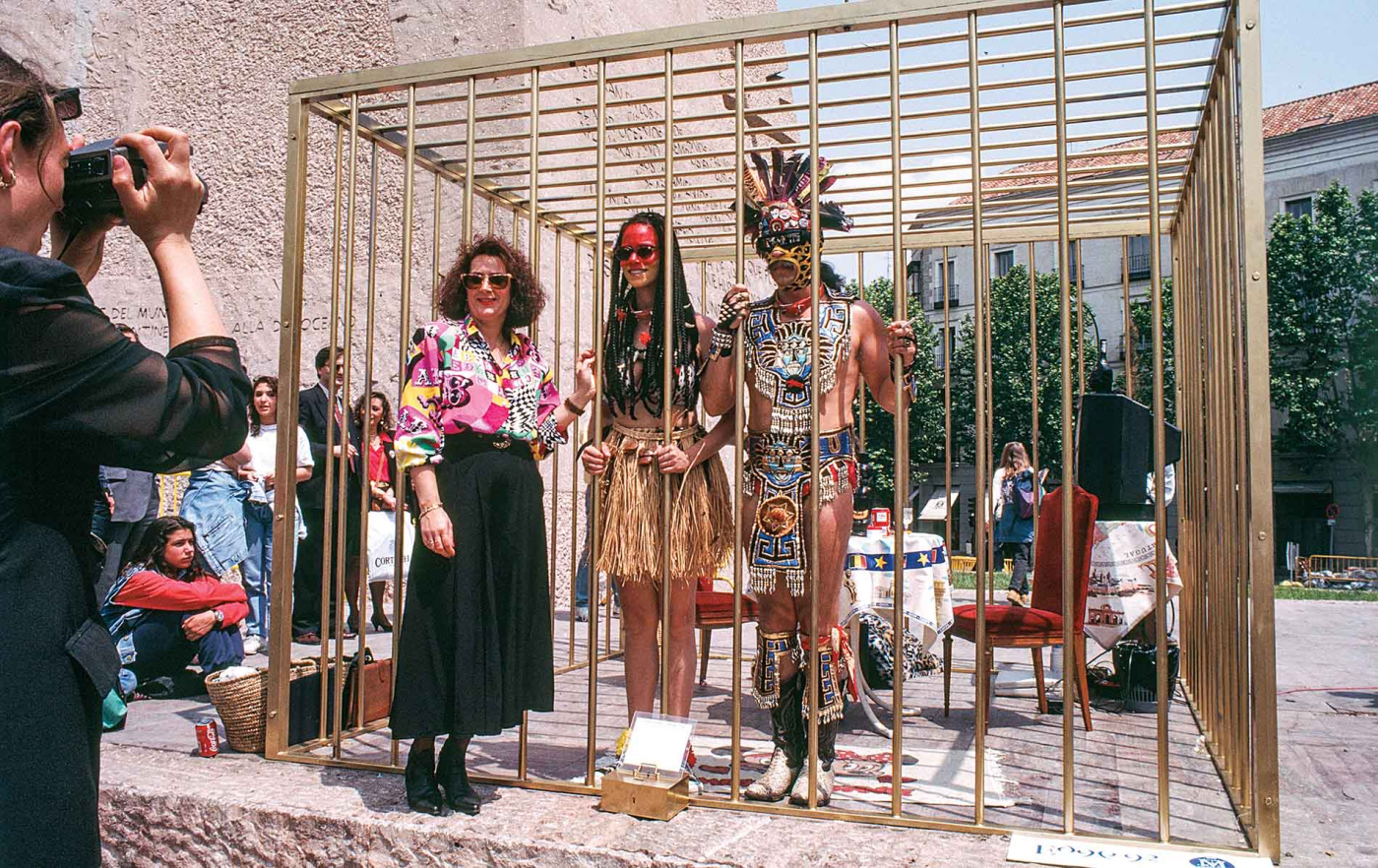
Fusco’s work, dismissed by some early ’90s critics as “identity politics” art, is now considered iconic, earning the attention of a new generation of curators and critics. Visual documentation of “Two Amerindians” is part of the permanent collection of the Museum of Modern Art. That and other of her works have been shown at the 56th Venice Biennale, Frieze, Basel, and three Whitney Museum biennials in New York City.
A multidecade retrospective of Fusco’s work called “Tomorrow, I Will Become an Island” opened at NYC’s Museo del Barrio in September and runs through January 11, 2026. The show, parts of which have been exhibited in recent years at Berlin’s KW Institute, will also include some previously unshown works, including one that juxtaposes Fusco’s restaging of photos of mostly European immigrants who arrived at Ellis Island around 1900 with photos of recent arrivals in the city, mostly from Latin America. “A lot of the peasants arriving more than 100 years ago from Europe looked just as freaky and exotic to New Yorkers as people coming now,” she says, “like a German stowaway covered in tattoos.”
Fusco, a professor at the Cooper Union School of Art, is keenly aware that, for more than 30 years, she’s challenged art-worlders who don’t consider work about race, ethnicity, and difference to be legitimate. “I’ve always been typecast as the race and gender girl, which I deeply resent,” she says. “But as a teacher, I’ve always tried to show artwork from all cultures and backgrounds, because I believe Americans should know about them.”