
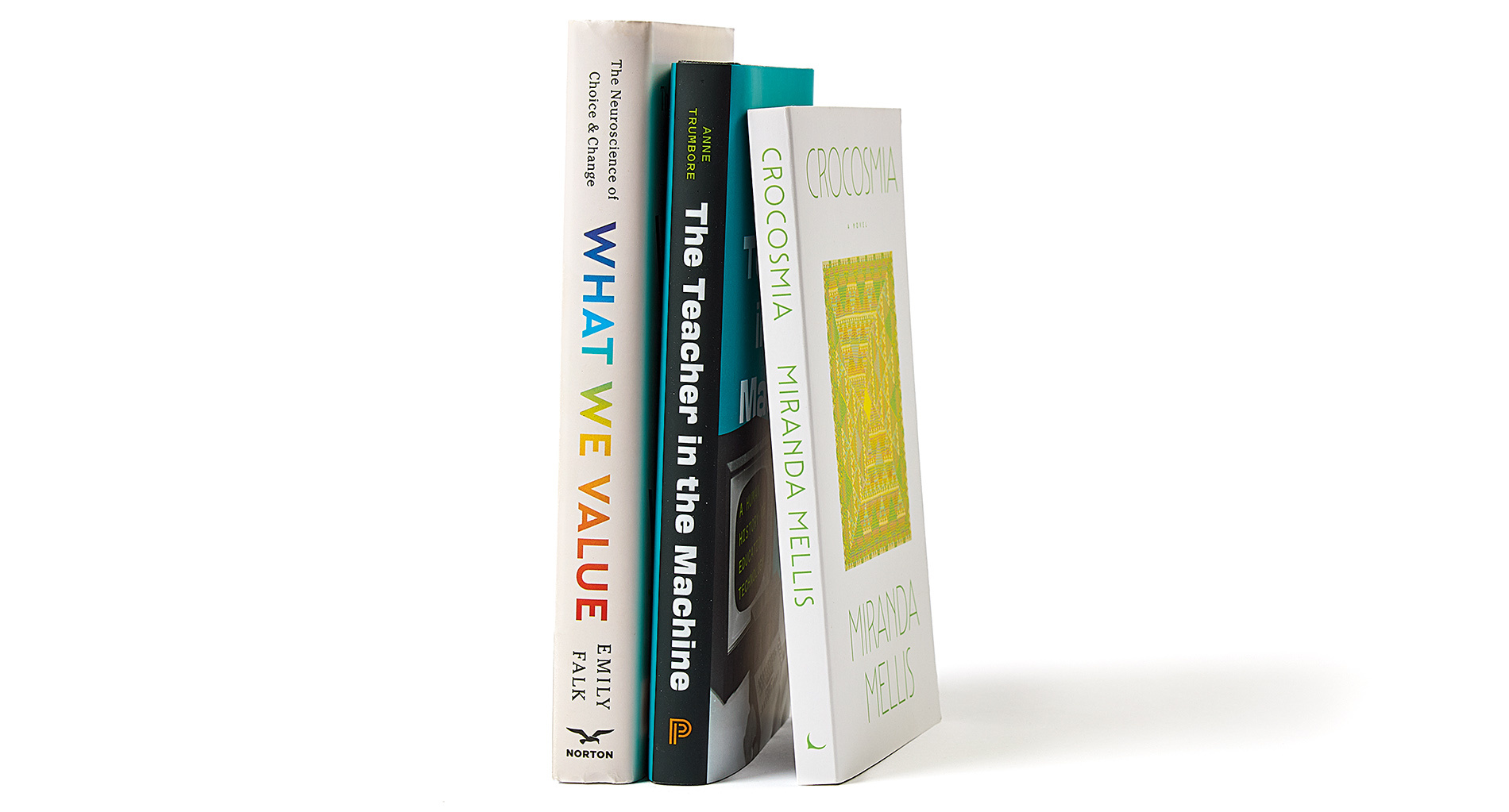
Crocosmia, by Miranda Mellis ’04 MFA (Nightboat Books)
In this brief novel, which floats like a philosophical fairy tale, you’ll meet Maya as she sits at a café on an observation deck encircling the stem of a 2,200-foot tall red-petaled crocosmia flower. It’s the near future, and the world is recovering from strings of ecological disasters, and most everyone is migrating, again and again, to escape the ravages of climate change. Maya is looping through memories of growing up in a commune, the Anarchesty, and of her missing mother, Jane, an artist and professor, whose work led to the “Great Turning,” a vast social and ecological shift. The novel is woven through with political and ecological meditations but ends with a surprising swing toward hope.
The Teacher in the Machine: A Human History of Education Technology, by Anne Trumbore ’89 (Princeton University Press)
Laced with interviews, case histories and plenty of historical perspective, Trumbore’s book does a vivid job tracing how universities have often been taken advantage of by corporations in the uneasy marriage of teaching and technology. Trumbore, who has worked in education technology for decades and helped develop one of the first online high schools, points out that using computers in education actually dates back to the middle of the last century. While there is a long history of tech advances designed to transform an education system that is always “in crisis,” a great many of those, she writes, have fallen short. Her hope is that by understanding this history, universities will make wiser choices—ones that grant more returns to students than investors.
What We Value: The Neuroscience of Choice and Change, by Emily Falk ’04 (Norton)
If you’ve ever thought: Wait, why did I just decide to do that?, Falk’s debut might offer clues. Falk is a professor of communication, psychology and marketing at UPenn and directs the Annenberg School’s Communication Neuroscience Lab. Here she’s written a bright, first-person, story-filled account that explores how our value systems, subjective as they are, direct our brains to weave through the tangled strands of information we face every time we make a decision—large or small. In this easy blend of narrative and neuroscience, Falk also gives concrete suggestions to help readers work with the way our brains are already arriving at decisions, which could lead to a few dropped habits and a few more fresh options.
Alumni Fiction
The Hitch by Sara Levine ’94 AM, ’98 PhD (Roxane Gay Books)
Clutch: A Novel by Emily Nemens ’05 (Tin House)
Blade by Wendy Walker ’89 (Thomas & Mercer)
Alumni Nonfiction
Overseen or Overlooked? Legislators, Armed Forces, and Democratic Accountability by David P. Auerswald ’86 (Stanford)
Moments That Matter: Marking Transitions in Midlife and Beyond by Laura Geller ’71 (CCAR Press)
Petroforms: Oil and the Shaping of Nigerian Aesthetics by Helen Kapstein ’92 (West Virginia University Press)
Justice Never Rests: A U.S. Attorney’s Battle Against Murderers, Drug Lords, Mob Kingpins & Cults by William Kolibash ’66 (Post Hill Press)
To Rule All Under Heaven: A History of Classical China from Confucius to the First Emperor by Andrew Seth Meyer ’89 (Oxford)
The Doom Loop: Why the World Economic Order is Spiralling into Disorder by Eswar S. Prasad ’86 AM (Basic Venture)
Protected: Birth Control’s Remarkable Story and Uncertain Future by Katherine (Katie) Quimby ’13, ’14 MPH (Bloomsbury)
Alumni Poetry
Poems on the Precipice by Elise Chadwick ’80 MAT (Kelsay Books)
For This and Other Cruelties by Youna Kwak ’95 (University of Iowa Press)
Misdirections by Jim Wolper ’81 PhD (Finishing Line Press)
Children’s
Buffalo Fluffalo and Puffalo by Bess Kalb ’10 (Penguin)
Spark: Jim West’s Electrifying Adventures in Creating the Microphone by Ainissa Ramirez ’90 (MIT Kids Press)
Independently Published
The Good Daughters by Brigitte Dale ’18 (Pegasus Books)
Fission: A Novel of Atomic Heartbreak by Leslie R. Schover ’74 (SheWrites Press)
You Say, I Say: Staying Alive with Literature, Language, and Friendship by Robert Waxler ’66 & David Beckman ’66 (Rivertowns Books)