
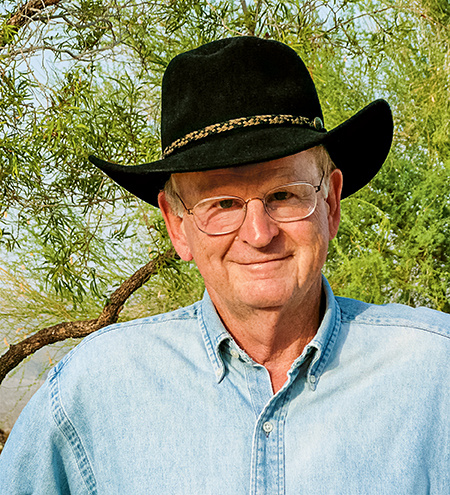
Nicholas Clapp ’57, of Borrego Springs, Calif.; Jul. 30, from a stroke. After Brown, he served in the Army Reserve and earned a master’s degree from the University of Southern California’s School of Cinematic Arts. As a filmmaker, author, and amateur archaeologist, he explored and documented the cultural and natural history of desert regions around the world, including Anza-Borrego Desert State Park (ABDSP). In Arabia, he led an expedition that discovered and unearthed the lost city of Ubar, resulting in him directing the documentary The Lost City of Arabia for the PBS series Nova in 1996. In 1998, he published The Road to Ubar: Finding the Atlantis of the Sands that became a Los Angeles Times best seller and prompted the Los Angeles Times to call him “a real-life Indiana Jones.” He told the Los Angeles Times in 1998, “As an amateur archaeologist, you can do things the professionals can’t,” and “There are no reputations at stake, no colleagues looking over your shoulder.” He lived a life of adventure and discovery as a successful documentary filmmaker for Disney, the National Geographic Society, Columbia Pictures, PBS, and David L. Wolper Productions. For two of his Oscar-nominated documentaries, Journey to the Outer Limits (1973) and The Incredible Machine (1975), he was both the producer and production manager. He edited some of the early episodes of the popular ABC series The Undersea World of Jacques Cousteau and produced and directed 1971’s The Great Mojave Desert, a one-hour special for National Geographic and CBS.
He went on to win more than 70 awards for his documentary work. For 15 years, he served on the Anza-Borrego Foundation (ABF) board in multiple capacities and was responsible for the creation of three documentary films about ABDSP, one of which continues to play daily at the Visitor Center—A Year in the Desert: Anza-Borrego (2010). In addition, he also coordinated and helped to produce a 14-minute video entitled A Desert Wilderness: Anza-Borrego (2001) that helped to create public awareness of ABF’s mission of obtaining inholdings. A condensed four-minute version of the film was completed in 2002 and used for viewing on ABF’s display inside the Visitor Center. The year that the film was released, it was named “Earthwatch Environmental Film of the Year.” He authored numerous books. His passion for filmmaking, historical research, and archaeology also inspired him to serve as a trustee of both the International Documentary Association and the American Center of Oriental Research. At the time of his death, he had a manuscript ready for publication on exploring Anza-Borrego’s Badlands. He is survived by wife Bonnie and two daughters.