
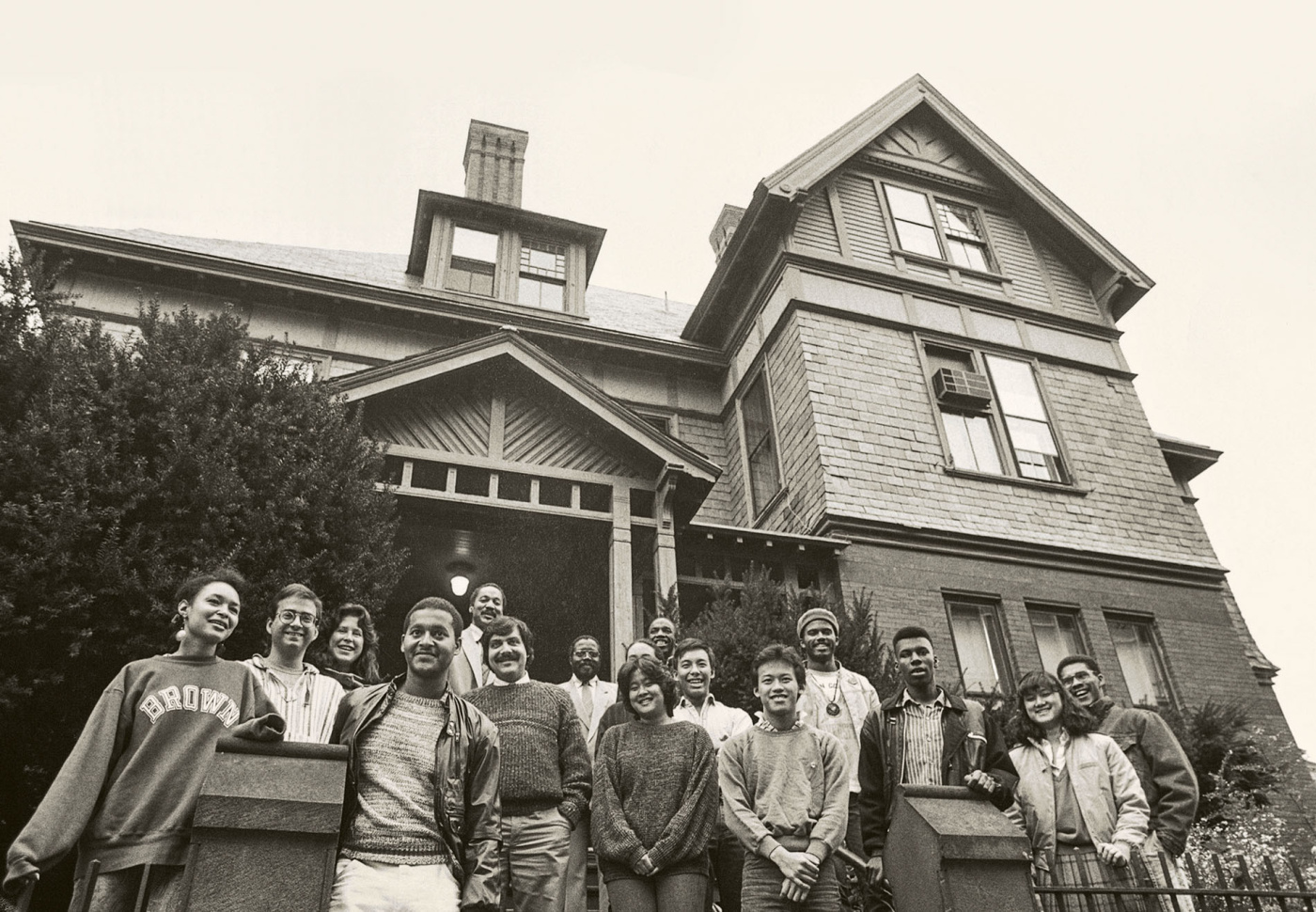
On October 25, during Parent’s Weekend, Partridge Hall was dedicated as the new Third World Center. It was a festive occasion—in dramatic contrast to the divisive circumstances that led to its inception—with balloons replacing protesters’ slogans, and cordiality supplanting indignation.
The move from the old center, located in the basement of Churchill House, was undertaken during the first weeks of September. The Churchill House facility had been established as one result of the 1975 protest by minority students in which University Hall was occupied. One of the issues raised by the 1985 protest by minority students was a new location for the Third World Center, said, been “miraculously transformed.” In addition to the administrative offices and lecture and function rooms on the first floor, a reception center and lounge, and a library on the second floor, Partridge House is now home for a variety of Third World-student organizations, including groups representing not only blacks, but Asians and Hispanics, as well as the Black Pre-Med Society and the National Society of Black Engineers.
After informal tours of the facility, a group of fifty parents and students gathered in two large first-floor rooms to be welcomed by Smith and to hear comments by Luis Hernandez ’87, on the uniqueness of the minority student’s experience at Brown and the role of the center in that experience, and by Ken Elmore ’85, currently pursuing graduate studies in multiculturalism at Boston University, on history of the center.
Dean Harriet Sheridan called the dedication “a significant moment in the history of Brown.” She pointed out that the TWC is no longer on the fringe of campus—literally and symbolically—bu is now closer to its center, ‘geographically integrated and no longer separated.” She also said that the existence of the center was evidence of the power students have “to influence the course of a university.”
When President’s Swearer commissioned the study of the minority student’s experience at Brown, which was later to take the form of the document, “The American University and the Pluralist Ideal” (BAM, June/July, 1986), he was concerned about the issue of “marginality,” of how minorities perceive themselves in the university setting. The keynote speaker was Ronald Takaki, professor of ethnic studies at the University of California at Berkeley, one of the authors of the report and of four books dealing with the African slave trade, race, and culture in nineteenth-century America, and with plantation life and labor in Hawaii. He spoke about the issue of marginality and about the difficulties facing Third World scholars in the 1980s.
Using Berkeley, where teaches Asian-American history and American race relations, as an example, he pointed out that 51 percent of the 1986 entering class were from the Third World, but 94 percent of the faculty is white. Despite these demographic changes, university curricula still reflect a “Eurocentric world view,” Takaki said, “privileging a certain body of knowledge and thus marginalizing the Third World, the exploited, and the colonized. These people’s history, literature, and culture are not recognized as a part of what the majority considers knowledge, and the Third World student suddenly finds himself in the white world.”
Takaki recalled his own experiences—he referred to himself as “this certain Third World scholar”—to point out, sometimes humorously but always pointedly, what the minority scholar faces when trying to deal with his own ethnicity in the Eurocentric university.
The basic issue of the minority students’ marginality has been addressed but not resolved. “What,” Takaki asked, “are we going to do about it?”—J.R.