
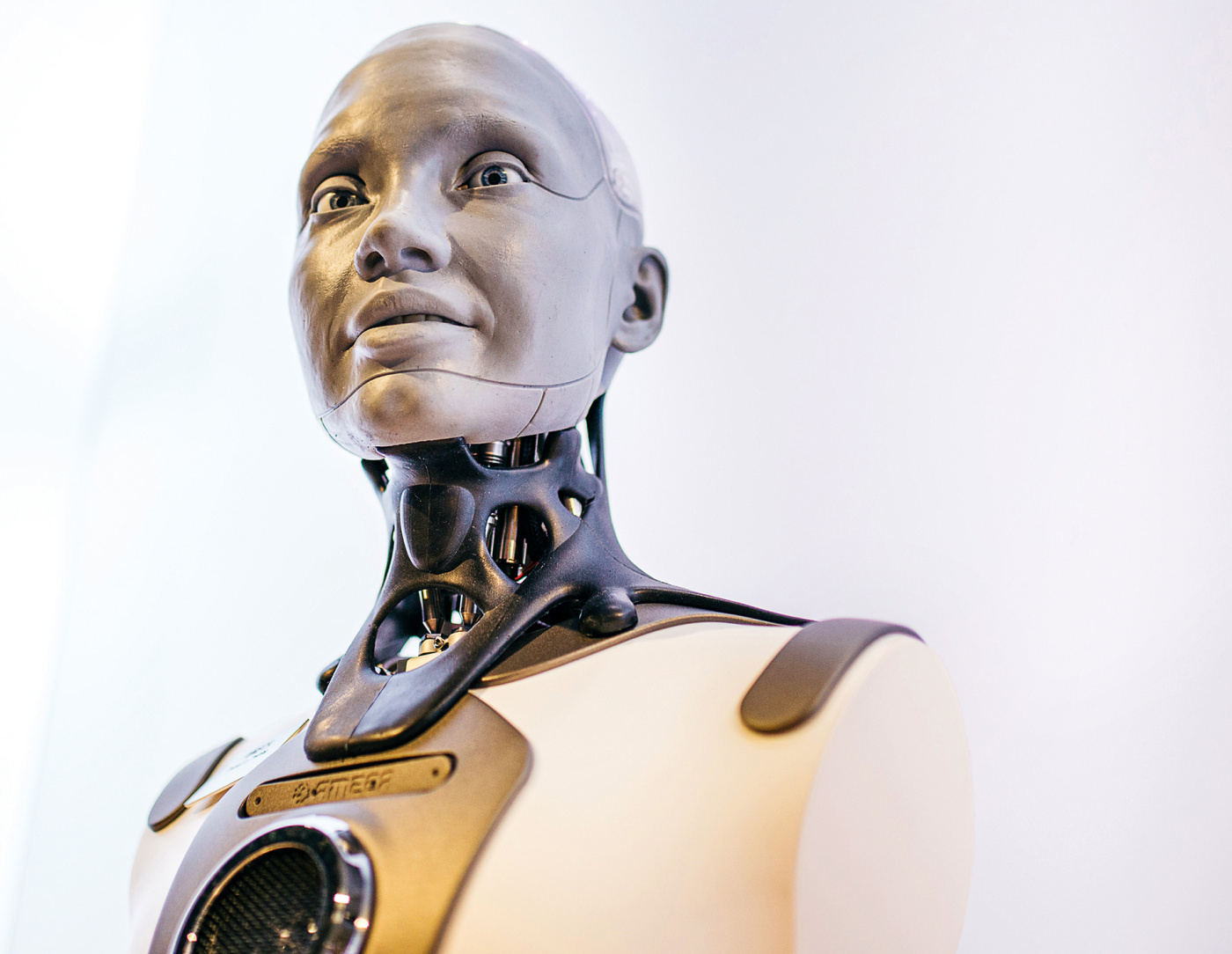
Expressive, emotional robots do not only appear in Hollywood films. Just a little farther north in Mountain View, California, there’s Ameca.
Ameca is a robotic humanoid that will talk to and interact with the people who visit her. She lives inside the Computer History Museum, a 120,000-square-foot building close to Google headquarters that opened in 2003.
“When you meet Ameca, you see her facial expressions and can hear how intelligent she is,” said Marc Etkind ’87, the museum’s CEO. “She’s our most popular exhibit.”
Ameca is one of 100,000 artifacts that have been amassed over 30 years and comprise the world’s largest collection of the digital age. The flagship exhibit, Revolution, tells 2,000 years of computer history in 25,000 square feet of space filled with interactive displays that start with the abacus and carry through to the iPhone and beyond.
“We are living through a historic moment that needs to be captured, but also needs to be explained,” Etkind said.
Etkind joined the museum in April, but he has been telling stories about science and technology since graduating from Brown with a degree in biology. He did so at Discovery Channel and History Channel, working on shows such as MythBusters, BattleBots, and the three-part documentary Silicon Valley: The Untold Story. He was head of communications at NASA, where he led a team of 400 across 10 centers and expanded the agency’s social media platforms to reach nearly half a billion followers. After four years—which included the launch of the James Webb Space Telescope—Etkind decided it was time to tell the digital side of science’s story. So he headed to California.
He arrived with a mission: “We’re a hidden gem, and I really would like us to be an unhidden gem,” Etkind said about the museum, which attracts upward of 100,000 visitors a year. He intends to bring more visibility to the museum, both inside and outside the building’s walls. There are plans to expand the exhibits to tell more stories about artificial intelligence, robotics, and crypto. Etkind also wants to build what he calls the digital museum of the future.
“We just put our collection online. It’s called Open CHM and lets us share our vast collection with the whole world,” he said.
Aside from being a lifelong storyteller, Etkind is also a self-described “museum person.” He believes these institutions are often the places where kids can learn and see things that will shape who they want to grow up and be.
“Museums collect, they share, they tell stories, they inform, and they inspire,” he said, adding that the desire to work in science came when he was a boy watching chicks hatch at the Museum of Science in Boston with his dad.
Not surprisingly, Etkind spends much of his time at work visiting the displays. His favorite: the Apollo Guidance Computer, which helped NASA astronauts land on the moon. “You couldn’t have the space revolution without the digital revolution,” he said.
“We want people to be smart about how they’re using technology. So we give you the context to understand how ideas and technology have been changing over time to get to this moment.”