
Imagine designing and building a one-of-a-kind scientific device capable of performing precisely controlled, fully self-contained experiments while meticulously recording the results—then chucking that custom-made labor of love down an eight-story elevator shaft.
Welcome to the scientific life of Madeline Federle ’23 ScM, a PhD candidate in the school of engineering. Federle spent last summer analyzing the dynamics of bubbles—in space.
“We have very little understanding of how bubbles move around in a fluid in microgravity,” Federle said. “So where bubbles go and how we control them become really important questions.”
Those questions, she says, are relevant for everything from drinking-water systems in crew cabins to the behavior of liquid fuels used for propulsion. To answer them, Federle needs ways of getting her experiments into zero gravity.
That’s where the elevator shaft comes in.
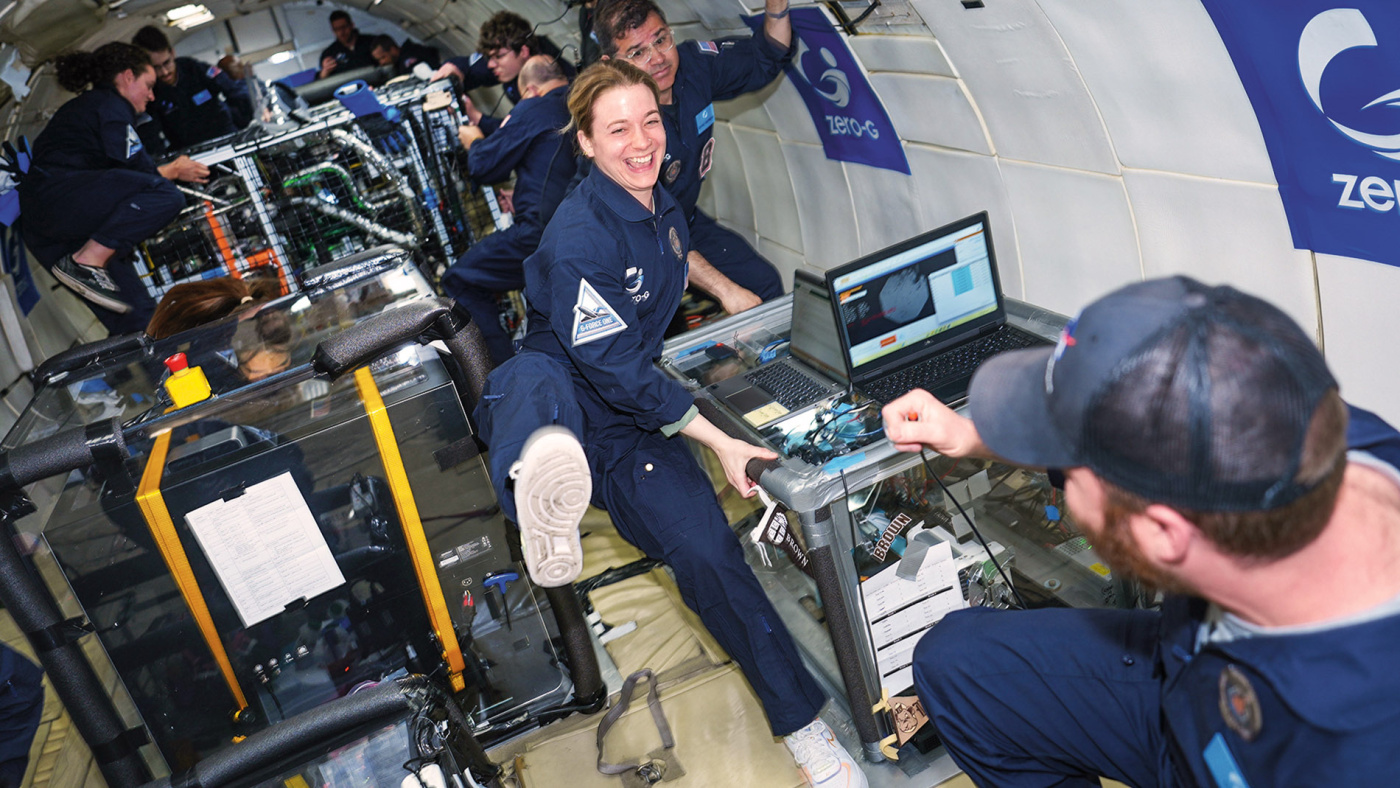
To simulate zero gravity, Federle used a NASA drop tower—an eight-story shaft that provided her device about 2 seconds of simulated weightlessness before it landed on an airbag at the bottom. Federle then managed to get a spot on a reduced-gravity aircraft flight, the “vomit comet,” as it’s affectionately known. Not only did the flights provide longer periods of weightlessness, but Federle was able to travel with the experiment and watch it as it happened.
“The bubbles were way bigger in microgravity than we expected them to be, and they broke up very differently,” she said. “We could see that in real time, which was great.”
Federle’s interest in weightlessness is more than just academic. “My dream is to be an astronaut,” she says, so experiencing the parabolic flight “was one of the best days of my life.”