
Related Issue

Fall 2026
An elephant went on a rampage and killed someone in 1916 in the Appalachian town of Kingsport, Tennessee. The elephant, known as Murderous Mary, was publicly hanged, via a crane.
In 2019 native Rhode Islander Joe Penza ’03, a clerk and archivist at the Elizabethton Carter County Library in Appalachian Tennessee, helped high school students develop a podcast about this notorious bit of town history, and it won a student podcast competition hosted by National Public Radio.
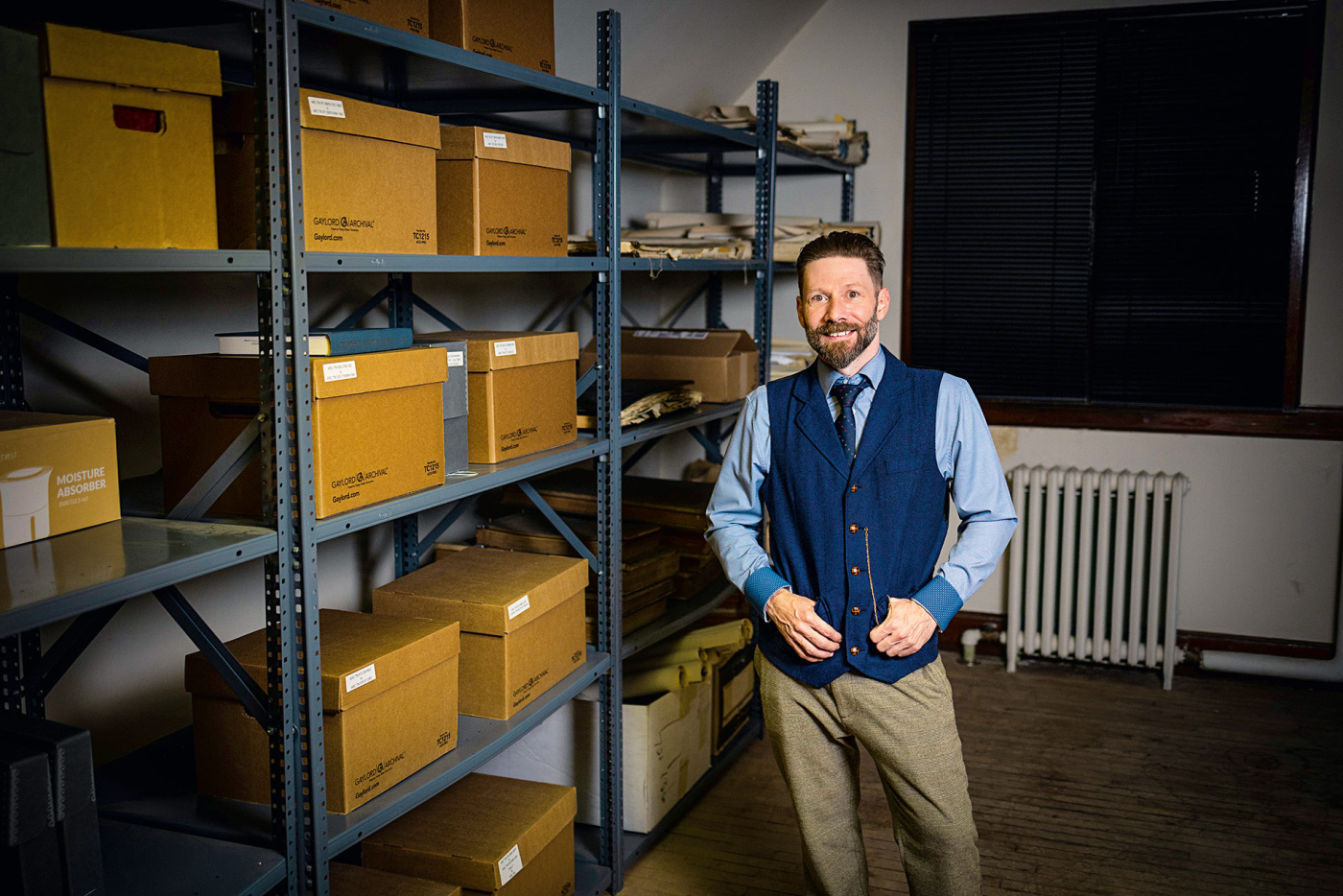
It was exactly the kind of deep dive into hyperlocal history relished by Penza, who had wanted to pursue biochemistry when he started at Brown. After taking Professor Joan Richards’s class on the 19th-century roots of modern science, Penza realized that he was more fascinated by science history than science itself. His final paper, about the construction of Brown’s chemistry labs, had him burrowing deep into the university archives.
“It was like touching the past,” he said.
After Brown, Penza held a series of odd jobs until he enrolled in a master’s program in archival studies at Eastern Tennessee State University, in the heart of Appalachia. “I was going to come for two years and leave,” he said. Instead, the Elizabethton Carter County Library hired him. The city manager asked Penza to start a regional archive. With a $2,800 Tennessee state grant, Penza digitized a trove of cookbooks, collected from decades of church and civic fundraisers and replete with regional classics like banana pudding and chicken ’n’ dumplings. The database now has over 8,000 historic community recipes.
Penza, who contributes a monthly column, “This Month in Carter County History,” to the Elizabethton Star newspaper, said he loves the community outreach part of the job the most, bringing historical arcana into schools and civic groups to encourage locals to both realize and analyze their area’s rich history.
“Graining and planing mills, iron furnaces, folk art that became hugely popular, the rayon industry—they all happened here,” he said of an area that has been hit hard by postindustrial poverty, painkillers, and addiction. “It took people here time to trust this Yankee.”
Penza believes that his archival work adds value to a region that is culturally rich, albeit economically impoverished. “People knowing their heritage and history can always uplift, because the truth uplifts, even if it’s difficult,” he said.