
Related Issue

Fall 2026
Lopez Sound blurs beneath a soft gray rain, which isn’t a surprise in the San Juan Islands, an archipelago in Washington State’s Salish Sea. Everything, including my camera, is varying degrees of wet, from damp to soaked, but by the time my drysuit is zipped, it doesn’t matter; I’m about to be underwater anyway.
I back-roll off the boat and float with my camera in the shallow, greenish water as biologists from the University of Washington’s Friday Harbor Labs and the Samish Indian Nation carefully lower a clear, plastic tub of sunflower sea stars into the ocean.
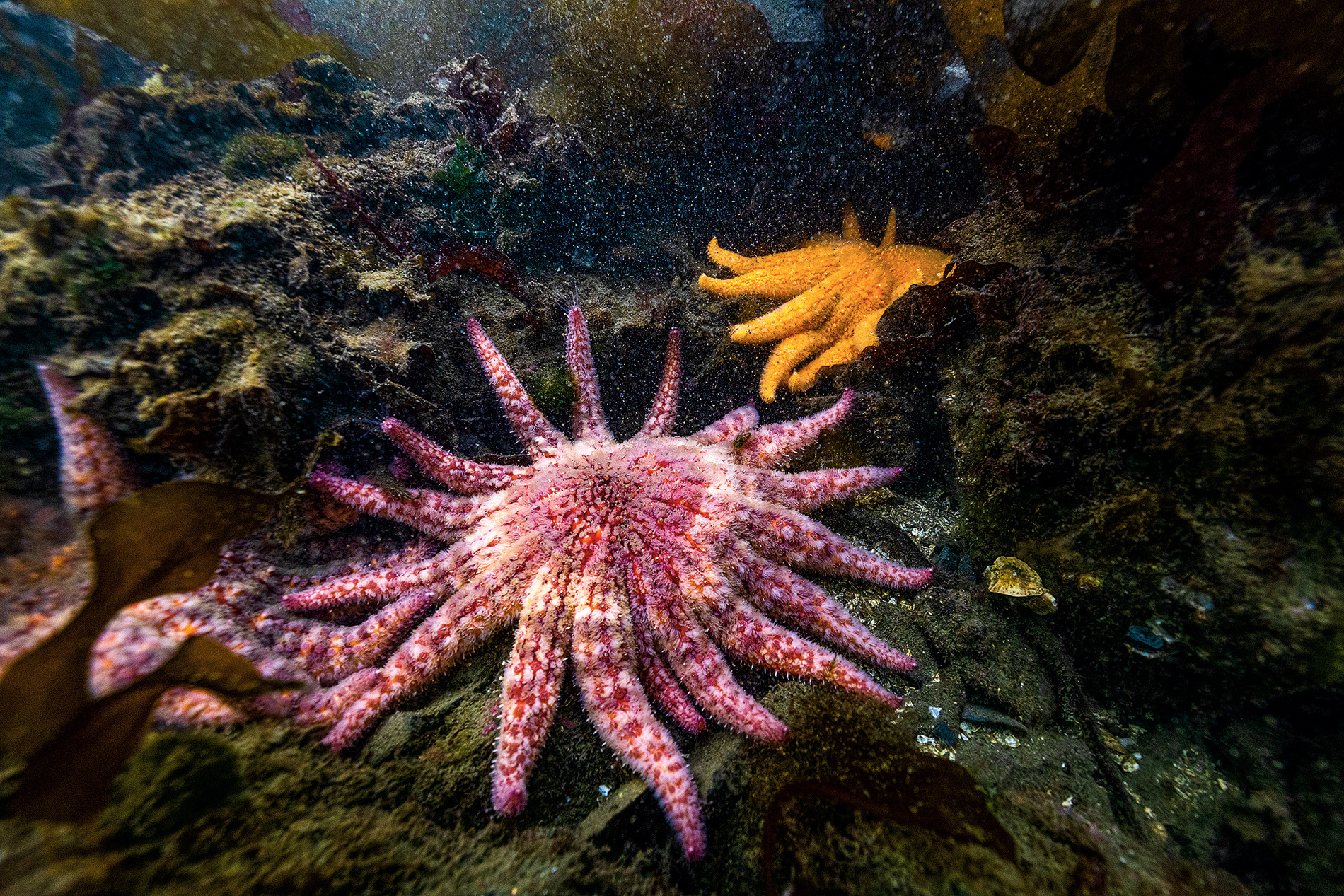
There are 20 sunflower stars in total, spread out in four tubs that now sit on the seafloor, each star marked with a yellow cattle tag. I sit next to one of the tubs and wait. After only a few minutes, I spy the tip of an arm reaching up over the edge, tube feet dancing as the star begins to explore its new home.
The star’s tube feet touch kelp for the first time. I’m unsure if you can describe a sea star as curious, but I’m almost certain that this one is. Each of the star’s 16 arms has a small, red eyespot at its tip, and I try to imagine what the star is sensing, feeling, tasting, seeing. His name is Pop Tart, and this is his first time in the ocean.
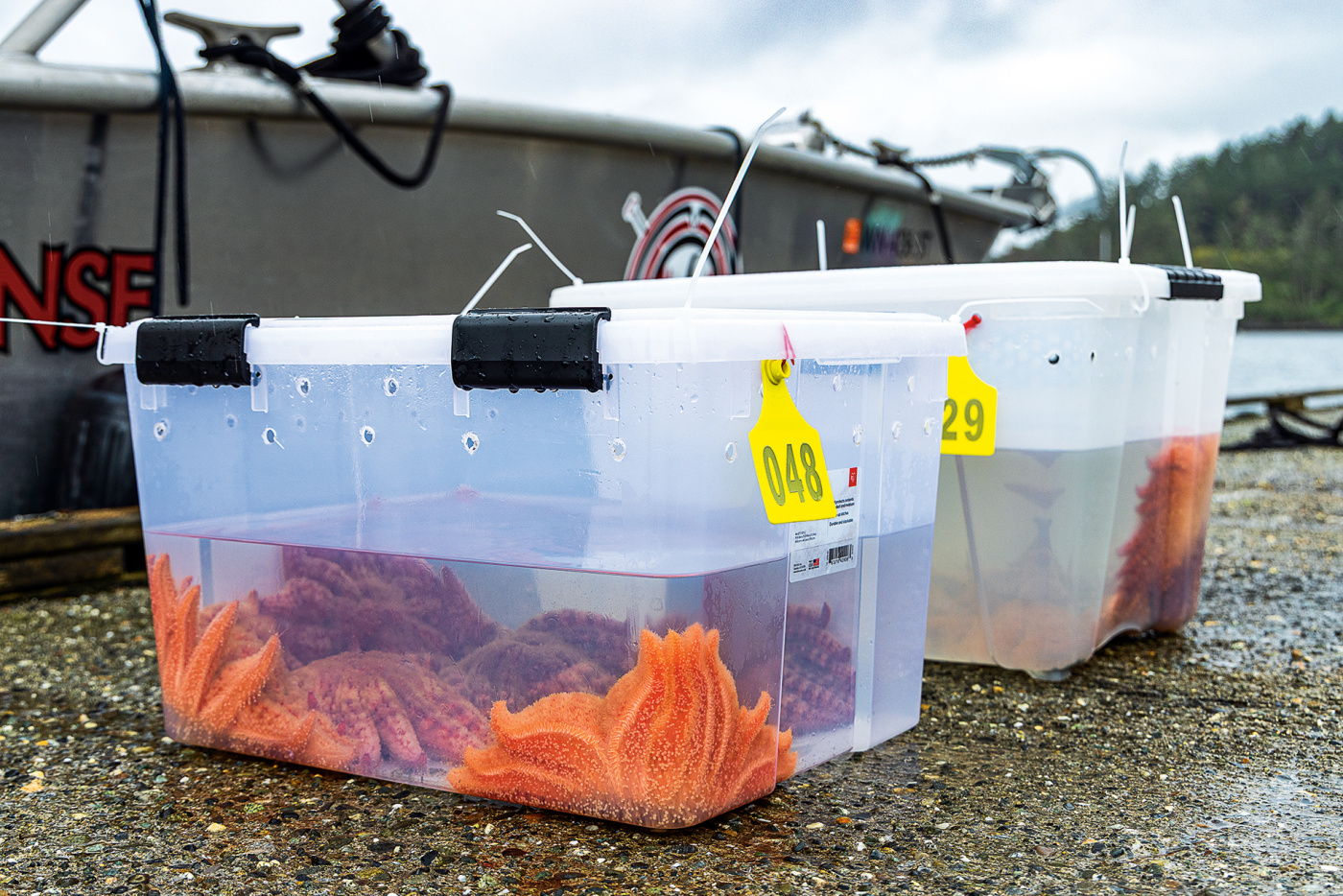
“Most people probably think sea stars don’t do anything, [that] they just sit there,” says Jason Hodin, the scientist who raised these stars in his lab. “That is not what sunflower stars are like—they are extremely active. They’re one of the fastest sea stars on the planet,” he says, “and they’re a lot more charismatic than you might normally give [them] credit for.”
Sunflower stars are basically the cheetahs of the intertidal zone. In fact, they’re keystone predators. In 1969, Bob Paine’s seminal ecological studies of ochre stars in Washington State led him to coin the term “keystone species”—a species that produces a major impact on its ecosystem and is considered essential to maintaining optimum ecosystem balance.
But now, sunflower stars are almost gone.
A trophic cascade
Starting in 2013, sea star wasting disease, caused by bacteria in the genus Vibrio, killed billions of sunflower stars throughout their range, from Baja California, Mexico, to the Aleutian Islands, Alaska. That was catastrophic not just for the stars but for the kelp forests. Sunflower stars eat sea urchins, so when sea urchins lost a main predator, their population exploded in numbers—a classic trophic, or feeding-related, cascade. Sea urchins love to eat kelp, and as their numbers grew, they mowed down the kelp forests like a herd of hungry goats. In places off of Northern California more than 90% of the kelp forests are gone, replaced by vast urchin barrens.
This underwater deforestation would probably feel more dramatic if people could see it—hidden beneath the surface, kelp doesn’t get as much attention as do forests on land or even kelp forests’ warm-water cousins, coral reefs. “Kelp” is not a scientific term; it’s a blanket term for brown macroalgae in the order of Laminariales—but saying that makes eyes glaze over (which, as a science journalist, is something I try to avoid).
Since finishing my PhD in 2018, I’ve spent nearly a decade documenting stories on every continent about science and conservation for The Nature Conservancy, National Geographic, HuffPost, Vox, and the International Women’s Media Foundation. Over the past five years, I’ve focused specifically on kelp forests. These underwater forests line about one-third of the world’s coasts, flourishing in cold or temperate, often turbulent waters. Most people will probably never swim in a kelp forest, but photos can help them feel like they’re immersed—and maybe even make them care about the forests’ decline.
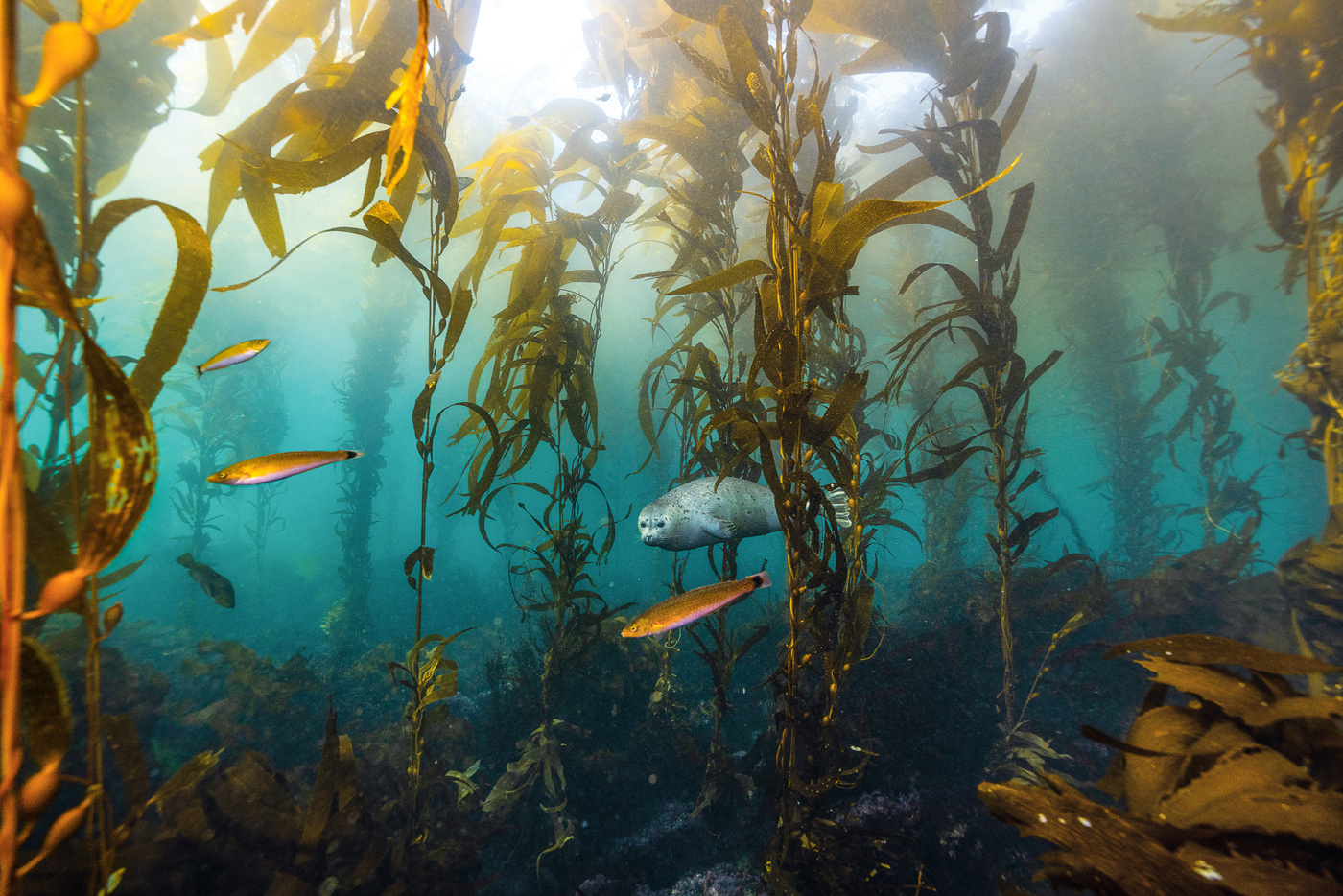
Photographs can communicate science or changes in ecosystems in a way that scientific fact doesn’t—with emotion. And although emotion may make some scientists uncomfortable, it’s essential in helping people understand what’s at stake as waters warm and climate change causes the destruction of many marine ecosystems. And science stories are also human stories—people care about the kelp and the sea stars, but they perhaps relate most to the folks who study marine life.
The snack-pack generation
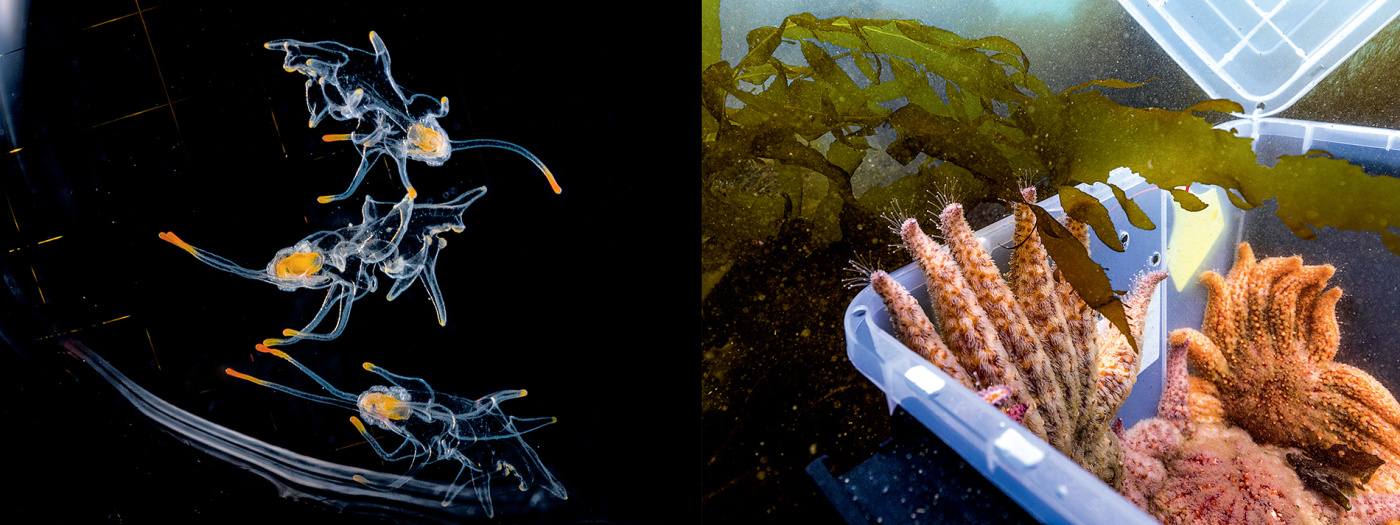
Jason Hodin’s lab in Friday Harbor, Washington, has a sign on the door that reads, “Enter on sea star business only.” He is the expert on sea star larvae—yes, sea stars (and all otherechinoderms) start out as free-floating larvae. To become what you’d think of as a sea star, they metamorphose like butterflies.
“They grow these elaborate flowing arms, and they have this extremely fluid body that looks nothing like a sea star,” says Hodin. After a few weeks (sometimes up to a few months) in the larval stage, they metamorphose into pinhead-sized sea stars with five arms. They immediately start adding more arms and cruising around the seafloor on outsized tube feet. They also pretty immediately start eating sea urchins.
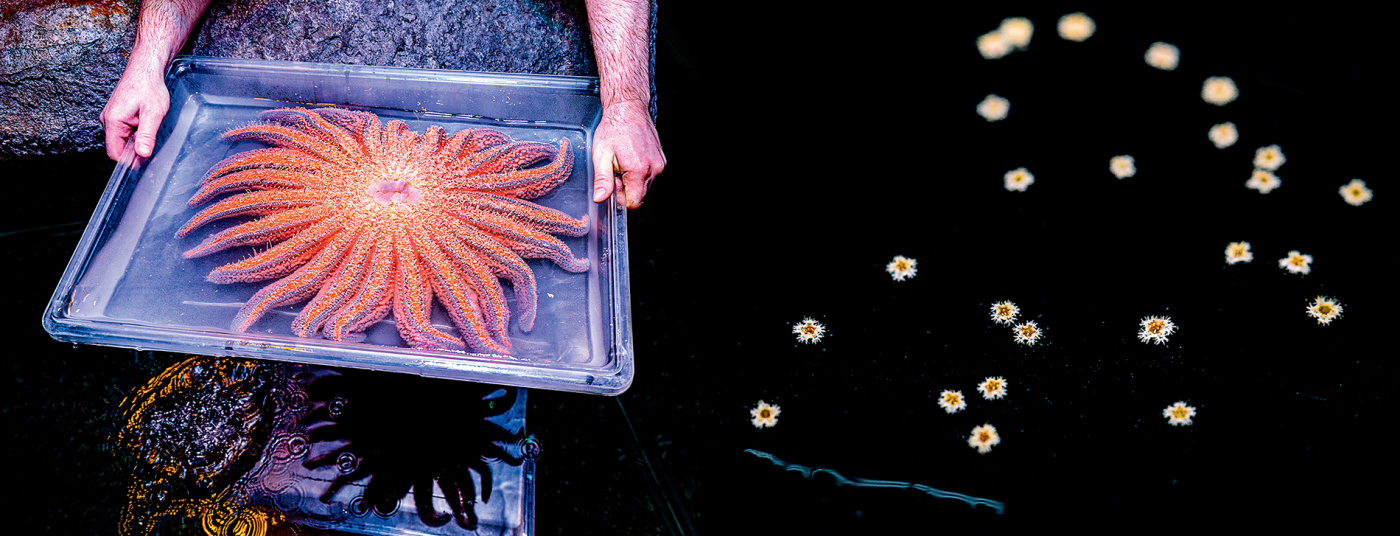
Hodin’s lab buzzes with recent graduates, who keep about 250 adult stars and tens of thousands of larvae alive. It’s like a sea star hostel—none has its own room, instead bunking up together in different bins. There are seven generations of stars in the lab, each with a theme: the astral generation, the pizza generation, the breakfast club, etc. There’s a clear food theme; who can resist falling in love with a pizza-sized star named Cheeto? “Plus,” Hodin says, “it helps us remember who is who—nobody will remember FH123, but Butternut, Chanterelle, and Meatball are memorable.”
The three-year-old stars in the “snack-pack” generation are the ones I watched in April, gliding into the ocean for the first time. They’re descendants of wild stars that survived wasting in Washington State, where the water is colder and sea star wasting wasn’t quite as severe as it was in the warmer waters to the south (Washington State had 90% loss, versus 100% loss in California and Baja).
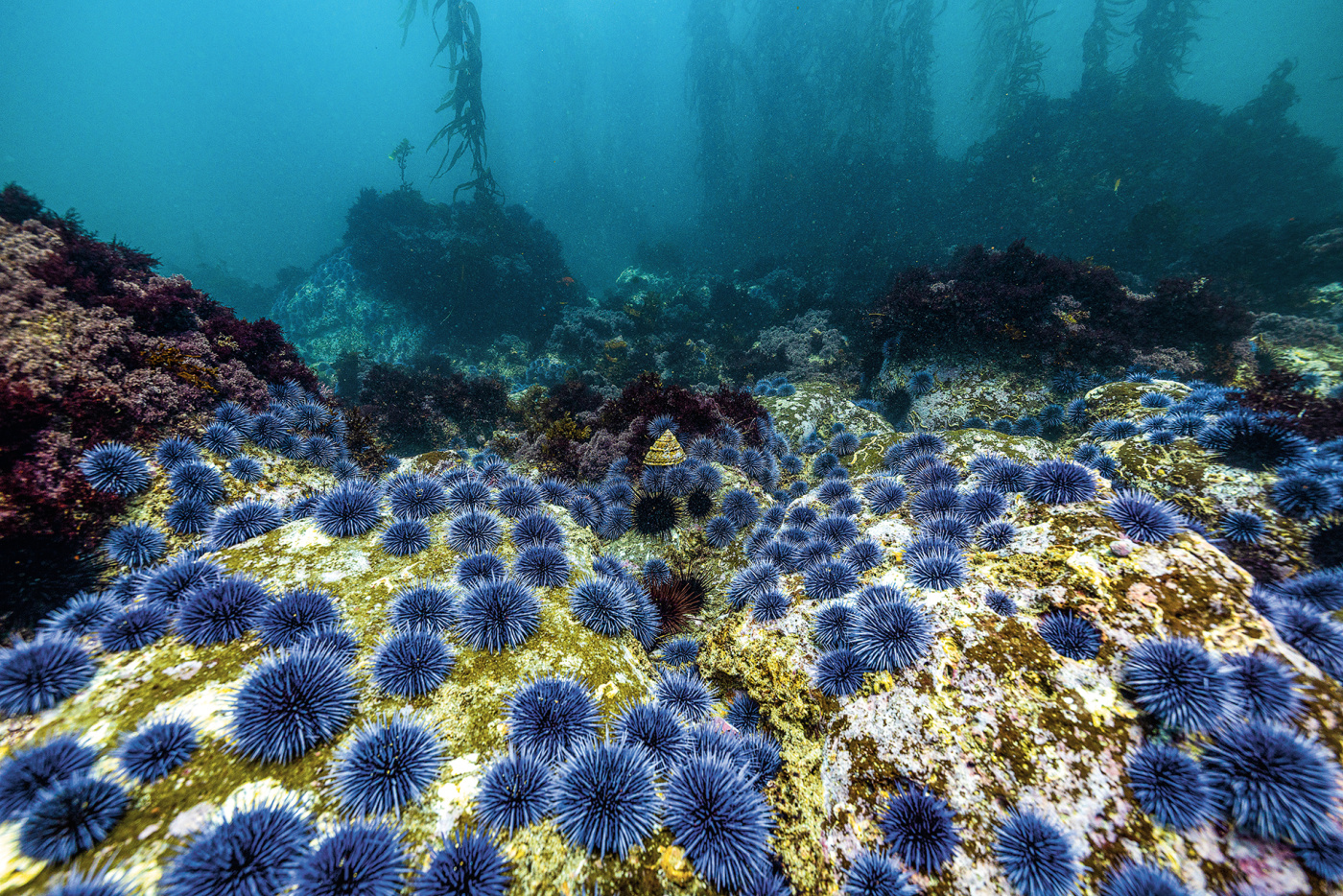
Scientists don’t yet know if some stars are resistant to wasting, but Hodin says there is evidence suggesting that is the case. In the meantime, they’re breeding the stars that have survived wasting, and then releasing their offspring. The way the currents flow, Pop Tart and the snack-pack larvae could float down the coast to repopulate Oregon and California.
The hope is that reintroducing these voracious predators will once again control the sea urchin population, allowing the kelp to grow back. And because they’re not mammals, sea stars are easy to breed.
“Unlike restoring other predators, like otters or tigers, we really aren’t limited by the biology of the sunflower star to reproduce,” says Willem Weertman, a PhD candidate in Hodin’s lab. Because the sunflower stars are broadcast spawners (reproducing by simultaneously releasing huge quantities of egg and sperm in the water), they should be able to produce millions of individuals, which Weertman says is “very unique and very hopeful.”
Even though sunflower stars are not charismatic megafauna that garner the kind of funding that elephants or orcas do, there is a community that cares.
“It has been incredible to see the enthusiasm that people have, the emotion that people feel, for the kelp and the organisms that live there,” says Hodin. “It’s as important as the science.”
Jennifer Adler is a conservation photographer and underwater photo-journalist. She has taught science journalism at Brown and Duke University.